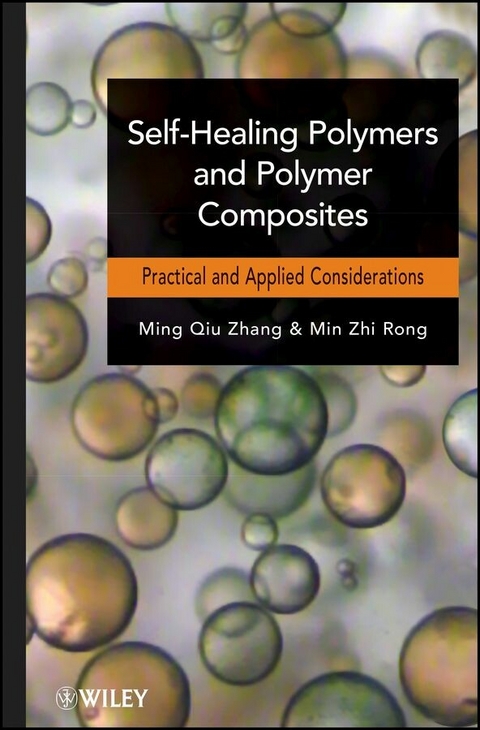
Self-Healing Polymers and Polymer Composites (eBook)
John Wiley & Sons (Verlag)
978-1-118-08287-4 (ISBN)
Inspired by the natural self-healing properties that exist in living organisms—for example, the regenerative ability of humans to heal from cuts and broken bones—interest in self-healing materials is gaining more and more attention. Addressing the broad advances being made in this emerging science, Self-Healing Polymers and Polymer Composites incorporates fundamentals, theory, design, fabrication, characterization, and application of self-healing polymers and polymer composites to describe how to prepare self-healing polymeric materials, how to increase the speed of crack repair below room temperature, and how to broaden the spectrum of healing agent species.
Some of the information readers will discover in this book include:
Focus on engineering aspects and theoretical backgrounds of smart materials
The systematic route for developing techniques and materials to advance the research and applications of self-healing polymers
Integration of existing techniques and introduction of novel synthetic approaches and target-oriented materials design and fabrication
Techniques for characterizing the healing process of polymers and applications of self-healing polymers and polymer composites
Practical aspects of self-healing technology in various industrial fields, such as electronics, automotive, construction, chemical production, and engineering
With this book, readers will have a comprehensive understanding of this emerging field, while new researchers will understand the framework necessary for innovating new self-healing solutions.
A state-of-art guide on the interdisciplinary aspects of design, chemistry, and physical properties of bio-inspired self-healing polymers Inspired by the natural self-healing properties that exist in living organisms for example, the regenerative ability of humans to heal from cuts and broken bones interest in self-healing materials is gaining more and more attention. Addressing the broad advances being made in this emerging science, Self-Healing Polymers and Polymer Composites incorporates fundamentals, theory, design, fabrication, characterization, and application of self-healing polymers and polymer composites to describe how to prepare self-healing polymeric materials, how to increase the speed of crack repair below room temperature, and how to broaden the spectrum of healing agent species. Some of the information readers will discover in this book include: Focus on engineering aspects and theoretical backgrounds of smart materials The systematic route for developing techniques and materials to advance the research and applications of self-healing polymers Integration of existing techniques and introduction of novel synthetic approaches and target-oriented materials design and fabrication Techniques for characterizing the healing process of polymers and applications of self-healing polymers and polymer composites Practical aspects of self-healing technology in various industrial fields, such as electronics, automotive, construction, chemical production, and engineering With this book, readers will have a comprehensive understanding of this emerging field, while new researchers will understand the framework necessary for innovating new self-healing solutions.
MING QIU ZHANG has over twenty-eight years of systematic experience in polymers, polymer blends, and polymer composites. He serves as a member of Asian-Australasian Association for Composite Materials (AACM) Council and the standing council of Chinese Society for Composites, as well as President of Guangdong Society for Composites. In 1997, he received the prestigious fellowship from the Natural Science Foundation of China for Outstanding Young Scientists; and in 2005, the Li Ka Shing Foundation and the Ministry of Education of China selected him as a Cheung Kong Scholar. In addition, Professor Zhang is on the editorial board of eight scientific journals and holds forty-three patents. MIN ZHI RONG obtained his PhD degree in polymer chemistry and physics in 1994 in Zhongshan University. Before that, he was a researcher and lecturer in the Department of Materials Science and Engineering, Tianjin University. His main interests are focused on thermosetting/thermoplastic blends, polymeric functional materials, structure of polymer networks, polymeric nanocomposites, natural fiber composites, and self-healing of polymeric materials. Among his many professional accolades, Professor Rong won the 2007 Prize for Achievements in Natural Science Research for his work on polymer nanocomposites awarded by the Ministry of Education of China. Along with having been published in about 180 journal papers and book chapters, Professor Rong also holds thirty-five patents.
| Erscheint lt. Verlag | 1.6.2011 |
|---|---|
| Sprache | englisch |
| Themenwelt | Naturwissenschaften ► Chemie ► Organische Chemie |
| Technik | |
| Schlagworte | Chemie • Chemistry • Composites • Farben, Pigmente, Beschichtungen, Farbstoffe • Materials Science • Materialwissenschaften • Paints, Pigments, Coatings, Dyes • Polymere • Polymer Science & Technology • Polymerwissenschaft • Polymerwissenschaft u. -technologie • Selbstheilende Materialien • self-healing polymeric materials, crack repair, high temperature applications, spectrum of healing agent species, self-healing functionality, novel synthetic approaches, polymer composites, materials chemistry • Verbundwerkstoffe |
| ISBN-10 | 1-118-08287-7 / 1118082877 |
| ISBN-13 | 978-1-118-08287-4 / 9781118082874 |
| Informationen gemäß Produktsicherheitsverordnung (GPSR) | |
| Haben Sie eine Frage zum Produkt? |
 PDF (Adobe DRM)
Kopierschutz: Adobe-DRM
Adobe-DRM ist ein Kopierschutz, der das eBook vor Mißbrauch schützen soll. Dabei wird das eBook bereits beim Download auf Ihre persönliche Adobe-ID autorisiert. Lesen können Sie das eBook dann nur auf den Geräten, welche ebenfalls auf Ihre Adobe-ID registriert sind.
Details zum Adobe-DRM
Dateiformat: PDF (Portable Document Format)
Mit einem festen Seitenlayout eignet sich die PDF besonders für Fachbücher mit Spalten, Tabellen und Abbildungen. Eine PDF kann auf fast allen Geräten angezeigt werden, ist aber für kleine Displays (Smartphone, eReader) nur eingeschränkt geeignet.
Systemvoraussetzungen:
PC/Mac: Mit einem PC oder Mac können Sie dieses eBook lesen. Sie benötigen eine
eReader: Dieses eBook kann mit (fast) allen eBook-Readern gelesen werden. Mit dem amazon-Kindle ist es aber nicht kompatibel.
Smartphone/Tablet: Egal ob Apple oder Android, dieses eBook können Sie lesen. Sie benötigen eine
Geräteliste und zusätzliche Hinweise
Buying eBooks from abroad
For tax law reasons we can sell eBooks just within Germany and Switzerland. Regrettably we cannot fulfill eBook-orders from other countries.
aus dem Bereich