Probability with R (eBook)
John Wiley & Sons (Verlag)
978-1-118-16595-9 (ISBN)
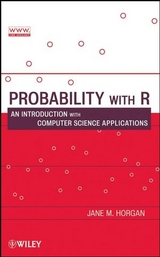
Probability with R serves as a comprehensive and introductory book on probability with an emphasis on computing-related applications. Real examples show how probability can be used in practical situations, and the freely available and downloadable statistical programming language R illustrates and clarifies the book's main principles.
Promoting a simulation- and experimentation-driven methodology, this book highlights the relationship between probability and computing in five distinctive parts:
The R Language presents the essentials of the R language, including key procedures for summarizing and building graphical displays of statistical data.
Fundamentals of Probability provides the foundations of the basic concepts of probability and moves into applications in computing. Topical coverage includes conditional probability, Bayes' theorem, system reliability, and the development of the main laws and properties of probability.
Discrete Distributions addresses discrete random variables and their density and distribution functions as well as the properties of expectation. The geometric, binomial, hypergeometric, and Poisson distributions are also discussed and used to develop sampling inspection schemes.
Continuous Distributions introduces continuous variables by examining the waiting time between Poisson occurrences. The exponential distribution and its applications to reliability are investigated, and the Markov property is illustrated via simulation in R. The normal distribution is examined and applied to statistical process control.
Tailing Off delves into the use of Markov and Chebyshev inequalities as tools for estimating tail probabilities with limited information on the random variable.
Numerous exercises and projects are provided in each chapter, many of which require the use of R to perform routine calculations and conduct experiments with simulated data. The author directs readers to the appropriate Web-based resources for installing the R software package and also supplies the essential commands for working in the R workspace. A related Web site features an active appendix as well as a forum for readers to share findings, thoughts, and ideas.
With its accessible and hands-on approach, Probability with R is an ideal book for a first course in probability at the upper-undergraduate and graduate levels for readers with a background in computer science, engineering, and the general sciences. It also serves as a valuable reference for computing professionals who would like to further understand the relevance of probability in their areas of practice.
A Complete Introduction to probability AND its computer Science Applications USING R Probability with R serves as a comprehensive and introductory book on probability with an emphasis on computing-related applications. Real examples show how probability can be used in practical situations, and the freely available and downloadable statistical programming language R illustrates and clarifies the book's main principles. Promoting a simulation- and experimentation-driven methodology, this book highlights the relationship between probability and computing in five distinctive parts: The R Language presents the essentials of the R language, including key procedures for summarizing and building graphical displays of statistical data. Fundamentals of Probability provides the foundations of the basic concepts of probability and moves into applications in computing. Topical coverage includes conditional probability, Bayes' theorem, system reliability, and the development of the main laws and properties of probability. Discrete Distributions addresses discrete random variables and their density and distribution functions as well as the properties of expectation. The geometric, binomial, hypergeometric, and Poisson distributions are also discussed and used to develop sampling inspection schemes. Continuous Distributions introduces continuous variables by examining the waiting time between Poisson occurrences. The exponential distribution and its applications to reliability are investigated, and the Markov property is illustrated via simulation in R. The normal distribution is examined and applied to statistical process control. Tailing Off delves into the use of Markov and Chebyshev inequalities as tools for estimating tail probabilities with limited information on the random variable. Numerous exercises and projects are provided in each chapter, many of which require the use of R to perform routine calculations and conduct experiments with simulated data. The author directs readers to the appropriate Web-based resources for installing the R software package and also supplies the essential commands for working in the R workspace. A related Web site features an active appendix as well as a forum for readers to share findings, thoughts, and ideas. With its accessible and hands-on approach, Probability with R is an ideal book for a first course in probability at the upper-undergraduate and graduate levels for readers with a background in computer science, engineering, and the general sciences. It also serves as a valuable reference for computing professionals who would like to further understand the relevance of probability in their areas of practice.
Jane M. Horgan is Associate Professor of Statistics in the School of Computing at Dublin City University, Ireland. A Fellow of the Institute of Statisticians, Dr. Horgan has published extensively in the areas of statistical sampling and estimation. Her research interests include applications to both financial auditing and rare incidence skewed populations.
"For anyone comfortable with basic mathematics, an independent
reading of this book would provide an excellent primer on
probability." (Zentralblatt Math, 2010)
"This is a wonderful text for beginners to learn probability.
Reading it is a joy. Although the book is oriented towards CS
majors, I believe that students in other fields can also benefit
from it." (Computing Reviews, January 26, 2009)
"For the audience this book is intended, the book is the best
lecture notes a teacher can give to students and to anybody wishing
to self-teach themselves, with that caveat." (Journal of
Statistical Software, January 2009)
"For the audience this book is intended, the book is the best
lecture notes a teacher can give to students and to anybody wishing
to self-teach themselves, with that caveat." (Journal of
Statistical Software, Jan 2009)
"This is a wonderful text for beginners to learn
probability. Reading it is a joy. Although the book is
oriented towards CS majors, I believe that students in other fields
can also benefit from it." (Computing Reviews, Jan 2009)
"..a great quality of this book is that it could be used by
anybody with a reasonable level of education to self-teach
themselves probability and its applications... It is more
user-friendly than the R manuals and, because the code is used
within the examples, it teaches R for probability much more
effectively." (Journal of Statistical
Software, 2008)
| Erscheint lt. Verlag | 30.9.2011 |
|---|---|
| Sprache | englisch |
| Themenwelt | Mathematik / Informatik ► Informatik |
| Mathematik / Informatik ► Mathematik ► Statistik | |
| Mathematik / Informatik ► Mathematik ► Wahrscheinlichkeit / Kombinatorik | |
| Technik | |
| Schlagworte | Computational & Graphical Statistics • Computer Science • Informatik • Probability & Mathematical Statistics • Rechnergestützte u. graphische Statistik • Rechnergestützte u. graphische Statistik • R (Programm) • R programming language, concepts of probability, simulate distributions, Probability theory, introductory probability applied to problems in computing, essentials of R, Conditional probability, system reliability, discrete random variables, three axioms of probability, continuous random variables, data analysis, conditional probability, system reliability, probabilistic analysis, probability and statistics for Computer Science, Computer Architecture, statistical probability, statistics with R, probability e • Statistics • Statistik • Wahrscheinlichkeitsrechnung • Wahrscheinlichkeitsrechnung u. mathematische Statistik |
| ISBN-10 | 1-118-16595-0 / 1118165950 |
| ISBN-13 | 978-1-118-16595-9 / 9781118165959 |
| Informationen gemäß Produktsicherheitsverordnung (GPSR) | |
| Haben Sie eine Frage zum Produkt? |
 PDF (Adobe DRM)
Kopierschutz: Adobe-DRM
Adobe-DRM ist ein Kopierschutz, der das eBook vor Mißbrauch schützen soll. Dabei wird das eBook bereits beim Download auf Ihre persönliche Adobe-ID autorisiert. Lesen können Sie das eBook dann nur auf den Geräten, welche ebenfalls auf Ihre Adobe-ID registriert sind.
Details zum Adobe-DRM
Dateiformat: PDF (Portable Document Format)
Mit einem festen Seitenlayout eignet sich die PDF besonders für Fachbücher mit Spalten, Tabellen und Abbildungen. Eine PDF kann auf fast allen Geräten angezeigt werden, ist aber für kleine Displays (Smartphone, eReader) nur eingeschränkt geeignet.
Systemvoraussetzungen:
PC/Mac: Mit einem PC oder Mac können Sie dieses eBook lesen. Sie benötigen eine
eReader: Dieses eBook kann mit (fast) allen eBook-Readern gelesen werden. Mit dem amazon-Kindle ist es aber nicht kompatibel.
Smartphone/Tablet: Egal ob Apple oder Android, dieses eBook können Sie lesen. Sie benötigen eine
Geräteliste und zusätzliche Hinweise
Buying eBooks from abroad
For tax law reasons we can sell eBooks just within Germany and Switzerland. Regrettably we cannot fulfill eBook-orders from other countries.
aus dem Bereich