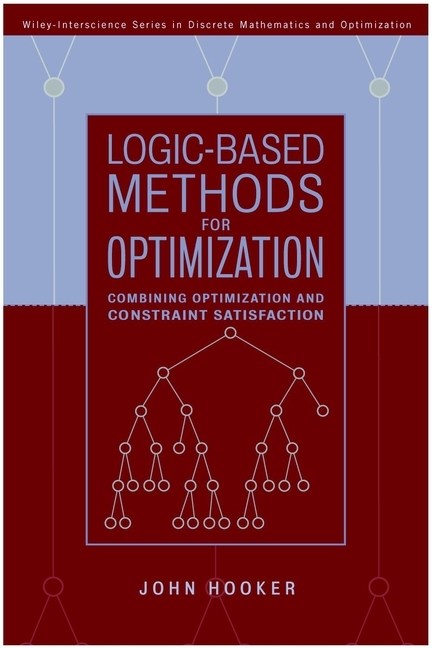
Logic-Based Methods for Optimization (eBook)
520 Seiten
John Wiley & Sons (Verlag)
9781118031285 (ISBN)
While recent efforts to combine optimization and constraint satisfaction have received considerable attention, little has been said about using logic in optimization as the key to unifying the two fields. Logic-Based Methods for Optimization develops for the first time a comprehensive conceptual framework for integrating optimization and constraint satisfaction, then goes a step further and shows how extending logical inference to optimization allows for more powerful as well as flexible modeling and solution techniques. Designed to be easily accessible to industry professionals and academics in both operations research and artificial intelligence, the book provides a wealth of examples as well as elegant techniques and modeling frameworks ready for implementation. Timely, original, and thought-provoking, Logic-Based Methods for Optimization:
* Demonstrates the advantages of combining the techniques in problem solving
* Offers tutorials in constraint satisfaction/constraint programming and logical inference
* Clearly explains such concepts as relaxation, cutting planes, nonserial dynamic programming, and Bender's decomposition
* Reviews the necessary technologies for software developers seeking to combine the two techniques
* Features extensive references to important computational studies
* And much more
JOHN HOOKER, PhD, is Professor of Operations Research and T. Jerome Holleran Professor of Business Ethics and Social Responsibility at the Graduate School of Industrial Administration, Carnegie Mellon University. Well-known for his work in the operations research/computer science interface, Dr. Hooker has published over 80 articles and coauthored (with Vijay Chandru) Optimization Methods for Logical Inference, also available from Wiley.
Some Examples.
The Logic of Propositions.
The Logic of Discrete Variables.
The Logic of 0-1 Inequalities.
Cardinality Clauses.
Classical Boolean Methods.
Logic-Based Modeling.
Logic-Based Branch and Bound.
Constraint Generation.
Domain Reduction.
Constraint Programming.
Continuous Relaxations.
Decomposition Methods.
Branching Rules.
Relaxation Duality.
Inference Duality.
Search Strategies.
Logic-Based Benders Decomposition.
Nonserial Dynamic Programming.
Discrete Relaxations.
References.
Index.
"This is a book that should be widely read by graduate students and researchers in both the computer science and optimization communities." (Choice, Vol. 38, No. 7, March 2001)
"Goal is to broaden the conceptual foundations of optimization to include logical and constraint based approaches to traditional optimization methods." (American Mathematical Monthly, November 2001)
"The author combines a low-key, often conversational presentation with enthusiasm for a synthesis with traditional optimization methods..." (SIAM Review, Vol. 43, No. 4)
"The book is for practitioners as well as theorists" (Zentralblatt Math, Vol.974, No.24, 2001)
| Erscheint lt. Verlag | 28.9.2011 |
|---|---|
| Reihe/Serie | Wiley-Interscience Series in Discrete Mathematics and Optimization | Wiley-Interscience Series in Discrete Mathematics and Optimization |
| Sprache | englisch |
| Themenwelt | Mathematik / Informatik ► Mathematik ► Angewandte Mathematik |
| Mathematik / Informatik ► Mathematik ► Finanz- / Wirtschaftsmathematik | |
| Technik | |
| Schlagworte | Constraint-logische Programmierung • Discrete Mathematics • Diskrete Mathematik • Mathematics • Mathematik • Optimierung • Optimization |
| ISBN-13 | 9781118031285 / 9781118031285 |
| Informationen gemäß Produktsicherheitsverordnung (GPSR) | |
| Haben Sie eine Frage zum Produkt? |
 PDF (Adobe DRM)
Kopierschutz: Adobe-DRM
Adobe-DRM ist ein Kopierschutz, der das eBook vor Mißbrauch schützen soll. Dabei wird das eBook bereits beim Download auf Ihre persönliche Adobe-ID autorisiert. Lesen können Sie das eBook dann nur auf den Geräten, welche ebenfalls auf Ihre Adobe-ID registriert sind.
Details zum Adobe-DRM
Dateiformat: PDF (Portable Document Format)
Mit einem festen Seitenlayout eignet sich die PDF besonders für Fachbücher mit Spalten, Tabellen und Abbildungen. Eine PDF kann auf fast allen Geräten angezeigt werden, ist aber für kleine Displays (Smartphone, eReader) nur eingeschränkt geeignet.
Systemvoraussetzungen:
PC/Mac: Mit einem PC oder Mac können Sie dieses eBook lesen. Sie benötigen eine
eReader: Dieses eBook kann mit (fast) allen eBook-Readern gelesen werden. Mit dem amazon-Kindle ist es aber nicht kompatibel.
Smartphone/Tablet: Egal ob Apple oder Android, dieses eBook können Sie lesen. Sie benötigen eine
Geräteliste und zusätzliche Hinweise
Buying eBooks from abroad
For tax law reasons we can sell eBooks just within Germany and Switzerland. Regrettably we cannot fulfill eBook-orders from other countries.
aus dem Bereich