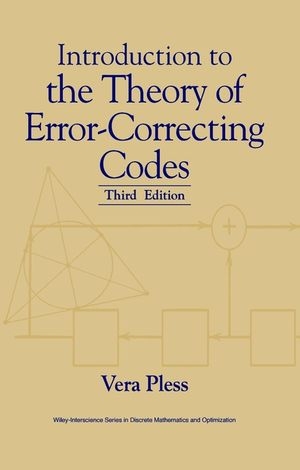
Introduction to the Theory of Error-Correcting Codes (eBook)
224 Seiten
John Wiley & Sons (Verlag)
9781118030998 (ISBN)
Mathematicians have been fascinated with the theory of error-correcting codes since the publication of Shannon's classic papers fifty years ago. With the proliferation of communications systems, computers, and digital audio devices that employ error-correcting codes, the theory has taken on practical importance in the solution of coding problems. This solution process requires the use of a wide variety of mathematical tools and an understanding of how to find mathematical techniques to solve applied problems.
Introduction to the Theory of Error-Correcting Codes, Third Edition demonstrates this process and prepares students to cope with coding problems. Like its predecessor, which was awarded a three-star rating by the Mathematical Association of America, this updated and expanded edition gives readers a firm grasp of the timeless fundamentals of coding as well as the latest theoretical advances. This new edition features:
* A greater emphasis on nonlinear binary codes
* An exciting new discussion on the relationship between codes and combinatorial games
* Updated and expanded sections on the Vashamov-Gilbert bound, van Lint-Wilson bound, BCH codes, and Reed-Muller codes
* Expanded and updated problem sets.
Introduction to the Theory of Error-Correcting Codes, Third Edition is the ideal textbook for senior-undergraduate and first-year graduate courses on error-correcting codes in mathematics, computer science, and electrical engineering.
VERA PLESS is Professor of Mathematics and Computer Science and a University Scholar at the University of Illinois at Chicago. Professor Pless holds a PhD in mathematics from Northwestern University.
Introductory Concepts.
Useful Background.
A Double-Error-Correcting BCH Code and a Finite Field of 16 Elements.
Finite Fields.
Cyclic Codes.
Group of a Code and Quadratic Residue (QR) Codes.
Bose-Chaudhuri-Hocquenghem (BCH) Codes.
Weight Distributions.
Designs and Games.
Some Codes Are Unique.
Appendix.
References.
Index.
| Erscheint lt. Verlag | 24.10.2011 |
|---|---|
| Reihe/Serie | Wiley-Interscience Series in Discrete Mathematics and Optimization | Wiley-Interscience Series in Discrete Mathematics and Optimization |
| Sprache | englisch |
| Themenwelt | Mathematik / Informatik ► Informatik ► Theorie / Studium |
| Mathematik / Informatik ► Mathematik ► Angewandte Mathematik | |
| Technik ► Elektrotechnik / Energietechnik | |
| Schlagworte | cryptography • Discrete Mathematics • Diskrete Mathematik • Fehlerkorrekturcode • Informationstheorie • Kryptographie • Mathematics • Mathematik |
| ISBN-13 | 9781118030998 / 9781118030998 |
| Informationen gemäß Produktsicherheitsverordnung (GPSR) | |
| Haben Sie eine Frage zum Produkt? |
 PDF (Adobe DRM)
Kopierschutz: Adobe-DRM
Adobe-DRM ist ein Kopierschutz, der das eBook vor Mißbrauch schützen soll. Dabei wird das eBook bereits beim Download auf Ihre persönliche Adobe-ID autorisiert. Lesen können Sie das eBook dann nur auf den Geräten, welche ebenfalls auf Ihre Adobe-ID registriert sind.
Details zum Adobe-DRM
Dateiformat: PDF (Portable Document Format)
Mit einem festen Seitenlayout eignet sich die PDF besonders für Fachbücher mit Spalten, Tabellen und Abbildungen. Eine PDF kann auf fast allen Geräten angezeigt werden, ist aber für kleine Displays (Smartphone, eReader) nur eingeschränkt geeignet.
Systemvoraussetzungen:
PC/Mac: Mit einem PC oder Mac können Sie dieses eBook lesen. Sie benötigen eine
eReader: Dieses eBook kann mit (fast) allen eBook-Readern gelesen werden. Mit dem amazon-Kindle ist es aber nicht kompatibel.
Smartphone/Tablet: Egal ob Apple oder Android, dieses eBook können Sie lesen. Sie benötigen eine
Geräteliste und zusätzliche Hinweise
Buying eBooks from abroad
For tax law reasons we can sell eBooks just within Germany and Switzerland. Regrettably we cannot fulfill eBook-orders from other countries.
aus dem Bereich