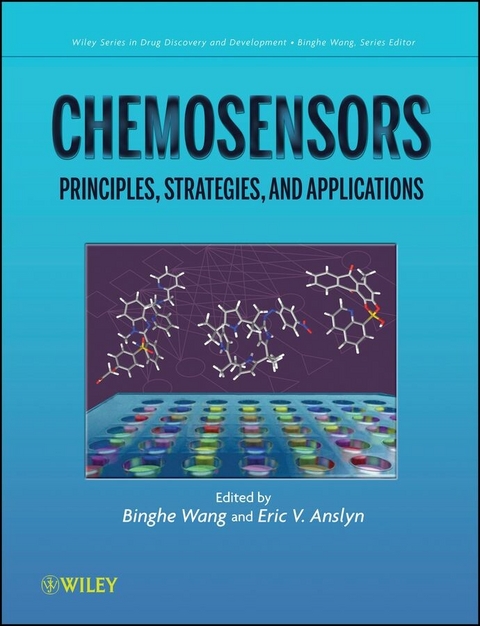
Chemosensors (eBook)
524 Seiten
John Wiley & Sons (Verlag)
978-1-118-01957-3 (ISBN)
Providing a comprehensive overview of chemosensors--organic
molecules designed to bind and sense small molecules or metal
ions--and their applications, Chemosensors: Principles,
Strategies, and Applications is an accessible one-stop resource for
analysts, clinicians, and graduate students studying advanced
chemistry and chemosensing.
Chemosensors function on a molecular level, generating a signal
upon binding. The book reviews their synthesis, design, and
applications for detecting biological and organic molecules as well
as metal ions. The text highlights applications in drug discovery
and catalyses that have not been well covered elsewhere.
Covering such topics as molecular recognition, detection
methods, design strategies, and important biological issues, the
book is broken into four sections that examine intermolecular
interactions, strategies in sensor design, detection methods, and
case studies in metal, saccharide, and amino acid sensing.
An indispensable source of information for chemical and
biomedical experts using sensors, Chemosensors includes case
studies to make the material both accessible and understandable to
chemists of all backgrounds.
BINGHE WANG, PhD, is Professor and Chair of the Department of Chemistry at Georgia State University as well as Georgia Research Alliance Eminent Scholar in Drug Discovery. He is Editor-in-Chief of the journal Medicinal Research Reviews, series editor for the Wiley Series in Drug Discovery and Development, and coeditor of Drug Delivery: Principles and Applications and Carbohydrate Recognition: Biological Problems, Methods, and Applications, both from Wiley. ERIC V. ANSLYN, PhD, is the Norman Hackerman Professor of Chemistry at the University of Texas at Austin. His research interests include physical organic chemistry, molecular recognition, sensor design, and sensor arrays.
Contributors.
Preface.
SECTION 1 FORCES GOVERNING EXCHANGEABLE INTERACTIONS.
1 van der Waals Interactions and the Hydrophobic Effect
(Bruce C. Gibb).
2 Ionic, Hydrogen Bond, and p -Cation Interactions
(Hector Adam Velazquez and Donald Hamelberg).
3 Covalent Interactions in Chemosensor Design (Yunfeng Cheng,
Xiaochuan Yang, and Binghe Wang).
4 Metal Chelation Chemistry (Dongwhan Lee).
SECTION 2 STRATEGIES TOWARD BUILDING THE DESIRED BINDING
MOIETY.
5 Scaffold Design Using Computational Chemistry (Dale
Drueckhammer).
6 Combinatorial Search of Sensors (Marc Vendrell, Suihan
Feng, and Young-Tae Chang).
7 Molecular Imprinting and Sensor Development (Yagang Zhang
and Ken D. Shimizu).
8 Dendrimer-Based Sensors (Lin Pu).
9 Nanoparticles and Sensors (Yi-Cheun Yeh, Sarit S. Agasti,
Krishnendu Saha, and Vincent M. Rotello).
10 Aptamer Selection, Phage Display, and Sensor Development
(Hui Wang, Yan Chen, and Weihong Tan).
11 Sensor Development Using Existing Scaffolds (Hiroyasu
Yamaguchi, Tomoki Ogoshi, and Akira Harada).
SECTION 3 DETECTION METHODS IN CHEMOSENSING.
12 Fluorescent Detection Principles and Strategies (Raman
Parkesh, Emma B. Veale, and Thorfinnur Gunnlaugsson).
13 New Fluorophore Design (Michael D. Heagy).
14 Colorimetric Sensor Design (Kevin L. Bicker, Sheryl L.
Wiskur, and John J. Lavigne).
15 Electrochemical Detection (Simon R. Bayly, George Z. Chen,
and Paul D. Beer).
16 Surface Plasmon Resonance and Quartz Crystal Microbalance
Methods for Detection of Molecular Interactions (Yang Liu,
Archana Jaiswal, Mark A. Poggi, and W. David Wilson).
17 Array-Based Sensors (Pavel Anzenbacher and Manuel A.
Palacios).
SECTION 4 CHEMOSENSORS: CASE STUDIES.
18 Design of Cation-Selective Synthetic Fluorescent Indicators
(Christoph J. Fahrni).
19 Anion Sensors (Philip A. Gale and Claudia
Caltagirone).
20 Chemosensors: Case Studies of Indicators for Organic
Molecules (Oleksandr Rusin, Jorge O. Escobedo, and Robert M.
Strongin).
21 Molecular Recognition Elements for Toxin and Pathogen
Detection (Daniel M. Lewallen, Duane M. Hatch, and Suri S.
Iyer).
22 Chemical Sensing and Detection in Forensic Science (Simon
W. Lewis).
Index.
| Erscheint lt. Verlag | 24.8.2011 |
|---|---|
| Reihe/Serie | Wiley series in drug discovery and development | Wiley series in drug discovery and development |
| Sprache | englisch |
| Themenwelt | Naturwissenschaften ► Chemie ► Organische Chemie |
| Technik | |
| Schlagworte | Analytical Chemistry • Analytische Chemie • Chemie • Chemistry • Drug Discovery & Development • Organic Chemistry • Organische Chemie • Wirkstoffforschung • Wirkstoffforschung u. -entwicklung |
| ISBN-10 | 1-118-01957-1 / 1118019571 |
| ISBN-13 | 978-1-118-01957-3 / 9781118019573 |
| Informationen gemäß Produktsicherheitsverordnung (GPSR) | |
| Haben Sie eine Frage zum Produkt? |
 EPUB (Adobe DRM)
Kopierschutz: Adobe-DRM
Adobe-DRM ist ein Kopierschutz, der das eBook vor Mißbrauch schützen soll. Dabei wird das eBook bereits beim Download auf Ihre persönliche Adobe-ID autorisiert. Lesen können Sie das eBook dann nur auf den Geräten, welche ebenfalls auf Ihre Adobe-ID registriert sind.
Details zum Adobe-DRM
Dateiformat: EPUB (Electronic Publication)
EPUB ist ein offener Standard für eBooks und eignet sich besonders zur Darstellung von Belletristik und Sachbüchern. Der Fließtext wird dynamisch an die Display- und Schriftgröße angepasst. Auch für mobile Lesegeräte ist EPUB daher gut geeignet.
Systemvoraussetzungen:
PC/Mac: Mit einem PC oder Mac können Sie dieses eBook lesen. Sie benötigen eine
eReader: Dieses eBook kann mit (fast) allen eBook-Readern gelesen werden. Mit dem amazon-Kindle ist es aber nicht kompatibel.
Smartphone/Tablet: Egal ob Apple oder Android, dieses eBook können Sie lesen. Sie benötigen eine
Geräteliste und zusätzliche Hinweise
Buying eBooks from abroad
For tax law reasons we can sell eBooks just within Germany and Switzerland. Regrettably we cannot fulfill eBook-orders from other countries.
aus dem Bereich