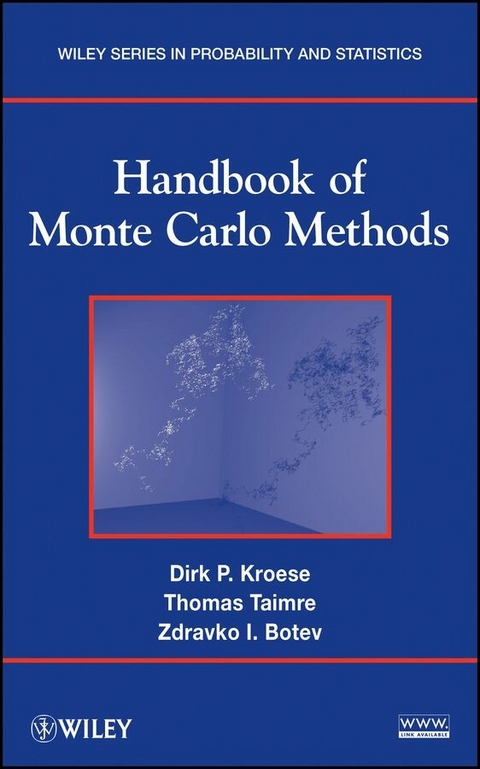
Handbook of Monte Carlo Methods (eBook)
John Wiley & Sons (Verlag)
978-1-118-01494-3 (ISBN)
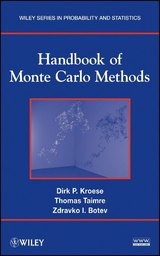
More and more of today's numerical problems found in engineering and finance are solved through Monte Carlo methods. The heightened popularity of these methods and their continuing development makes it important for researchers to have a comprehensive understanding of the Monte Carlo approach. Handbook of Monte Carlo Methods provides the theory, algorithms, and applications that helps provide a thorough understanding of the emerging dynamics of this rapidly-growing field.
The authors begin with a discussion of fundamentals such as how to generate random numbers on a computer. Subsequent chapters discuss key Monte Carlo topics and methods, including:
- Random variable and stochastic process generation
- Markov chain Monte Carlo, featuring key algorithms such as the Metropolis-Hastings method, the Gibbs sampler, and hit-and-run
- Discrete-event simulation
- Techniques for the statistical analysis of simulation data including the delta method, steady-state estimation, and kernel density estimation
- Variance reduction, including importance sampling, latin hypercube sampling, and conditional Monte Carlo
- Estimation of derivatives and sensitivity analysis
- Advanced topics including cross-entropy, rare events, kernel density estimation, quasi Monte Carlo, particle systems, and randomized optimization
The presented theoretical concepts are illustrated with worked examples that use MATLAB®, a related Web site houses the MATLAB® code, allowing readers to work hands-on with the material and also features the author's own lecture notes on Monte Carlo methods. Detailed appendices provide background material on probability theory, stochastic processes, and mathematical statistics as well as the key optimization concepts and techniques that are relevant to Monte Carlo simulation.
Handbook of Monte Carlo Methods is an excellent reference for applied statisticians and practitioners working in the fields of engineering and finance who use or would like to learn how to use Monte Carlo in their research. It is also a suitable supplement for courses on Monte Carlo methods and computational statistics at the upper-undergraduate and graduate levels.
Dirk P. Kroese, PhD, is Australian Professorial Fellow in Statistics at The University of Queensland (Australia). Dr. Kroese has more than seventy publications in such areas as stochastic modeling, randomized algorithms, computational statistics, and reliability. He is a pioneer of the cross-entropy method and the coauthor of Simulation and the Monte Carlo Method, Second Edition (Wiley).
Thomas Taimre, PhD, is a Postdoctoral Research Fellow at The University of Queensland. He currently focuses his research on Monte Carlo methods and simulation, from the theoretical foundations to performing computer implementations.
Zdravko I. Botev, PhD, is a Postdoctoral Research Fellow at the University of Montreal (Canada). His research interests include the splitting method for rare-event simulation and kernel density estimation. He is the author of one of the most widely used free MATLAB® statistical software programs for nonparametric kernel density estimation.
A comprehensive overview of Monte Carlo simulation that explores the latest topics, techniques, and real-world applications More and more of today s numerical problems found in engineering and finance are solved through Monte Carlo methods. The heightened popularity of these methods and their continuing development makes it important for researchers to have a comprehensive understanding of the Monte Carlo approach. Handbook of Monte Carlo Methods provides the theory, algorithms, and applications that helps provide a thorough understanding of the emerging dynamics of this rapidly-growing field. The authors begin with a discussion of fundamentals such as how to generate random numbers on a computer. Subsequent chapters discuss key Monte Carlo topics and methods, including: Random variable and stochastic process generation Markov chain Monte Carlo, featuring key algorithms such as the Metropolis-Hastings method, the Gibbs sampler, and hit-and-run Discrete-event simulation Techniques for the statistical analysis of simulation data including the delta method, steady-state estimation, and kernel density estimation Variance reduction, including importance sampling, latin hypercube sampling, and conditional Monte Carlo Estimation of derivatives and sensitivity analysis Advanced topics including cross-entropy, rare events, kernel density estimation, quasi Monte Carlo, particle systems, and randomized optimization The presented theoretical concepts are illustrated with worked examples that use MATLAB , a related Web site houses the MATLAB code, allowing readers to work hands-on with the material and also features the author's own lecture notes on Monte Carlo methods. Detailed appendices provide background material on probability theory, stochastic processes, and mathematical statistics as well as the key optimization concepts and techniques that are relevant to Monte Carlo simulation. Handbook of Monte Carlo Methods is an excellent reference for applied statisticians and practitioners working in the fields of engineering and finance who use or would like to learn how to use Monte Carlo in their research. It is also a suitable supplement for courses on Monte Carlo methods and computational statistics at the upper-undergraduate and graduate levels.
Dirk P. Kroese, PhD, is Australian Professorial Fellow in Statistics at The University of Queensland (Australia). Dr. Kroese has more than seventy publications in such areas as stochastic modeling, randomized algorithms, computational statistics, and reliability. He is a pioneer of the cross-entropy method and the coauthor of Simulation and the Monte Carlo Method, Second Edition (Wiley). Thomas Taimre, PhD, is a Postdoctoral Research Fellow at The University of Queensland. He currently focuses his research on Monte Carlo methods and simulation, from the theoretical foundations to performing computer implementations. Zdravko I. Botev, PhD, is a Postdoctoral Research Fellow at the University of Montreal (Canada). His research interests include the splitting method for rare-event simulation and kernel density estimation. He is the author of one of the most widely used free MATLAB® statistical software programs for nonparametric kernel density estimation.
style="font-family: "Helvetica","sans-serif"; color: #333333; font-size: 10pt;">"Statisticians
Kroese, Thomas Taimre (both U. of Queensland), and Zdravko I. Botev
(U. of Montreal)
style="font-family: "Helvetica","sans-serif"; color: #333333; font-size: 10pt;">offer
researchers and graduate and advanced graduate students a
compendium of Monte Carlo
style="font-family: "Helvetica","sans-serif"; color: #333333; font-size: 10pt;">methods,
which are statistical methods that involve random experiments on a
computer. There are a
style="font-family: "Helvetica","sans-serif"; color: #333333; font-size: 10pt;">great
many such methods being used for so many kinds of problems in so
many fields that such an
style="font-family: "Helvetica","sans-serif"; color: #333333; font-size: 10pt;">overall
view is hard to find. Combining theory, algorithms, and
applications, they consider such topics
style="font-family: "Helvetica","sans-serif"; color: #333333; font-size: 10pt;">as
uniform random number generation, probability distributions,
discrete event simulation, variance
style="font-family: "Helvetica","sans-serif"; color: #333333; font-size: 10pt;">reduction,
estimating derivatives, and applications to network
reliability." (Annotation 2011 Book News
style="line-height: 115%; font-family: "Helvetica","sans-serif"; color: #333333; font-size: 10pt;">Inc.
Portland, OR)
| Erscheint lt. Verlag | 29.3.2011 |
|---|---|
| Reihe/Serie | Wiley Series in Probability and Statistics |
| Wiley Series in Probability and Statistics | Wiley Series in Probability and Statistics |
| Zusatzinfo | Tables: 0 B&W, 0 Color; Graphs: 75 B&W, 0 Color |
| Sprache | englisch |
| Themenwelt | Mathematik / Informatik ► Mathematik ► Analysis |
| Mathematik / Informatik ► Mathematik ► Statistik | |
| Mathematik / Informatik ► Mathematik ► Wahrscheinlichkeit / Kombinatorik | |
| Technik | |
| Schlagworte | Angewandte Wahrscheinlichkeitsrechnung u. Statistik • Angew. Wahrscheinlichkeitsrechn. u. Statistik / Modelle • Applications • Applied Probability & Statistics • Applied Probability & Statistics - Models • Carlo • Comprehensive • Continuing • Development • Engineering • Finance • heightened popularity • important • Latest • Methods • Monte • Monte Carlo Methode • Numerical • Overview • Problems • Researchers • Simulation • Spezialthemen Statistik • Statistics • Statistics Special Topics • Statistik • todays • Topics • Understanding |
| ISBN-10 | 1-118-01494-4 / 1118014944 |
| ISBN-13 | 978-1-118-01494-3 / 9781118014943 |
| Informationen gemäß Produktsicherheitsverordnung (GPSR) | |
| Haben Sie eine Frage zum Produkt? |
 PDF (Adobe DRM)
Kopierschutz: Adobe-DRM
Adobe-DRM ist ein Kopierschutz, der das eBook vor Mißbrauch schützen soll. Dabei wird das eBook bereits beim Download auf Ihre persönliche Adobe-ID autorisiert. Lesen können Sie das eBook dann nur auf den Geräten, welche ebenfalls auf Ihre Adobe-ID registriert sind.
Details zum Adobe-DRM
Dateiformat: PDF (Portable Document Format)
Mit einem festen Seitenlayout eignet sich die PDF besonders für Fachbücher mit Spalten, Tabellen und Abbildungen. Eine PDF kann auf fast allen Geräten angezeigt werden, ist aber für kleine Displays (Smartphone, eReader) nur eingeschränkt geeignet.
Systemvoraussetzungen:
PC/Mac: Mit einem PC oder Mac können Sie dieses eBook lesen. Sie benötigen eine
eReader: Dieses eBook kann mit (fast) allen eBook-Readern gelesen werden. Mit dem amazon-Kindle ist es aber nicht kompatibel.
Smartphone/Tablet: Egal ob Apple oder Android, dieses eBook können Sie lesen. Sie benötigen eine
Geräteliste und zusätzliche Hinweise
Buying eBooks from abroad
For tax law reasons we can sell eBooks just within Germany and Switzerland. Regrettably we cannot fulfill eBook-orders from other countries.
aus dem Bereich