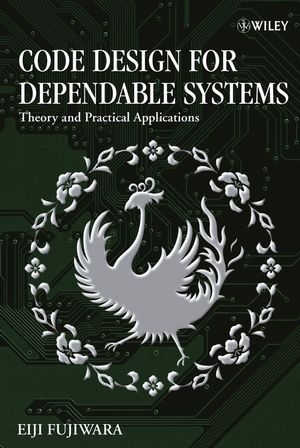
Code Design for Dependable Systems (eBook)
720 Seiten
John Wiley & Sons (Verlag)
978-0-471-79273-4 (ISBN)
strategy and technique
Error correcting and detecting codes are essential to improving
system reliability and have popularly been applied to computer
systems and communication systems. Coding theory has been studied
mainly using the code generator polynomials; hence, the codes are
sometimes called polynomial codes. On the other hand, the codes
designed by parity check matrices are referred to in this book as
matrix codes. This timely book focuses on the design theory for
matrix codes and their practical applications for the improvement
of system reliability. As the author effectively demonstrates,
matrix codes are far more flexible than polynomial codes, as they
are capable of expressing various types of code functions.
In contrast to other coding theory publications, this one does not
burden its readers with unnecessary polynomial algebra, but rather
focuses on the essentials needed to understand and take full
advantage of matrix code constructions and designs. Readers are
presented with a full array of theoretical and practical tools to
master the fine points of matrix code design strategy and
technique:
* Code designs are presented in relation to practical applications,
such as high-speed semiconductor memories, mass memories of disks
and tapes, logic circuits and systems, data entry systems, and
distributed storage systems
* New classes of matrix codes, such as error locating codes, spotty
byte error control codes, and unequal error control codes, are
introduced along with their applications
* A new parallel decoding algorithm of the burst error control
codes is demonstrated
In addition to the treatment of matrix codes, the author provides
readers with a general overview of the latest developments and
advances in the field of code design. Examples, figures, and
exercises are fully provided in each chapter to illustrate concepts
and engage the reader in designing actual code and solving real
problems. The matrix codes presented with practical parameter
settings will be very useful for practicing engineers and
researchers. References lead to additional material so readers can
explore advanced topics in depth.
Engineers, researchers, and designers involved in dependable system
design and code design research will find the unique focus and
perspective of this practical guide and reference helpful in
finding solutions to many key industry problems. It also can serve
as a coursebook for graduate and advanced undergraduate students.
EIJI FUJIWARA, PhD, is Professor at the Tokyo Institute of Technology. His research interests include design theory for error control codes, dependable systems, and error tolerant data compression.
Preface.
1. Introduction.
1.1 Faults and Failures.
1.2 Error Models.
1.3 Error Recovery Techniques for Dependable Systems.
1.4 Code Design Process for Dependable Systems.
References.
2. Mathematical Background and Matrix Codes.
2.1 Introduction to Algebra.
2.2 Linear Codes.
2.3 Basic Matrix Codes.
Exercises.
References.
3. Design Techniques for Matrix Codes.
3.1 Minimum-Weight & Equal-Weight-Row Codes.
3.2 Odd-Weight-Column Codes.
3.3 Even-Weight-Row Codes.
3.4 Odd-Weight-Row Codes.
3.5 Rotational Codes.
Exercises.
References.
4. Codes for High-Speed Memories I: Bit Error Control Codes.
4.1 Modified Hamming SEC-DED Codes.
4.2 Modified Double-Bit Error Correcting BCH Codes.
4.3 On-Chip ECCs.
Exercises.
References.
5. Codes for High-Speed Memories II: Byte Error Control Codes.
5.1 Single-Byte Error Correcting (SbEC) Codes.
5.2 Single-Byte Error Correcting and Double-Byte Error Detecting (SbEC-DbED) Codes.
5.3 Single-Byte Error Correcting and Single p-Byte within a Block Error Detecting (SbEC-Spb=BED) Codes.
Exercises.
References.
6. Codes for High-Speed Memories III: Bit / Byte Error Control Codes.
6.1 Single-Byte / Burst Error Detecting SEC-DED Codes.
6.2 Single-Byte Error Correcting and Double-Bit Error Detecting (SbEC-DED) Codes.
6.3 Single-Byte Error Correcting and Double-Bit Error Correcting (SbEC-DEC) Codes.
6.4 Single-Byte Error Correcting and Single-Byte Plus Single-Bit Error Detecting (SbEC-(SbdS)ED) Codes.
Exercises.
References.
7. Codes for High-Speed Memories IV: Spotty Byte Error Control Codes.
7.1 Spotty Byte Errors.
7.2 Single Spotty Byte Error Correcting (St=bEC) Codes.
7.3 Single Spotty Byte Error Correcting and Single-Byte Error Detecting (St=bEC-SbED) Codes.
7.4 Single Spotty Byte Error Correcting and Double Spotty Byte Error Detecting (St=bEC-Dt=bED) Codes.
7.5 A General Class of Spotty Byte Error Control Codes.
Exercises.
References.
8. Paralled Decoding for Burst / Byte Error Control Codes.
8.1 Parallel Decoding Burst Error Control Codes.
8.2 Parallel Decoding Cyclic Burst Error Correcting Codes.
8.3 Transient Behavior of Parallel Encoder / Decoder Circuits of Error Control Codes.
Exercises.
References.
9. Codes for Error Location: Error Locating Codes.
9.1 Error Location of Faulty Packages and Faulty Chips.
9.2 Block Error Locating (Sb=pbEL) Codes.
9.3 Single-Bit Error Correcting and Single-Block Error Locating (SEC-Sb=pbEL) Codes.
9.4 Single-Bit Error Correcting and Single-Byte Error Locating (SEC-Se=bEL) Codes.
9.5 Burst Error Locating Codes.
9.6 Code Conditions for Error Locating Codes.
10. Codes for Unequal Error Control / Protection (UEC / UEP).
10.1 Error Models for UEC Codes and UEP Codes.
10.2 Fixed-Byte Error Control UEC Codes.
10.3 Burst Error Control UEC / UEP Codes.
10.4 Application of the UEC / UEP Codes.
Exercises.
References.
11. Codes for Mass Memories.
11.1 Tape Memory Codes.
11.2 Magnetic Disk Memory Codes.
11.3 Optical Disk Memory Codes.
Exercises.
References.
12. Coding for Logic and System Design.
12.1 Self-checking Concept.
12.2 Self-testing Checkers.
12.3 Self-checking ALU.
12.4 Self-checking Design for Computer Systems.
Exercises.
References.
13. Codes for Data Entry Systems.
13.1 M-Ary Asymmetric Errors in Data Entry Systems.
13.2 M-Ary Asymmetric Symbol Error Correcting Codes.
13.3 Nonsystematic M-Ary Asymmetric Error Correcting Codes with Deletion / Insertion / Adjacent-Symbol-Transposition Error Correction Capabilities.
13.4 Codes for Two-Dimentional Matrix Symbols.
Exercises.
References.
14. Codes for Multiple / Distributed Storage Systems.
14.1 MDS Array Codes Tolerating Multiple-Disk Failures.
14.2 Codes for Distributed Storage Systems.
Exercises.
References.
Index.
| Erscheint lt. Verlag | 28.7.2006 |
|---|---|
| Sprache | englisch |
| Themenwelt | Technik ► Elektrotechnik / Energietechnik |
| Schlagworte | Control Systems Technology • Electrical & Electronics Engineering • Elektrotechnik u. Elektronik • Regelungstechnik • Technische Zuverlässigkeit • Technische Zuverlässigkeit |
| ISBN-10 | 0-471-79273-X / 047179273X |
| ISBN-13 | 978-0-471-79273-4 / 9780471792734 |
| Informationen gemäß Produktsicherheitsverordnung (GPSR) | |
| Haben Sie eine Frage zum Produkt? |
 PDF (Adobe DRM)
Kopierschutz: Adobe-DRM
Adobe-DRM ist ein Kopierschutz, der das eBook vor Mißbrauch schützen soll. Dabei wird das eBook bereits beim Download auf Ihre persönliche Adobe-ID autorisiert. Lesen können Sie das eBook dann nur auf den Geräten, welche ebenfalls auf Ihre Adobe-ID registriert sind.
Details zum Adobe-DRM
Dateiformat: PDF (Portable Document Format)
Mit einem festen Seitenlayout eignet sich die PDF besonders für Fachbücher mit Spalten, Tabellen und Abbildungen. Eine PDF kann auf fast allen Geräten angezeigt werden, ist aber für kleine Displays (Smartphone, eReader) nur eingeschränkt geeignet.
Systemvoraussetzungen:
PC/Mac: Mit einem PC oder Mac können Sie dieses eBook lesen. Sie benötigen eine
eReader: Dieses eBook kann mit (fast) allen eBook-Readern gelesen werden. Mit dem amazon-Kindle ist es aber nicht kompatibel.
Smartphone/Tablet: Egal ob Apple oder Android, dieses eBook können Sie lesen. Sie benötigen eine
Geräteliste und zusätzliche Hinweise
Buying eBooks from abroad
For tax law reasons we can sell eBooks just within Germany and Switzerland. Regrettably we cannot fulfill eBook-orders from other countries.
aus dem Bereich