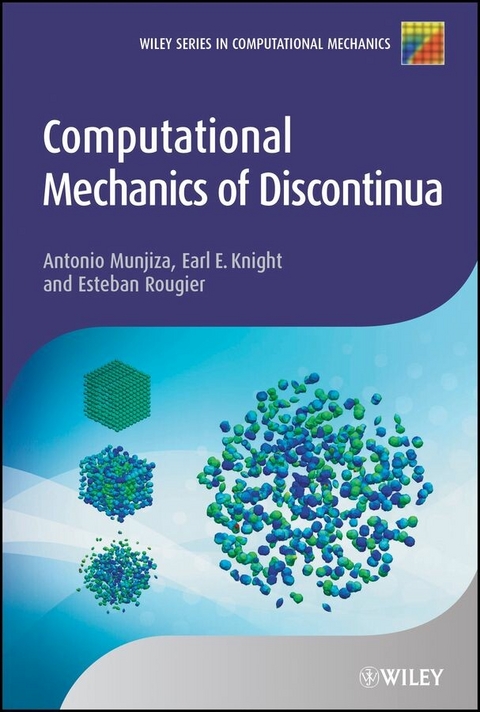
Computational Mechanics of Discontinua (eBook)
John Wiley & Sons (Verlag)
978-1-119-97118-4 (ISBN)
Ante Munjiza, Queen Mary College, London
Ante Munjiza is professor of computational mechanics in the Department of Computational Mechanics at Queen Mary College, London. His research interests include finite element methods, discrete element methods, molecular dynamics, structures and solids, structural dynamics, software engineering, blasts, impacts, and nanomaterials. He has authored one book, The Combined Finite-Discrete Element Method (Wiley 2004), and over 110 refereed journal papers. In addition, he is on the editorial board of seven international journals. Dr Munjiza is widely recognised as a key international expert in computational mechanics of discontinua. He is also an accomplished software engineer with three research codes behind him and one commercial code all based on his technology.
Earl E. Knight & Esteban Rougier, Los Alamos National Laboratories
Earl Knight is a Team Leader in the Geodynamics Team at Los Alamos National Laboratory. His research interests include geodynamic modeling, rock mechanical modeling for deep water oil reservoirs and ground based nuclear explosion monitoring
Esteban Rougier is a Post Doctoral Research Associate at LANL. He has received his Ph.D. from Queen Mary, University of London in 2008` on Computational Mechanics of Discontinuum and its Application to the Simulation of Micro-Flows.
Mechanics of Discontinua is the first book to comprehensively tackle both the theory ofthis rapidly developing topic and the applications that span a broad field of scientific and engineering disciplines, from traditional engineering to physics of particulates, nano-technology and micro-flows. Authored by a leading researcher who has been at the cutting edge of discontinua simulation developments over the last 15 years, the book is organized into four parts: introductory knowledge, solvers, methods and applications. In the first chapter a short revision of Continuum Mechanics together with tensorial calculus is introduced. Also, a short introduction to the finite element method is given. The second part of the book introduces key aspects of the subject. These include a diverse field of applications, together with fundamental theoretical and algorithmic aspects common to all methods of Mechanics of Discontinua. The third part of the book proceeds with the most important computational and simulation methods including Discrete Element Methods, the Combined Finite-Discrete Element Method, Molecular Dynamics Methods, Fracture and Fragmentation solvers and Fluid Coupling. After these the reader is introduced to applications stretching from traditional engineering and industry (such as mining, oil industry, powders) to nanotechnology, medical and science.
Ante Munjiza, Queen Mary College, London Ante Munjiza is professor of computational mechanics in the Department of Computational Mechanics at Queen Mary College, London. His research interests include finite element methods, discrete element methods, molecular dynamics, structures and solids, structural dynamics, software engineering, blasts, impacts, and nanomaterials. He has authored one book, The Combined Finite-Discrete Element Method (Wiley 2004), and over 110 refereed journal papers. In addition, he is on the editorial board of seven international journals. Dr Munjiza is widely recognised as a key international expert in computational mechanics of discontinua. He is also an accomplished software engineer with three research codes behind him and one commercial code all based on his technology. Earl E. Knight & Esteban Rougier, Los Alamos National Laboratories Earl Knight is a Team Leader in the Geodynamics Team at Los Alamos National Laboratory. His research interests include geodynamic modeling, rock mechanical modeling for deep water oil reservoirs and ground based nuclear explosion monitoring Esteban Rougier is a Post Doctoral Research Associate at LANL. He has received his Ph.D. from Queen Mary, University of London in 2008` on Computational Mechanics of Discontinuum and its Application to the Simulation of Micro-Flows.
"This introduction to the rapidly growing field of
Mechanics of Discontinua will appeal to graduate and undergraduate
students, as well as practicing engineers, and will equip the
reader with a sound theoretical and practical understanding of the
topic." (Mathematical Reviews, 1 January
2013)
| Erscheint lt. Verlag | 7.9.2011 |
|---|---|
| Reihe/Serie | Wiley Series in Computational Mechanics | Wiley Series in Computational Mechanics |
| Sprache | englisch |
| Themenwelt | Technik ► Architektur |
| Technik ► Elektrotechnik / Energietechnik | |
| Technik ► Maschinenbau | |
| Schlagworte | Computational / Numerical Methods • Electrical & Electronics Engineering • Elektrotechnik u. Elektronik • Maschinenbau • Maschinenbau - Entwurf • mechanical engineering • Mechanical Engineering - Design • Numerical Methods & Algorithms • Numerische Methoden u. Algorithmen • Rechnergestützte / Numerische Verfahren im Maschinenbau • Rechnergestützte / Numerische Verfahren im Maschinenbau • systems of discontinua, complex simulation, powders, blasts, impacts, demolitions, progressive collapse, blasting, milling, biomechanics, sediments, fluidized bed, nanoscale simulations, computer modeling |
| ISBN-10 | 1-119-97118-7 / 1119971187 |
| ISBN-13 | 978-1-119-97118-4 / 9781119971184 |
| Informationen gemäß Produktsicherheitsverordnung (GPSR) | |
| Haben Sie eine Frage zum Produkt? |
 PDF (Adobe DRM)
Kopierschutz: Adobe-DRM
Adobe-DRM ist ein Kopierschutz, der das eBook vor Mißbrauch schützen soll. Dabei wird das eBook bereits beim Download auf Ihre persönliche Adobe-ID autorisiert. Lesen können Sie das eBook dann nur auf den Geräten, welche ebenfalls auf Ihre Adobe-ID registriert sind.
Details zum Adobe-DRM
Dateiformat: PDF (Portable Document Format)
Mit einem festen Seitenlayout eignet sich die PDF besonders für Fachbücher mit Spalten, Tabellen und Abbildungen. Eine PDF kann auf fast allen Geräten angezeigt werden, ist aber für kleine Displays (Smartphone, eReader) nur eingeschränkt geeignet.
Systemvoraussetzungen:
PC/Mac: Mit einem PC oder Mac können Sie dieses eBook lesen. Sie benötigen eine
eReader: Dieses eBook kann mit (fast) allen eBook-Readern gelesen werden. Mit dem amazon-Kindle ist es aber nicht kompatibel.
Smartphone/Tablet: Egal ob Apple oder Android, dieses eBook können Sie lesen. Sie benötigen eine
Geräteliste und zusätzliche Hinweise
Buying eBooks from abroad
For tax law reasons we can sell eBooks just within Germany and Switzerland. Regrettably we cannot fulfill eBook-orders from other countries.
aus dem Bereich