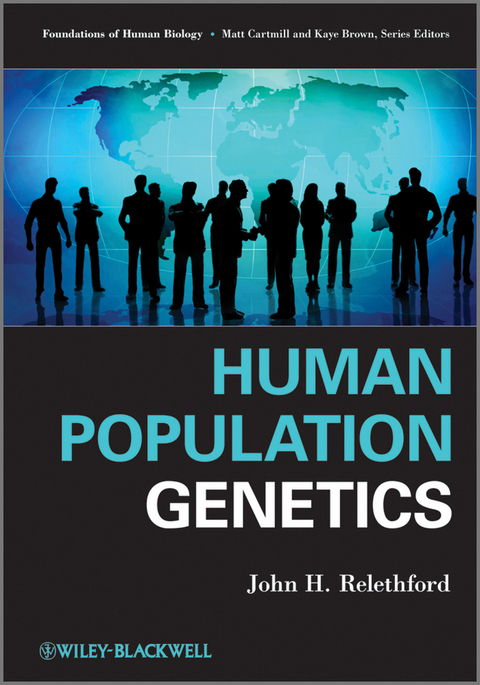
Human Population Genetics (eBook)
John Wiley & Sons (Verlag)
978-1-118-18162-1 (ISBN)
Introductory guide to human population genetics and microevolutionary theory
Providing an introduction to mathematical population genetics, Human Population Genetics gives basic background on the mechanisms of human microevolution. This text combines mathematics, biology, and anthropology and is best suited for advanced undergraduate and graduate study.
Thorough and accessible, Human Population Genetics presents concepts and methods of population genetics specific to human population study, utilizing uncomplicated mathematics like high school algebra and basic concepts of probability to explain theories central to the field. By describing changes in the frequency of genetic variants from one generation to the next, this book hones in on the mathematical basis of evolutionary theory.
Human Population Genetics includes:
-
Helpful formulae for learning ease
-
Graphs and analogies that make basic points and relate the evolutionary process to mathematical ideas
-
Glossary terms marked in boldface within the book the first time they appear
-
In-text citations that act as reference points for further research
-
Exemplary case studies
-
Topics such as Hardy-Weinberg equilibrium, inbreeding, mutation, genetic drift, natural selection, and gene flow
Human Population Genetics solidifies knowledge learned in introductory biological anthropology or biology courses and makes it applicable to genetic study.
NOTE: errata for the first edition can be found at the author's website: http://employees.oneonta.edu/relethjh/HPG/errata.pdf
Dr. John H. Relethford (Distinguished Teaching Professor) is a biological anthropologist who received his Ph.D. in anthropology in 1980 from the State University of New York at Albany. Dr. Relethford's major interests are in the fields of anthropological genetics, human variation, and modern human origins. Much of his research has focused on the reconstruction of history from patterns of modern biological variation. His past work has also included studies of migration, quantitative genetics, child growth, epidemiology, and aging. His current work focuses on two topics, the evolutionary history of Irish populations and the origin of modern humans.
Dr. John H. Relethford (Distinguished Teaching Professor) is a biological anthropologist who received his Ph.D. in anthropology in 1980 from the State University of New York at Albany. Dr. Relethford's major interests are in the fields of anthropological genetics, human variation, and modern human origins. Much of his research has focused on the reconstruction of history from patterns of modern biological variation. His past work has also included studies of migration, quantitative genetics, child growth, epidemiology, and aging. His current work focuses on two topics, the evolutionary history of Irish populations and the origin of modern humans.
Foreword vii
Preface ix
1 Genetic, Mathematical, and Anthropological Background 1
I. The Scope of Population Genetics 2
II. Genetics Background 5
III. Principles of Probability 14
IV. The Anthropological Connection 17
V. A Closing Thought 21
2 Hardy-Weinberg Equilibrium 23
I. Genotype and Allele Frequencies 24
II. What is Hardy-Weinberg Equilibrium? 30
III. The Mathematics of Hardy-Weinberg Equilibrium 31
IV. Using Hardy-Weinberg Equilibrium 37
V. Extensions of Hardy-Weinberg Equilibrium 40
VI. Hardy-Weinberg Equilibrium and Evolution 44
VII. Summary 45
3 Inbreeding 49
I. Quantifying Inbreeding 51
II. Population Genetics and Inbreeding 62
III. Inbreeding in Human Populations 65
IV. Summary 75
4 Mutation 77
I. The Nature of Mutations 77
II. Models of Mutation 81
III. Mutational History and Anthropological Questions 88
IV. Summary 96
5 Genetic Drift 101
I. What is Genetic Drift? 102
II. Genetic Drift and Population Size 112
III. Effects on Genetic Variation 120
IV. Mutation and Genetic Drift 121
V. Coalescent Theory 125
VI. Summary 131
6 Models of Natural Selection 139
I. How Does Natural Selection Work? 140
II. A General Model of Natural Selection 145
III. Types of Natural Selection 147
IV. Other Aspects of Selection 160
V. Summary 167
7 Natural Selection in Human Populations 181
I. Case Studies of Natural Selection in Human Populations 182
II. Are Humans Still EvolVIng? 198
III. Summary 203
8 Gene Flow 205
I. The Evolutionary Impact of Gene Flow 206
II. Models of Gene Flow 208
III. Gene Flow and Genetic Drift 213
IV. Estimating Admixture in Human Populations 226
V. Summary 230
9 Human Population Structure and History 237
I. Case Studies of Human Population Structure 238
II. The Origin of Modern Humans 242
III. Case Studies of Population Origins 247
IV. Summary 255
Glossary 257
References 267
Index 279
"Relethford's Human Population Geneticsis a superb
attempt at facing the challenges of explaining the basics of
population genetics to those with a limited background in
evolutionary theory and a fear of the quantitative."
(The Quarterly Review of Biology, 1 September
2014)
"For many students, and likely some instructors, who have
found the mathematical underpinnings of evolutionary genetics
daunting, this new volume will be a welcome addition to the
bookshelf. It is an easy book to recommend either as a primary text
in anthropological genetics courses, or as a recommended or adjunct
text in upper division/beginning graduate courses in human biology,
human genetics, or human evolution." (American
Journal of Physical Anthropology, 19 September 2013)
| Erscheint lt. Verlag | 15.2.2012 |
|---|---|
| Reihe/Serie | Foundation of Human Biology |
| Foundation of Human Biology | Foundation of Human Biology |
| Sprache | englisch |
| Themenwelt | Naturwissenschaften ► Biologie ► Genetik / Molekularbiologie |
| Naturwissenschaften ► Biologie ► Humanbiologie | |
| Technik | |
| Schlagworte | Anthropologie • Anthropology • Biological Anthropology • Biologische Anthropologie • Biowissenschaften • Evolution des Menschen • Genetik • Human Evolution • Human genetics • Humangenetik • human population genetics, human genetics, population genetics, human microevolution, microevolution, mathematical population genetics, genetics, anthropological genetics • Life Sciences • Populationsgenetik |
| ISBN-10 | 1-118-18162-X / 111818162X |
| ISBN-13 | 978-1-118-18162-1 / 9781118181621 |
| Informationen gemäß Produktsicherheitsverordnung (GPSR) | |
| Haben Sie eine Frage zum Produkt? |
 EPUB (Adobe DRM)
Kopierschutz: Adobe-DRM
Adobe-DRM ist ein Kopierschutz, der das eBook vor Mißbrauch schützen soll. Dabei wird das eBook bereits beim Download auf Ihre persönliche Adobe-ID autorisiert. Lesen können Sie das eBook dann nur auf den Geräten, welche ebenfalls auf Ihre Adobe-ID registriert sind.
Details zum Adobe-DRM
Dateiformat: EPUB (Electronic Publication)
EPUB ist ein offener Standard für eBooks und eignet sich besonders zur Darstellung von Belletristik und Sachbüchern. Der Fließtext wird dynamisch an die Display- und Schriftgröße angepasst. Auch für mobile Lesegeräte ist EPUB daher gut geeignet.
Systemvoraussetzungen:
PC/Mac: Mit einem PC oder Mac können Sie dieses eBook lesen. Sie benötigen eine
eReader: Dieses eBook kann mit (fast) allen eBook-Readern gelesen werden. Mit dem amazon-Kindle ist es aber nicht kompatibel.
Smartphone/Tablet: Egal ob Apple oder Android, dieses eBook können Sie lesen. Sie benötigen eine
Geräteliste und zusätzliche Hinweise
Buying eBooks from abroad
For tax law reasons we can sell eBooks just within Germany and Switzerland. Regrettably we cannot fulfill eBook-orders from other countries.
aus dem Bereich