Intelligent Surfaces in Biotechnology (eBook)
400 Seiten
John Wiley & Sons (Verlag)
978-1-118-18121-8 (ISBN)
biotechnology and their applications
A wave of recent advances in cell biology, biophysics,
chemistry, and materials science has enabled the development of a
new generation of smart biomaterials. Intelligent Surfaces in
Biotechnology: Scientific and Engineering Concepts, Enabling
Technologies, and Translation to Bio-Oriented Applications provides
readers with a comprehensive overview of surface modifications and
their applications, including coverage of the physico-chemical
properties, characterization methods, smart coating technologies,
and demonstration of performance in vitro and in vivo.
The first part of the book covers applications in the fields of
biosensing and biodiagnostics, while the second part focuses more
on coatings for medical devices, drug delivery, and tailored
cell-surface interactions. The book explores intelligent surface
applications such as tissue engineering, drug targeting and
delivery, wound healing and anti-infection strategies, biosensors,
nanopatterning, and bioinspired design of novel responsive
materials and multifunctional surfaces.
Designed to aid scientists and engineers in understanding the
rapidly developing field of biofunctional surfaces, Intelligent
Surfaces in Biotechnology is an edited volume with each chapter
written by a respected expert and featuring examples taken from the
most state-of-the-art developments in the discipline.
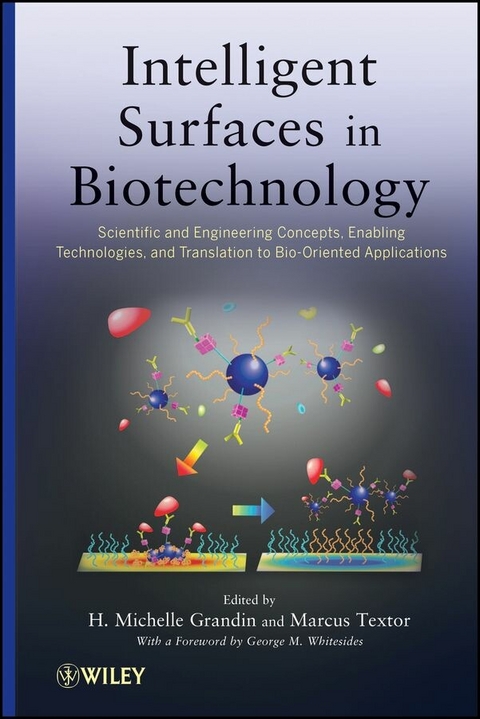
Cover Image: Design concept for a diagnostic microfluidic system
based on responsive polymer- and antibody-conjugated nanobeads (see
Chapter 2 of this book, Figure 2.5; reproduced by permission from
the Royal Society of Chemistry).
H. Michelle Grandin currently works as a scientific writer and consultant in the field of tissue regeneration and implant surfaces for dental applications. Previously, she worked as a senior research scientist in the biointerface group of Marcus Textor at ETH Zurich. There, she developed a waveguide fluorescence microscope for the study of bio-interactions in the near-field as well as leading a group in the development of 3D single cellular microwell arrays for application in stem cell and cancer research. Marcus Textor is a Professor Emeritus at ETH Zurich, Department of Materials. He was head of a research group dedicated to surfaces and interfaces in bio-related fields of material science. His research interests cover both fundamental aspects of the behavior of materials in contact with biological milieus and the design and development of surfaces that elicit biospecific responses.
Chapter 1. Responsive Polymers as Intelligent Coatings for Biosensors: Architectures, Response Mechanisms, and Applications
Vinalia Tjong, Jianming Zhang, Ashutosh Chilkoti and Stefan Zauscher
1.1 Introduction
1.2 SRP Architectures for Biosensor Applications
1.3 Mechanisms of Response
1.4 Sensing and Transduction Mechanisms
1.5 Limitations and Challenges
1.6 Conclusion and Outlook
Chapter 2. Smart Surfaces for Point-of-Care Diagnostics
Michael A. Nash, Allison L. Golden, John M. Hoffman, James Lai, and Patrick S. Stayton
2.1 Introduction
2.2 Standard Methods for Biomarker Purification, Enrichment, and Detection
2.3 Smart Reagents for Biomarker Purification and Processing
2.4 Sample-Processing Modules for Smart Conjugate Bioassays
2.5 Devices for use in Smart Conjugate Bioassays
2.6 Conclusions
Chapter 3. Design of Intelligent Surface Modifications and Optimal Liquid Handling for Nanoscale Bioanalytical Sensors
Laurent Feuz, Fredrik Höök and Erik Reimhult
3.1 Introduction
3.2 Orthogonal small (nano) scale surface modification using molecular self-assembly
3.3 Alternative surface patterning strategies
3.4 The challenge of analytic transport
3.5 Concluding remarks
Chapter 4. Intelligent Surfaces for Effect Based Nano-biosensing
Akira Matsumoto, Yuji Miyahara and Kazunori Kataoka
4.1 Introduction
4.2 Field effect transistor based biosensors
4.3 Intelligent surfaces for signal transduction and amplification of Bio-FETs
4.4 New targets of Bio-FETs
4.5 Future Perspective
Chapter 5. Supported Lipid Bilayers: Intelligent Surfaces for Ion Channel Recordings
Andreas Janshoff and Claudia Steinem
5.1 Introduction
5.2 Supported lipid bilayers
5.3 Characterizatics of SSMs
5.4 Ion channels in SSMs
5.5 Future perspective: Ion channels in micropatterned membranes
Chapter 6. Antimicrobial and Anti-inflammatory Intelligent Surfaces
Hans J. Griesser, Heike Hall, Toby Jenkins, Stefani S. Griesser and Krasimir Vasilev
6.1 Introduction
6.2 Antibacterial strategies
6.3 Bioactive antibacterial surfaces
6.4 Stimulus-responsive antibacterial coatings for wound dressings
6.5 Anti-inflammatory surfaces
6.6 Conclusions and Outlook
Chapter 7. Intelligent Polymer Thin Films and Coatings for Drug Delivery
Alexander N. Zelikin and Brigitte Städler
7.1 Introduction
7.2 Surface Mediated Drug Delivery
7.3 Drug Delivery Vehicles With Functional Polymer Coatings
7.4 Outlook
Chapter 8. Micro- and Nanopatterning of Active Biomolecules and Cells
Daniel Aydin, Vera C. Hirschfeld-Warneken, Ilia Louban and Joachim P. Spatz
8.1 Introduction
8.2 Chemical Approaches for Protein Immobilization
8.3 Biomolecule patterning by "top-down" techniques
8.4 Biomolecule Nanoarrays bu Block Copolymer Nanolithography
8.5 Application of Nanostructured Surfaces to Study Cell Adhesion
8.6 Conclusion
Chapter 9. Responsive Polymer Coatings for Smart Applications in Cromatography, Drug Delivery Systems and Cell Sheet Engineering
Rogério P. Pirraco, Masayuki Yamato, Yoshikatsu Akiyama, Kenichi Nagase, Masamichi Nakayama, Alexandra P. Marques, Rui L. Reis and Teruo Okano
9.1 Introduction
9.2 Temperature-responsive chromatography
9.3 Temperature-responsive polymer micelle
9.4 Temperature-responsive culture surfaces
9.5 Cell sheet Engineering
9.6 Conclusions
"The present book with its 350 pages is not a textbook but
reading for experts and inspires scientists and engineers to
further investigations to tackle the transition from synthetic to
living materials, äs it is meant by the term "intelligent
interfaces". The presented "smart" biosensors and medical
devices demonstrate nicely, how we can learn from nature and make
profit of its impressive "inventions" in our modern
life." (Tenside Surfactants Detergents, 1 May
2012)
| Erscheint lt. Verlag | 31.1.2012 |
|---|---|
| Vorwort | George M. Whitesides |
| Sprache | englisch |
| Themenwelt | Naturwissenschaften ► Chemie |
| Technik ► Maschinenbau | |
| Technik ► Umwelttechnik / Biotechnologie | |
| Schlagworte | Biomaterial • Biotechnologie i. d. Biowissenschaften • Biotechnology • Biowissenschaften • Chemie • Chemistry • Dünne Schichten, Oberflächen u. Grenzflächen • Dünne Schichten, Oberflächen u. Grenzflächen • Life Sciences • Materials Science • Materialwissenschaften • Physical Chemistry • Physikalische Chemie • Thin Films, Surfaces & Interfaces |
| ISBN-10 | 1-118-18121-2 / 1118181212 |
| ISBN-13 | 978-1-118-18121-8 / 9781118181218 |
| Informationen gemäß Produktsicherheitsverordnung (GPSR) | |
| Haben Sie eine Frage zum Produkt? |
 PDF (Adobe DRM)
Kopierschutz: Adobe-DRM
Adobe-DRM ist ein Kopierschutz, der das eBook vor Mißbrauch schützen soll. Dabei wird das eBook bereits beim Download auf Ihre persönliche Adobe-ID autorisiert. Lesen können Sie das eBook dann nur auf den Geräten, welche ebenfalls auf Ihre Adobe-ID registriert sind.
Details zum Adobe-DRM
Dateiformat: PDF (Portable Document Format)
Mit einem festen Seitenlayout eignet sich die PDF besonders für Fachbücher mit Spalten, Tabellen und Abbildungen. Eine PDF kann auf fast allen Geräten angezeigt werden, ist aber für kleine Displays (Smartphone, eReader) nur eingeschränkt geeignet.
Systemvoraussetzungen:
PC/Mac: Mit einem PC oder Mac können Sie dieses eBook lesen. Sie benötigen eine
eReader: Dieses eBook kann mit (fast) allen eBook-Readern gelesen werden. Mit dem amazon-Kindle ist es aber nicht kompatibel.
Smartphone/Tablet: Egal ob Apple oder Android, dieses eBook können Sie lesen. Sie benötigen eine
Geräteliste und zusätzliche Hinweise
Buying eBooks from abroad
For tax law reasons we can sell eBooks just within Germany and Switzerland. Regrettably we cannot fulfill eBook-orders from other countries.
aus dem Bereich