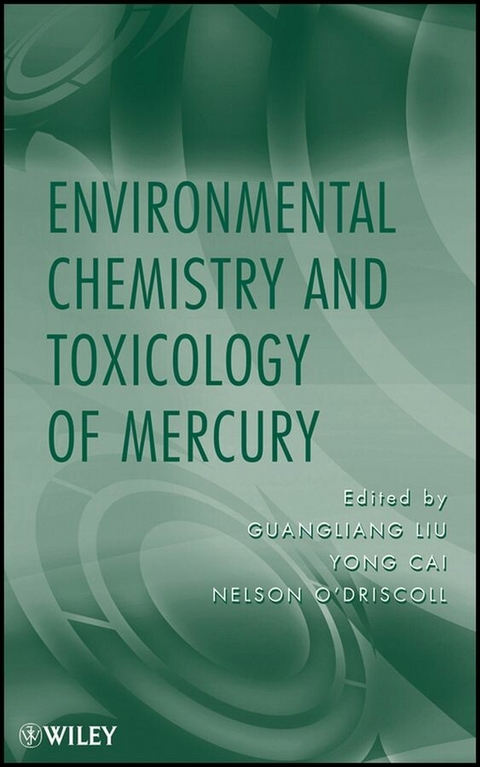
Environmental Chemistry and Toxicology of Mercury (eBook)
John Wiley & Sons (Verlag)
978-1-118-14661-3 (ISBN)
The book that looks at mercury's impact on the planet today
Recent research by the EPA has concluded that one in six women of childbearing age have unsafe levels of mercury in their bodies, which puts 630,000 newborn babies each year at risk of neurological impairment. Mercury poses severe risks to the health of animals and ecosystems around the world, and this book provides the essential information that anyone interested in environmental sciences should know about the fundamentals of the entire mercury cycle.
Comprised of four parts that present an overview of mercury in the environment, mercury transformations, transport, and bioaccumulation and toxicology, each chapter of Environmental Chemistry and Toxicology of Mercury includes the basic concepts of the targeted subject, a critical review of that subject, and the future research needs.
This book explains the environmental behavior and toxicological effects of mercury on humans and other organisms, and provides a baseline for what is known and what uncertainties remain in respect to mercury cycling. The chapters focus on the fundamental science underlying the environmental chemistry and fate of mercury. This work will be invaluable to a wide range of policy experts, environmental scientists, and other people requiring a comprehensive source for the state of the science in this field.
Guangliang Liu, PhD, is Research Scientist in the Department of Chemistry and Biochemistry, Florida International University, where he manages the Mercury Laboratory.
Yong Cai, PhD, is Professor in the Department of Chemistry and Biochemistry, Florida International University. He has been working on environmental chemistry and the geochemistry of mercury for almost twenty years.
Nelson O'Driscoll, PhD, is Canada Research Chair in Environmental Biogeochemistry and Associate Professor in the Department of Earth and Environmental Science, Acadia University.
This book provides the fundamentals, recent developments, and future research needs for critical mercury transformation and transport processes, as well as the experimental methods that have been employed in recent studies. The coverage discusses the environmental behavior and toxicological effects of mercury on organisms, including humans, and provides case studies at the end of each chapter. Bringing together information normally spread across several books, this text is unique in covering the entire mercury cycle and providing a baseline for what is known and what uncertainties remain in respect to mercury cycling.
Guangliang Liu, PhD, is Research Scientist in the Department of Chemistry and Biochemistry, Florida International University, where he manages the Mercury Laboratory. Yong Cai, PhD, is Professor in the Department of Chemistry and Biochemistry, Florida International University. He has been working on environmental chemistry and the geochemistry of mercury for almost twenty years. Nelson O'Driscoll, PhD, is Canada Research Chair in Environmental Biogeochemistry and Associate Professor in the Department of Earth and Environmental Science, Acadia University.
ENVIRONMENTAL CHEMISTRY AND TOXICOLOGY OF MERCURY 3
CONTENTS 7
PREFACE 15
ACKNOWLEDGMENTS 17
CONTRIBUTORS 19
1 OVERVIEW OF MERCURY IN THE ENVIRONMENT 23
1.1 Introduction 23
1.2 Toxicity and Health Risks of Mercury Exposure 24
1.3 Sources of Mercury 24
1.4 Overview of Mercury Biogeochemical Cycling 29
1.5 Structure of the Book 30
1.6 Concluding Remarks 31
References 31
PART I ANALYTICAL DEVELOPMENTS 35
2 ADVANCES IN SPECIATION ANALYSIS OF MERCURY IN THE ENVIRONMENT 37
2.1 Introduction 37
2.2 Sample Preparation for Hg Speciation in Environmental Samples 38
2.3 Application of GC Technique in Hg Speciation Analysis 54
2.4 Application of HPLC Technique in Hg Speciation Analysis 58
2.5 Application of Capillary Electrophoresis Techniques in Hg Speciation Analysis 61
2.6 Application of X-Ray Absorption Spectroscopy in Probing Chemical Microenvironment of Hg 62
2.7 Application of Stable Isotope Dilution Technique in Mercury Speciation Analysis 63
2.8 Summary 65
References 66
3 MEASURING GAS PHASE MERCURY EMISSIONS FROM INDUSTRIAL EFFLUENTS 81
3.1 Introduction 81
3.2 Standardized Methods for Measuring Mercury 94
3.3 Mercury Continuous Emission Monitors (CEMs) 103
3.4 Future Outlook 117
References 118
PART II SPECIATION AND TRANSFORMATION 133
4 ATMOSPHERIC CHEMISTRY OF MERCURY 135
4.1 Introduction 135
4.2 The Overall Picture 136
4.3 Chemical Transformations in the Gas Phase 140
4.4 Chemical Transformations in the Aqueous Phase 153
4.5 Redox Chemistry at the Interface Between the Atmosphere and Earth's Surfaces 158
4.6 Atmospheric Implications of the Identified Redox Pathways 161
4.7 Future Research Needs 165
References 166
5 MICROBIAL TRANSFORMATIONS IN THE MERCURY CYCLE 177
5.1 Introduction 177
5.2 Mercury Methylation 180
5.3 Methylmercury Degradation 190
5.4 Redox Cycling of Inorganic Hg 191
5.5 Conclusions 201
References 202
6 PHOTOREACTIONS OF MERCURY IN AQUATIC SYSTEMS 215
6.1 Significance of Mercury Photoreactions 215
6.2 Concepts in Mercury Photoreactions 216
6.3 Current Methods in Mercury Photochemistry 231
6.4 Summary 233
References 234
7 CHEMICAL SPECIATION OF MERCURY IN SOIL AND SEDIMENT 241
7.1 Introduction 241
7.2 Physicochemical Properties, Oxidation States, Chemical Forms, Structures, and Concentrations of Mercury in the Environment 242
7.3 Aqueous Phase: Major Ligands and Their Affinities for Mercury(II) 244
7.4 Liquid and Solid Phases of Mercury in Soils and Sediments 251
7.5 Reactions of Mercury(II) with Soil and Sediment Particle Surfaces 253
7.6 Stabilization of Nanoparticulate Mercury(II) Sulfides by Natural Organic Matter 259
7.7 Solubility and Chemical Speciation of Mercury(II) in Soils and Sediments 259
7.8 Methods for Studying the Chemistry of Mercury(II) in Soils and Sediments 270
7.9 Future Research Needs 271
References 274
8 THE EFFECTS OF DISSOLVED ORGANIC MATTER ON MERCURY BIOGEOCHEMISTRY 281
8.1 Introduction 281
8.2 Dissolved Organic Matter 282
8.3 Field Observations 285
8.4 Effects of DOM on Mercury Distributions Between Solution and Particles 287
8.5 Mercury Binding Strength 290
8.6 Mercury Binding Environment 293
8.7 Methylmercury Binding Strength and Environment 296
8.8 DOM and Mercury Mineral Dissolution 298
8.9 DOM and Mercury Mineral Precipitation 302
References 306
9 TRACKING GEOCHEMICAL TRANSFORMATIONS AND TRANSPORT OF MERCURY THROUGH ISOTOPE FRACTIONATION 315
9.1 Introduction 315
9.2 Fractionation of Mercury Isotopes in Environmental Processes 322
9.3 Hg Isotope Variations in Nature 337
9.4 Summary 341
References 342
PART III TRANSPORT AND FATE 351
10 ATMOSPHERIC TRANSPORT OF MERCURY 353
10.1 Introduction 353
10.2 General Concepts of Mercury Cycling in the Atmosphere 353
10.3 Methods for Studying Atmospheric Mercury Transport 358
10.4 Assessments of Airborne Mercury Pollution 364
10.5 Knowledge Gaps 376
References 378
11 ADSORPTION OF MERCURY ON SOLIDS IN THE AQUATIC ENVIRONMENT 389
11.1 Introduction 389
11.2 Adsorption of Mercury on Solids 391
11.3 Role of Colloids in Mercury Adsorption 396
11.4 Concluding Remarks 402
References 403
12 EXCHANGE OF ELEMENTAL MERCURY BETWEEN THE OCEANS AND THE ATMOSPHERE 411
12.1 Introduction 411
12.2 Models of Gas Exchange of Elemental Mercury at the Air–Sea Interface 412
12.3 Field Studies of Ocean-To-Air Fluxes of Mercury 420
12.4 Rate Constants for Reduction and Oxidation of Mercury Species in Ocean Waters 422
12.5 Modeling Studies Estimating Oceanic Air–Sea Exchange 433
12.6 Conclusions and Future Directions 437
References 438
13 EXCHANGE OF MERCURY BETWEEN THE ATMOSPHERE AND TERRESTRIAL ECOSYSTEMS 445
13.1 General Overview 445
13.2 Methods and Tools Applied for Measurement and Understanding of Air–Terrestrial Surface Exchange 447
13.3 Measured Fluxes 455
13.4 Conclusions 464
References 466
PART IV BIOACCUMULATION, TOXICITY, AND METALLOMICS 475
14 BIOACCUMULATION AND BIOMAGNIFICATION OF MERCURY THROUGH FOOD WEBS 477
14.1 Introduction 477
14.2 Mercury in Aquatic and Terrestrial Organisms 479
14.3 Mercury within Organisms 486
14.4 Factors Affecting Mercury in Biota 487
14.5 Biomagnification of Mercury Through Food Webs 496
14.6 Mercury Stable Isotopes in Bioaccumulation Studies 503
14.7 Case Study—Kejimkujik National Park and Historic Site, Nova Scotia, Canada 504
14.8 Conclusions 506
References 507
15 A REVIEW OF MERCURY TOXICITY WITH SPECIAL REFERENCE TO METHYLMERCURY 523
15.1 Introduction 523
15.2 Global Mercury Emission into the Atmosphere 524
15.3 Metabolism and Toxicity of Chemical Forms of Mercury 525
15.4 Risk Assessment of Prenatal Exposure to Methylmercury 531
15.5 Risks and Benefits of Fish Consumption for Brain Development 532
15.6 Exceptional Methylmercury Exposure Through Rice 532
15.7 Summary 533
References 533
16 METALLOMICS OF MERCURY: ROLE OF THIOLAND SELENOL-CONTAINING BIOMOLECULES 539
16.1 Introduction 539
16.2 Metallomics of Mercury 539
16.3 Mercury and Methylmercury Complexes with Thiol-Containing Biomolecules 541
16.4 Mercury and Methylmercury Binding to Selenol-Containing Biomolecules 544
16.5 Lability of Mercury or Methylmercury Complexes with Thiols or Selenols 546
16.6 Thiol-Containing Biomolecules in the Uptake and Metabolism of Mercury 548
16.7 Selenium Aided Biomineralization of Mercury and Methylmercury 551
16.8 Analytical and Modeling Approaches 553
16.9 Conclusion 560
References 560
17 HUMAN HEALTH SIGNIFICANCE OF DIETARY EXPOSURES TO METHYLMERCURY 567
17.1 Introduction 567
17.2 Methylmercury Exposure 568
17.3 Nutrients in Fish and Seafood 570
17.4 Major Prospective Cohort Studies 571
17.5 Health Effects 574
17.6 Cardiovascular Outcomes 577
17.7 Nutrient and Methylmercury Exposure as Predictors of Developmental Outcomes 578
17.8 Confounding Variables 579
17.9 Risk Assessment and Exposure Imprecision 580
17.10 Conclusions 581
References 583
INDEX 591
JOURNAL OF APPLIEDTOXICOLOGYBRITISH TOXICOLOGY SOCIETYNEWENVIRONMENTAL CHEMISTRYGROUPTOXICOLOGYECOTOXICOLOGYINTERNATIONAL JOURNAL OFENVIRONMENTAL SCIENCESGREEN CHEMISTRYENVIRONMENTALENGINEERINGAPPLIEDGEOCHEMISTRYCHEMICAL & ENGINEERINGNEWSCLINICAL TOXICOLOGYENVIRONMENTALGEOSCIENCESENVIRONMENTAL SCIENCE ANDTECHNOLOGYENVIRONMENTAL TOXICOLOGY& CHEMISTRYINSTRUMENTATION SCIENCE &TECHNOLOGYINTERNATIONAL JOURNAL OFTOXICOLOGYJOURNAL OF TOXICOLOGY ANDENVIRONMENTAL HEALTHSCIENCE NEWSTOXICOLOGY MECHANISMS, ANDMETHODS
| Erscheint lt. Verlag | 5.12.2011 |
|---|---|
| Sprache | englisch |
| Themenwelt | Medizin / Pharmazie |
| Naturwissenschaften ► Biologie ► Biochemie | |
| Naturwissenschaften ► Chemie | |
| Technik ► Umwelttechnik / Biotechnologie | |
| Schlagworte | Ãkotoxikologie, Umweltverschmutzung • Chemie • Chemistry • Ecotoxicology & Pollution Science • Environmental Chemistry • Environmental Studies • mercury cycle, hg cycle, bioaccumulation of mercury, mercury environmental effects, mercury transformation, mercury contamination, mercury gold mining, mercury in atmosphere • Ökotoxikologie, Umweltverschmutzung • Quecksilber • Toxicology • Toxikologie • Umweltchemie • Umweltforschung |
| ISBN-10 | 1-118-14661-1 / 1118146611 |
| ISBN-13 | 978-1-118-14661-3 / 9781118146613 |
| Informationen gemäß Produktsicherheitsverordnung (GPSR) | |
| Haben Sie eine Frage zum Produkt? |
 PDF (Adobe DRM)
Kopierschutz: Adobe-DRM
Adobe-DRM ist ein Kopierschutz, der das eBook vor Mißbrauch schützen soll. Dabei wird das eBook bereits beim Download auf Ihre persönliche Adobe-ID autorisiert. Lesen können Sie das eBook dann nur auf den Geräten, welche ebenfalls auf Ihre Adobe-ID registriert sind.
Details zum Adobe-DRM
Dateiformat: PDF (Portable Document Format)
Mit einem festen Seitenlayout eignet sich die PDF besonders für Fachbücher mit Spalten, Tabellen und Abbildungen. Eine PDF kann auf fast allen Geräten angezeigt werden, ist aber für kleine Displays (Smartphone, eReader) nur eingeschränkt geeignet.
Systemvoraussetzungen:
PC/Mac: Mit einem PC oder Mac können Sie dieses eBook lesen. Sie benötigen eine
eReader: Dieses eBook kann mit (fast) allen eBook-Readern gelesen werden. Mit dem amazon-Kindle ist es aber nicht kompatibel.
Smartphone/Tablet: Egal ob Apple oder Android, dieses eBook können Sie lesen. Sie benötigen eine
Geräteliste und zusätzliche Hinweise
Buying eBooks from abroad
For tax law reasons we can sell eBooks just within Germany and Switzerland. Regrettably we cannot fulfill eBook-orders from other countries.
aus dem Bereich