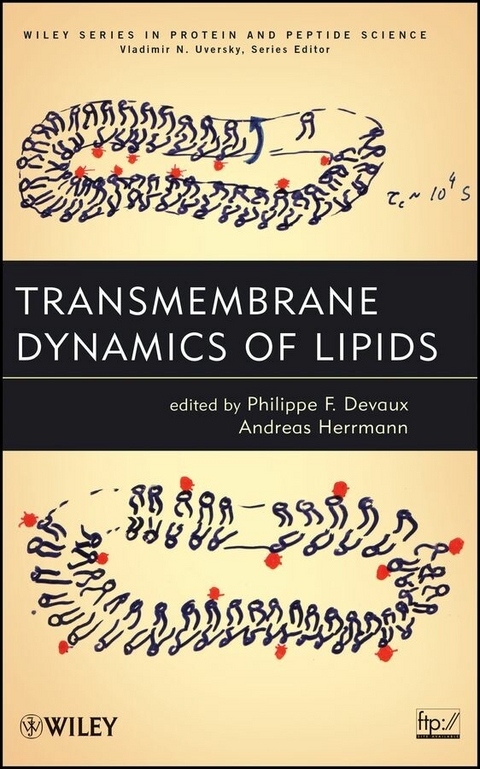
Transmembrane Dynamics of Lipids (eBook)
563 Seiten
John Wiley & Sons (Verlag)
978-1-118-12010-1 (ISBN)
Transmembrane Dynamics of Lipids is comprised of contributions from expert authors from leading research groups that present up-to-date quantitative data on the formation, stability, and biological consequences of the asymmetrical organization of lipids in cell membranes.
Incorporating an impressive amount of new, previously uncollected data, the book examines transmembrane asymmetry and movement of lipids in biological membranes, and methods for the measurement of transmembrane lipid motion, emphasizing the role of lipid flippases and discusses biological functions associated with lipid asymmetry. In addition, it draws attention to important new discoveries in the field, such as the correlation between malfunction of lipid flippases and human diseases such as thrombosis and cancer. The book also addresses the manifold methods that are used to measure the rate of transmembrane movement of lipids in biological and model systems.
The only guide to new discoveries regarding lipids in cell membranes, Transmembrane Dynamics of Lipids is designed to appeal to biophysicists, biochemists, and cellular and molecular biologists working in the growing field of membrane research.
Philippe F. Devaux, PhD, is Professor of Physics at the Paris 7 University.He has long-standing expertise in teaching molecular and cellular biophysics and physics applied to biology and medicine. He is the author of almost two hundred scientific papers and three books, and is an Editor of the European Biophysics Journal.
Andreas Herrmann, PhD, is Professor of Molecular Biophysics at Humboldt-University of Berlin. He teaches courses on the subjects of molecular; cell; and membrane biophysics, optical spectroscopy, and fluorescence microscopy. He is the author of more than two hundred scientific papers focusing on lipid dynamics in biological membranes and molecular mechanisms of virus infection.
The first and only book devoted entirely to MEMBRANE LIPID ASYMMETRY AND ITS BIOLOGICAL IMPLICATIONS Transmembrane Dynamics of Lipids is comprised of contributions from expert authors from leading research groups that present up-to-date quantitative data on the formation, stability, and biological consequences of the asymmetrical organization of lipids in cell membranes. Incorporating an impressive amount of new, previously uncollected data, the book examines transmembrane asymmetry and movement of lipids in biological membranes, and methods for the measurement of transmembrane lipid motion, emphasizing the role of lipid flippases and discusses biological functions associated with lipid asymmetry. In addition, it draws attention to important new discoveries in the field, such as the correlation between malfunction of lipid flippases and human diseases such as thrombosis and cancer. The book also addresses the manifold methods that are used to measure the rate of transmembrane movement of lipids in biological and model systems. The only guide to new discoveries regarding lipids in cell membranes, Transmembrane Dynamics of Lipids is designed to appeal to biophysicists, biochemists, and cellular and molecular biologists working in the growing field of membrane research.
Philippe F. Devaux, PhD, is Professor of Physics at the Paris 7 University.He has long-standing expertise in teaching molecular and cellular biophysics and physics applied to biology and medicine. He is the author of almost two hundred scientific papers and three books, and is an Editor of the European Biophysics Journal. Andreas Herrmann, PhD, is Professor of Molecular Biophysics at Humboldt-University of Berlin. He teaches courses on the subjects of molecular; cell; and membrane biophysics, optical spectroscopy, and fluorescence microscopy. He is the author of more than two hundred scientific papers focusing on lipid dynamics in biological membranes and molecular mechanisms of virus infection.
Introduction
List of Contributors.
Part I: ASSESSING TRANSMEMBRANE MOVEMENT AND ASYMMETRY OF
LIPIDS.
1. Methods for the Determination of Lipid Transmembrane
Distribution and Movement in Biological Membranes (Philippe F.
Devaux and Andreas Herrmann).
2. Detection and Measurement of Unlabeled Lipid Transmembrane
Movement(Iván López-Montero, Marisela Vélez and
Philippe F. Devaux).
Part II: LIPID ASYMMETRY IN CELL MEMBRANES.
3. New Insights in Membrane Lipid Asymmetry in Animal and Plant
Cells (Alain Zachowski).
4. Sphingolipid Asymmetry and Transmembrane Translocation in
Mammalian Cells (Gerrit van Meer, Sylvia Neumann, and Per
Haberkant).
5. Transbilayer Movement and Distribution of Cholesterol
(Peter Müller, Anna Pia Plazzo, and Andreas
Herrmann).
Part III. ENERGY-INDEPENDENT PROTEIN-MEDIATED TRANSMEMBRANE
MOVEMENT OF LIPIDS.
6. Phospholipid Flip-Flop in Biogenic Membranes (Anant K.
Menon and Andreas Herrmann).
7. Phospholipid Scramblase: When Phospholipid Asymmetry Goes
Away (Edouard M. Bevers and Patrick L. Williamson).
Part IV: ENERGY-DEPENDENT LIPID TRANSPORT ACROSS
MEMBRANES.
8. Flip or Flop: Mechanism and (Patho)Physiology of
P4-ATPase-Catalyzed Lipid Transport (Patricia M.
Verhulst, Joost C.M. Holthuis, and Thomas G. Pomorski).
9. Coupling Drs2p to Phospholipid Translocation, Membrane
Asymmetry, and Vesicle Budding (Xiaoming Zhou, Paramasivam
Natarajan, Baby-Periyanayaki Muthusamy, Todd R. Graham, and Ke
Liu).
10. Substrate Specifi city of the Aminophospholipid Flippase
(Shelley M. Cook and David L. Daleke).
11. The Flippase Delusion? (Naomi L. Pollock, Petra H.M.
Niesten, and Richard Callaghan).
Part V: RELEVANCE OF LIPID TRANSMEMBRANE DISTRIBUTION
FOR MEMBRANE PROPERTIES AND PROCESSES
12. Membrane Lipid Asymmetry and Permeability to Drugs: A Matter
of Size (Adam Blanchard and Cyril Rauch).
13. Endocytosis and Lipid Asymmetry (Nina Ohlwein, Andreas
Herrmann, and Philippe F. Devaux).
Part VI: APOPTOSIS AND DISEASES: CONSEQUENCES OF DISRUPTION
TO LIPID TRANSMEMBRANE ASYMMETRY
14. Membrane Lipid Asymmetry in Aging and Apoptosis
(Krishnakumar Balasubramanian and Alan J. Schroit).
15. Phosphatidylserine Exposure in Hemoglobinopathies (Frans
A. Kuypers and Eric Soupene).
16. Scott Syndrome: More Than a Hereditary Defect of Plasma
Membrane Remodeling (Florence Toti and Jean-Marie
Freyssinet).
17. ABCA1, Tangier Disease, and Lipid Flopping (Ana Zarubica
and Giovanna Chimini).
INTRODUCTION
HISTORICAL PERSPECTIVES: WHO DID WHAT AND WHAT’S NEXT?
Ole Mouritsen, in his recent monograph entitled “Lipids—As a Matter of Fat,” summarized with humor the views of many biologists concerning lipids, as follows: “Lipids appear to play a fairly non-specific role, being rather dull and anonymous compared to fashionable stuff like the proteins that catalyze all biochemical reactions and the genes that contain the information needed to produce proteins” [1].
The present book, which is addressed to researchers, teachers, and students in cell biology and in biochemistry, has the goal of convincing all scientists that lipids, on the contrary, have sophisticated behaviors and play multiple important roles in living organisms. It is also addressed to physicists fascinated by the various spontaneous self-organization of lipids in water (lipid polymorphism) to warn them that lipids in biological systems are not always at thermal equilibrium, and that phase separations and lateral or transmembrane domains seen in model systems can differ fundamentally from biological situations. Indeed, molecule segregation in biological systems results often from the work of ATPases, like the flippases, or is the result of a molecule sorting by “protein gates” (see the “fence and picket model” of Kusumi and collaborators [2]). Such mechanisms are difficult to mimic in model systems.
In any case, all lipids are not equivalent and their chemical heterogeneity, for example, between the two sides of a biomembrane, is the result of a long selection during evolution, which allows lipids to fulfill different functions, from that of a fluid hydrophobic medium for membrane proteins to that of selective messenger molecules and enzyme cofactors. In the latter case, they have to find their partners in a cell, hence to move rapidly in a very anisotropic environment.
To many biologists, lipids form the third class of molecules of living organism after proteins and nucleic acids. Yet, lipids were probably not the third in the evolution nor are they third in importance, since a cell and even many viruses cannot exist without a membrane. The fact is that lipids form the building blocks of biological membranes. They determine the boundary of all living organisms as well as the compartmentalization of organelles in eukaryotes. Regarded as passive molecules forming only viscous cement that holds membrane proteins, filtering out hydrophilic molecules, the lipid bilayer is in reality a sophisticated structure capable of a remarkable polymorphism in water. The physical characteristic of a lipid bilayer permits not only protein movement but also membrane deformations and, coupled to the cytoskeleton, provides the cell membrane with mechanical properties. Not the least astonishing is the bilayer’s ability to divide in two compartments during cell division without losing molecules in the plasma due to efficient self-sealing capacities. Nonetheless, there are still mysteries concerning lipids, which are matters of research, speculation, and controversy. (1) Biophysicists have succeeded in making stable membranes (liposomes) with only one type of lipids, in suspension in water, for example, with egg phosphatidylcholine (PC), while biological membranes harbor several hundred different lipids. Why are there so many chemically different lipids coexisting in nature? (2) Why is the lipid composition of various membranes of eukaryotes different and sometimes even the two sides of biological membranes different (asymmetrical)? This requires numerous specific enzymes for the synthesis and ultimately for the shuttling to the right destination of newly formed lipids. Is such a multiplicity necessary for a fine-tuning of membrane-bound enzymes or is the variety of lipids used to give specific messages to specific proteins? Is the detailed chemical structure of lipids without real importance and does it reflect only the precursor molecules available? Not only do eukaryotic membranes have many chemically different lipids if one considers chain length, unsaturation, and polar head group, but also the lipids are not homogenously distributed within the various organelles and even between the different sides of one membrane. This lipid heterogeneity, a “complication of Nature,” was transmitted more than a million years in eukaryotic cells and has survived the filter of evolution, suggesting that the lipid composition and distribution within a cell is neither accidental nor inconsequential for the activity of cells.
Although cells tolerate certain variability in lipid composition, many human diseases have been associated with the inability of mutated cells to synthesize specific lipids or to recycle particular lipids from the nutriments or to address specific lipids to their correct destination. Alternatively, the excess of certain lipids such as cholesterol or saturated phospholipid chains can be poisonous.
In the late 1960s, V. Luzzati, in a pioneer work carried out in France, showed by X-ray crystallography that lipids extracted from biological membranes form, in water, lamellar phases, giving rise spontaneously to large multilamellar (onion-style) liposomes made of a superposition of bilayers [3, 4]. Physicists characterized the bilayers as liquid crystals that could be in a fluid state or in a more viscous, gel state. In the early 1970s, the concept of lipid bilayer emerged as the basic model of biomembranes and was popularized in the famous model of “fluid mosaic membrane” of S.J. Singer and G.L. Nicolson [5]. Although the concept of “mosaicity” implies the presence of heterogeneous lateral domains, and in spite of the work carried out by several physical chemists such as H. McConnell, it was only in 1997 (almost 30 years after the initial work of Luzzati and McConnell) that the importance of lateral domains began to be popular among membranologists and that biological functions associated with lateral domains (or rafts) were highlighted (see the work of K. Simons and E. Ikonen [6]).
Indeed, the two monolayers of biomembranes form distinct lipid domains: M. Bretscher in England demonstrated in the early 1970s the asymmetrical transmembrane distribution of phospholipids in the plasma membrane of human erythrocytes [7]. Bretscher used the chemical labeling of the amino groups of phosphatidylserine (PS) or phosphatidylethanolamine (PE) and showed that aminophospholipids are principally in the membrane inner monolayer, while PC and sphingomyelin (SM) are essentially in the outer monolayer of human red cells. Subsequent investigation in the laboratory of L.L.M. van Deenen in The Netherlands based on phospholipases and sphingomylinases assays [8, 9] confirmed Bretscher’s results and demonstrated that the transmembrane asymmetry of red cells is an ubiquitous property of the plasma membrane of eukaryotes. In model systems, on the other hand, no transmembrane lipid segregation was found to form spontaneously. Sonication allows one to achieve a lipid sorting between inner and outer monolayers in small unilamellar vesicles (SUVs), but the latter structures are not physiological because of their small size compared with that of vesicles produced in vivo (∼20-nm diameter for SUVs vs. ∼200 nm for endocytic vesicles). Thus, lipid sorting observed in biomembranes had to be caused by a process that does not exist in liposomes and is not a mere thermodynamic equilibrium. Initially, the segregation of aminophospholipids was believed to be due to the topology of enzymes responsible for lipid synthesis or to lipid–cytoskeleton interactions (J.A.F. Op den Kamp [10]). However, Bretscher had the remarkable intuition to postulate the existence of specific lipid enzymes that he named “phospholipid flippase,” which would be responsible for the establishment of the asymmetrical lipid organization at the expense of ATP hydrolysis. In practice, it was later found necessary to specify the orientation of the postulated lipid carrier and the requirement or absence of requirement for ATP hydrolysis. This explains why the habit is now to differentiate among flippase, floppase, and scramblase (Fig. I.1).
Figure I.1. Definition of the various lipid transporters in eukaryotic cell membranes. Note that the scramblase is calcium dependent and that “flippase” is a term that is used sometimes to designate an enzyme that catalyzes lipid flip-flop in both directions (inward or outward), for example, in the endoplasmic reticulum.
A prerequisite for stable lipid segregation between the two monolayers of a membrane is a priori a slow transmembrane diffusion. In 1971, R.D. Kornberg and H.M. McConnell at Stanford University demonstrated for the first time, with spin-labeled lipids, the very slow transmembrane diffusion of phospholipids in sonicated lipid vesicles, where the “flip-flop” between the two monolayers was found to require several hours at 30°C [11]. It is now admitted that the spontaneous transmembrane diffusion of lipids is very slow in liposomes of any size as well as in biological membranes. A few exceptions to this rule were discovered recently. Cholesterol, ceramide, phospatidic acid, diacylglycerol, and free fatty acids or esters have a rapid spontaneous diffusion (τ1/2 less than 1 minute). The absence of real polar head groups in such lipids probably explains this unusual result.
It was only in 1984, that is, more than 10 years after Bretscher’s hypothesis, that the existence of a phospholipid flippase was demonstrated in France by M. Seigneuret and P.F. Devaux in the human erythrocyte membrane using spin-labeled analogs of naturally occurring phospholipids [12]...
| Erscheint lt. Verlag | 26.9.2011 |
|---|---|
| Reihe/Serie | Wiley Series in Protein and Peptide Science |
| Wiley Series in Protein and Peptide Science | Wiley Series in Protein and Peptide Science |
| Sprache | englisch |
| Themenwelt | Naturwissenschaften ► Biologie ► Biochemie |
| Naturwissenschaften ► Chemie ► Organische Chemie | |
| Technik | |
| Schlagworte | Biochemie u. Chemische Biologie • Biochemistry (Chemical Biology) • Biophysics • Biophysik • Biowissenschaften • Cell & Molecular Biology • Chemie • Chemistry • Life Sciences • Lipide • lipids in cell membranes, lipid transmembrane distribution, biological membranes, transmembrane diffusion, membrane research, lipids • Membran • Physics • Physik • Physikalische Chemie • Zell- u. Molekularbiologie |
| ISBN-10 | 1-118-12010-8 / 1118120108 |
| ISBN-13 | 978-1-118-12010-1 / 9781118120101 |
| Informationen gemäß Produktsicherheitsverordnung (GPSR) | |
| Haben Sie eine Frage zum Produkt? |
 EPUB (Adobe DRM)
Kopierschutz: Adobe-DRM
Adobe-DRM ist ein Kopierschutz, der das eBook vor Mißbrauch schützen soll. Dabei wird das eBook bereits beim Download auf Ihre persönliche Adobe-ID autorisiert. Lesen können Sie das eBook dann nur auf den Geräten, welche ebenfalls auf Ihre Adobe-ID registriert sind.
Details zum Adobe-DRM
Dateiformat: EPUB (Electronic Publication)
EPUB ist ein offener Standard für eBooks und eignet sich besonders zur Darstellung von Belletristik und Sachbüchern. Der Fließtext wird dynamisch an die Display- und Schriftgröße angepasst. Auch für mobile Lesegeräte ist EPUB daher gut geeignet.
Systemvoraussetzungen:
PC/Mac: Mit einem PC oder Mac können Sie dieses eBook lesen. Sie benötigen eine
eReader: Dieses eBook kann mit (fast) allen eBook-Readern gelesen werden. Mit dem amazon-Kindle ist es aber nicht kompatibel.
Smartphone/Tablet: Egal ob Apple oder Android, dieses eBook können Sie lesen. Sie benötigen eine
Geräteliste und zusätzliche Hinweise
Buying eBooks from abroad
For tax law reasons we can sell eBooks just within Germany and Switzerland. Regrettably we cannot fulfill eBook-orders from other countries.
aus dem Bereich