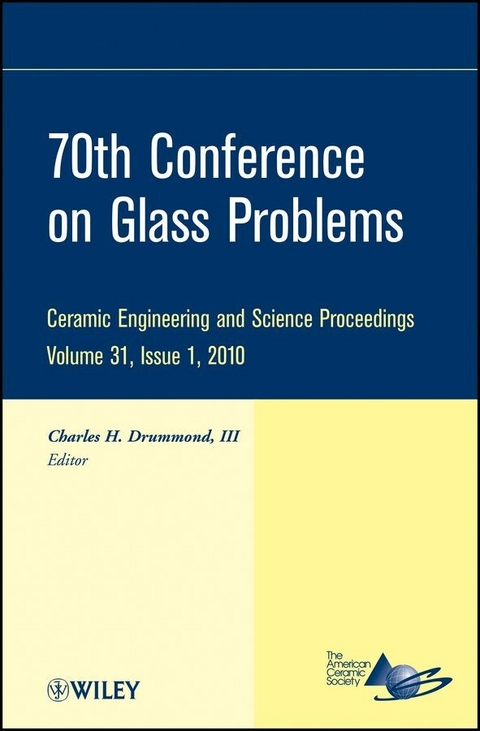
70th Conference on Glass Problems, Volume 31, Issue 1 (eBook)
232 Seiten
John Wiley & Sons (Verlag)
978-0-470-76983-6 (ISBN)
Conference on Glass Problems at The Ohio State University,
Columbus, Ohio. Topics include melting and molding, refractories,
and environmental issues and new products.
Charles H. Drummond, III, is a Professor at The Ohio State University's Department of Materials Science and Engineering, Columbus, Ohio. He is a recipient of the Ohio Governor's Award for Emerging Technology; is the Director for the Annual Conference on Glass Problems; and is a recipient of The American Ceramic Society's Cramer Award. His current research is concerned primarily with the structure and properties of amorphous solids or glasses. This includes bulk glasses of scientific and commercial interest and glasses present in crystalline materials. He received his Ph.D. from Harvard University in 1974.
Foreword ix
Preface xi
Acknowledgments xiii
GLASS MELTING
Rapid Refining of Submerged Combustion Melter Product Glass
3
David Rue, Walter Kunc, John Wagner, Bruno Purnode, and Aaron
Huber
Modeling the Quality of Glass Melting Processes 11
Adriaan Lankhorst, Andries Habraken, Mathi Rongen, Philip
Simons, and Ruud Beerkens
Process Optimization of the Glass Forming Process by
Advanced 3D Forming Models 21
Erik Muijsenberg
Operational Experience of an Oxy-Fuel Fired Glass Melter
Using an Improved Silica Crown and Wide Flame Burners
33
Alonso Gonzalez, Wladimir Sarmiento-Darkin, John T. Brown, Len
Switzer, Euan Evenson, Sho Kobayashi, and Cuauhtemoc Lagos
C'mon, Level with Me 45
Terry Berg
THE FUTURE OF THE GLASS INDUSTRY AND ENVIRONMENTAL
REGULATIONS
How Big is My Carbon Footprint? 53
Todd J. Seifried, Christopher J. Hoyle, and Douglas H.
Davis
ICG: A Global Cooperation in the Challenging World of Glass
67
Fabiano Nicoletti and René Vacher
Particle Size Measurements in the Flue Gas of Glass
Melting Furnaces 75
Andreas Kasper, Simon Slade, Dilek Bolean, and Guy van Marcke de
Lummen
Ceramic Filter Elements for Emission Control on Glass
Furnaces Efficient Multi-Pollutant Treatment in a Single Step
85
Gary Elliott and Andrew Startin
Requirements for Glass Compositions for Solar Applications
97
A. Ganjoo, L. J. Shelestak, J. W. McCamy, and M. Arbab
Strategic Materials: Strategic Planning, Geopolitical Forces
and Risk Management 107
Peter Wray
ENERGY
Red Lion Bio-Energy--Syngas Production from a Novel
Thermal Conversion Process of Coal/Biomass 121
Douglas Struble
Macro Energy Balances 127
John Brown and John Nelson
Glass Furnace Stack Gas Calculation Issues 135
C. Philip Ross
Increase of Glass Production Efficiency and Energy Efficiency
with Model-Based Predictive Control 143
Erik Muijsenberg, Menno Eisenga, and Jörg Buchmayer
Temperature Distributions in Glass Gobs between Shears and
Blank Mold: Calculations and Measurements 151
Hayo Müller-Simon, Gesine Bergmann, and Kristina
Kessler
REFRACTORIES
Postmortem of a Conventional Silica Brick from a Soda-Lime
Float Glass Furnace Crown 161
Warren Curtis
Refractory Ceramic Fibers 175
Joe Ventura and Daniel M. Wood
Refractory Solutions for Extra White Glasses 179
Michèle Blackburn, L. Massard, and M. Gaubil
Testing and Performance of Fusion-Cast Refractories
189
Amul Gupta, Kevin Selkregg, and Roland Heidrich
Mullite Regenerators--An Optimum Solution 203
Chris Windle and Trevor Wilson
Author Index 217
"The overall themes are glass melting, the future of the glass
industry and environmental regulations, energy, and refractories.
Topics of the 21 papers include modeling the quality of glass
melting processes, the operational experience of an oxy-fuel fired
glass melter using an improved silica crown and wide flame burners,
measuring particle size in the flue gas of glass melting furnaces,
requirements of glass compositions for solar applications,
model-based predictive control to increase the efficiency of glass
production and energy, calculating and measuring temperature
distributions in glass gobs between shears and blank mold,
postmortem of a conventional silica brick from a soda-lime float
glass furnace crown, and refractory solutions for extra white
glasses." (SciTech Book News, December 2010)
| Erscheint lt. Verlag | 5.7.2010 |
|---|---|
| Reihe/Serie | Ceramic Engineering and Science Proceedings | Ceramic Engineering and Science Proceedings |
| Sprache | englisch |
| Themenwelt | Naturwissenschaften ► Chemie |
| Technik ► Maschinenbau | |
| Schlagworte | Ceramics • Keramik (Techn.) • keramische Werkstoffe • Materials Science • Materialwissenschaften • Optics & Photonics • Optik u. Photonik • Physics • Physik • Werkstoff |
| ISBN-10 | 0-470-76983-1 / 0470769831 |
| ISBN-13 | 978-0-470-76983-6 / 9780470769836 |
| Informationen gemäß Produktsicherheitsverordnung (GPSR) | |
| Haben Sie eine Frage zum Produkt? |
 PDF (Adobe DRM)
Kopierschutz: Adobe-DRM
Adobe-DRM ist ein Kopierschutz, der das eBook vor Mißbrauch schützen soll. Dabei wird das eBook bereits beim Download auf Ihre persönliche Adobe-ID autorisiert. Lesen können Sie das eBook dann nur auf den Geräten, welche ebenfalls auf Ihre Adobe-ID registriert sind.
Details zum Adobe-DRM
Dateiformat: PDF (Portable Document Format)
Mit einem festen Seitenlayout eignet sich die PDF besonders für Fachbücher mit Spalten, Tabellen und Abbildungen. Eine PDF kann auf fast allen Geräten angezeigt werden, ist aber für kleine Displays (Smartphone, eReader) nur eingeschränkt geeignet.
Systemvoraussetzungen:
PC/Mac: Mit einem PC oder Mac können Sie dieses eBook lesen. Sie benötigen eine
eReader: Dieses eBook kann mit (fast) allen eBook-Readern gelesen werden. Mit dem amazon-Kindle ist es aber nicht kompatibel.
Smartphone/Tablet: Egal ob Apple oder Android, dieses eBook können Sie lesen. Sie benötigen eine
Geräteliste und zusätzliche Hinweise
Buying eBooks from abroad
For tax law reasons we can sell eBooks just within Germany and Switzerland. Regrettably we cannot fulfill eBook-orders from other countries.
aus dem Bereich