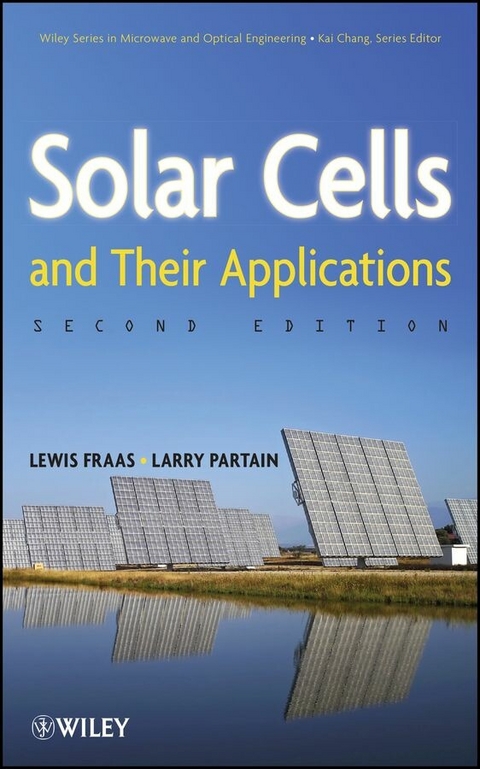
Solar Cells and Their Applications (eBook)
648 Seiten
John Wiley & Sons (Verlag)
978-0-470-63687-9 (ISBN)
marketplace
Since the first publication of this important volume over a
decade ago, dramatic changes have taken place with the solar market
growing almost 100-fold and the U.S. moving from first to fourth
place in the world market as analyzed in this Second Edition. Three
bold new opportunities are identified for any countries wanting to
improve market position. The first is combining pin solar cells
with 3X concentration to achieve economic competitiveness near
term. The second is charging battery-powered cars with solar
cell-generated electricity from arrays in surrounding
areas--including the car owners' homes--while
simultaneously reducing their home electricity bills by over ninety
percent. The third is formation of economic "unions" of sufficient
combined economic size to be major competitors.
In this updated edition, feed-in tariffs are identified as the
most effective approach for public policy. Reasons are provided to
explain why pin solar cells outperform more traditional pn solar
cells. Field test data are reported for nineteen percent pin solar
cells and for ~500X concentrating systems with bare cell
efficiencies approaching forty percent. Paths to bare cell
efficiencies over fifty percent are described, and key missing
program elements are identified. Since government support is needed
for new technology prototype integration and qualification testing
before manufacturing scale up, the key economic measure is
identified in this volume as the electricity cost in cents per
kilowatt-hour at the complete installed system level, rather than
just the up-front solar cell modules' costs in dollars per
watt.
This Second Edition will benefit technologists in the fields of
solar cells and systems; solar cell researchers; power systems
designers; academics studying microelectronics, semiconductors, and
solar cells; business students and investors with a technical
focus; and government and political officials developing public
policy.
Lewis M. Fraas, PhD, is the founder and President of JX Crystals Inc. He has spearheaded the development of high-power-density photovoltaic cells and complete concentrating photovoltaic and thermophotovoltaic systems. Dr. Fraas wrote the first paper describing the forty percent-efficient triple-junction concentrator solar cell now entering high-volume production, and his group at Boeing demonstrated the first thirty-five percent-efficient dual-junction cell. Larry D. Partain, PhD, is Director of Marketing and Advanced Technology, initiating and managing high-risk/high-payoff R&D programs for Varian Medical Systems. A prominent researcher in solar cell and related X-ray imager technology, Dr. Partain recently led efforts to develop high-performance X-ray and flat-panel imaging medical systems, helping to create over $100 million in company sales.
I. Introduction to Solar Cells.
1. Solar Cells: A Brief History and Introduction (Lewis Fraas
and Larry Partain).
2. Solar Cell Electricity Market History, Public Policy,
Projected Future and Estimated Costs (Larry Partain and Lewis
Fraas).
3. Solar Cells, Single Crystal Semiconductors, and High
Efficiency (Lewis Fraas).
4. Solar Cell Device Physics (Larry Partain).
II. Terrestrial Solar Cell Electricity.
5. Crystalline Silicon Solar Cells and Modules (Leonid
Rubin).
6. Thin Film Solar Cells and Modules (Robert
Birkmire).
7. Terrestrial Module Fabrication & Assembly Technologies
(Christopher Bunner).
8. Chinese Solar Cell Status (Wang Sicheng).
9. Tracking the Sun for More kWh and Lower Cost Solar
Electricity (Ron Corio, Michael Reed and Lewis Fraas).
10. Solar Cell Systems: Definition, Performance &
Reliability (Jason Strauch, Larry Moore and Elmer
Collins).
11. Leveled Cost of Energy for Utility-Scale Photovoltaics
(Matthew Campbell).
III. Terrestrial Concentrator Solar Cell Systems.
12. Low Concentration Crystalline Silicon Systems (Lewis
Fraas).
13. High-Concentration, III-V Multijunction Solar Cells
(Geoffrey Kinsey).
14. High Concentration Fresnel Lens Assemblies and Systems
(Gerhard (Peharz and Andreas Bett).
15. High Concentration Cassengrainian Solar Cell Modules and
Arrays (Michael Ludowise and Lewis Fraas).
16. Concentrator Solar Cell Installations at University of
Nevada Las Vegas (Suresh Sadineni and Robert Boehm).
17. Concentrator Solar Cell Field Installations (Francisca
Rubio, Mar¡a Martinez and Pedro Banda).
IV. Solar Cells in Space.
18. Space Solar Cells and Applications (Sheila Bailey and
Ryne Raffaelle).
V. Other Aspects & Considerations.
19. Solar Resource for Space and Terrestrial Applications
(Christian Gueymard and Daryl Myers).
20. Solar Energy Costs: The Solar Advisor Model (Paul Gilman,
Nathan Blair and Christopher Cameron).
21. Challenges of Large-Scale Solar Cell Electricity Production
(David Faiman).
VI. Thin Films & X-ray Imager Technologies.
22. Market Overview of Flat Panel Detectors for X-Ray Imaging
(Carl LaCasce, Larry Partain and Chuck Blouir).
23. Amorphous Silicon Transistors and Photodiodes (Robert
Street).
24. Amorphous Silicon Digital X-ray Imaging (Richard
Colbeth).
25. Photoconductor Digital X-ray Imaging (George
Zentai).
VII. Summary.
26. Summary, Conclusions, and Recommendations (Lewis Fraas
and Larry Partain).
"In this updated edition, feed-in tariffs are identified as the
most effective approach for public policy. Reasons are provided to
explain why pin solar cells outperform more traditional pn solar
cells. Field test data are reported for nineteen percent pin solar
cells and for -500X concentrating systems with bare cell
efficiencies approaching forty percent." (Global Print Monitor, 26
November 2010)
| Erscheint lt. Verlag | 20.7.2010 |
|---|---|
| Reihe/Serie | Wiley Series in Microwave and Optical Engineering | Wiley Series in Microwave and Optical Engineering |
| Sprache | englisch |
| Themenwelt | Technik ► Elektrotechnik / Energietechnik |
| Schlagworte | Electrical & Electronics Engineering • Elektrotechnik u. Elektronik • Energie • Energietechnik • Energy • Halbleiter • Power Technology & Power Engineering • semiconductors • Solarenergie u. Photovoltaik • Solar Energy & Photovoltaics • Solarzelle |
| ISBN-10 | 0-470-63687-4 / 0470636874 |
| ISBN-13 | 978-0-470-63687-9 / 9780470636879 |
| Informationen gemäß Produktsicherheitsverordnung (GPSR) | |
| Haben Sie eine Frage zum Produkt? |
 PDF (Adobe DRM)
Kopierschutz: Adobe-DRM
Adobe-DRM ist ein Kopierschutz, der das eBook vor Mißbrauch schützen soll. Dabei wird das eBook bereits beim Download auf Ihre persönliche Adobe-ID autorisiert. Lesen können Sie das eBook dann nur auf den Geräten, welche ebenfalls auf Ihre Adobe-ID registriert sind.
Details zum Adobe-DRM
Dateiformat: PDF (Portable Document Format)
Mit einem festen Seitenlayout eignet sich die PDF besonders für Fachbücher mit Spalten, Tabellen und Abbildungen. Eine PDF kann auf fast allen Geräten angezeigt werden, ist aber für kleine Displays (Smartphone, eReader) nur eingeschränkt geeignet.
Systemvoraussetzungen:
PC/Mac: Mit einem PC oder Mac können Sie dieses eBook lesen. Sie benötigen eine
eReader: Dieses eBook kann mit (fast) allen eBook-Readern gelesen werden. Mit dem amazon-Kindle ist es aber nicht kompatibel.
Smartphone/Tablet: Egal ob Apple oder Android, dieses eBook können Sie lesen. Sie benötigen eine
Geräteliste und zusätzliche Hinweise
Buying eBooks from abroad
For tax law reasons we can sell eBooks just within Germany and Switzerland. Regrettably we cannot fulfill eBook-orders from other countries.
aus dem Bereich