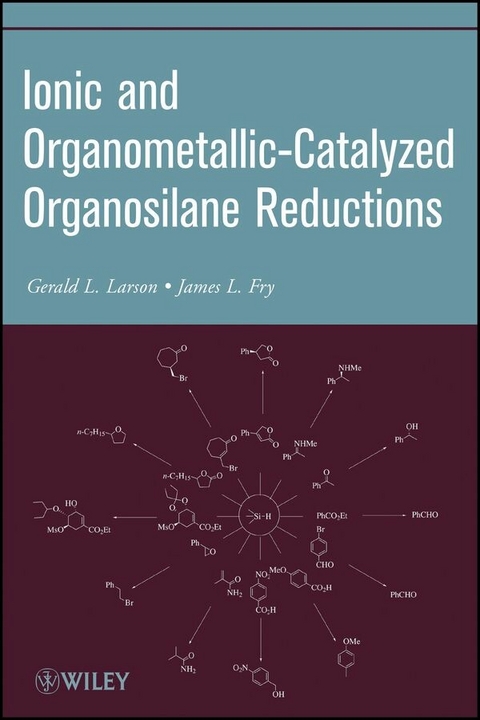
Ionic and Organometallic-Catalyzed Organosilane Reductions (eBook)
John Wiley & Sons (Verlag)
978-0-470-57267-2 (ISBN)
The exceptionally useful chemical-reducing properties of organosilicon hydrides have been known for more than half a century. Since the early discovery of these properties, interest in the use of organosilicon hydrides for the reduction of organic functional groups has increased steadily and has led to the development of many techniques for their deployment in chemo-, regio-, and stereoselective transformations in organic synthesis.
Ionic and Organometallic-Catalyzed Organosilane Reductions provides an up-to-date, comprehensive survey of the literature of this rich chemistry as it pertains to organic synthesis. Both ionic and catalyst-mediated reaction types are included, with appropriate reference to reaction mechanisms where they have been elucidated. A wide variety of organic functional group reductions by organosilicon hydrides receive critical comments and evaluation, especially with respect to scope and limitations. A substantial discussion of asymmetric reductions is also included in this book.
The contents of the book are taken from the comprehensive review of the topic contained in the Organic Reactions series and cover the reduction of all organic groups. All known examples are compiled in thirty-four easily scanned, comprehensive tables compiled from 809 original articles. Updated lists comprising 256 additional references for the tables are provided that bring the coverage up to March 2009.
The authors have been, and continue to be, involved in the applications of organosilanes to organic synthesis. Consistent with the goal of Organic Reactions, the content and presentation of this text emphasize the preparative aspects of the reductions focusing on the scope and limitations of the individual transformations along with detailed experimental procedures.
Ionic and Organometallic-Catalyzed Organosilane Reductions is an essential reference book for all synthetic organic chemists working in academic and industrial laboratories.
Gerald L. Larson received his PhD from the University of California, Davis, and became professor of chemistry at the University of Puerto Rico, Río Piedras. He has worked at Petrarch Systems and then Gelest. His research interests include the use of organosilanes in synthesis and chromatography and the process development of the preparation of organosilanes and related materials. He has published over 100 papers in the area of organosilicon chemistry.
James L. Fry received his PhD from Michigan State University, was granted emeritus professor status from The University of Toledo in 1999, and retired from Colorado State University in 2002. His research interests have included organometallic chemistry, chiral syntheses, electrochemical processes, kinetic isotope effects, functional group transformation methods using organosilicon hydrides, and surface chemistry.
Ionic and Organometallic-Catalyzed Organosilane Reductions provides an up-to-date, comprehensive review of reductions with organosilanes. Both ionic and catalyst-mediated reaction types are included, with appropriate reference to reaction mechanisms where they have been elucidated. The text also provides a wide variety of organic functional group reductions by organosilicon hydrides, and includes a substantial discussion of asymmetric reductions. All known examples have been compiled in thirty-four easily scanned, comprehensive tables compiled from 809 original articles. This is a must-have reference book for all synthetic organic chemists working in academic and industrial laboratories.
Gerald L. Larson received his PhD from the University of California, Davis, and became professor of chemistry at the University of Puerto Rico, Río Piedras. He has worked at Petrarch Systems and then Gelest. His research interests include the use of organosilanes in synthesis and chromatography and the process development of the preparation of organosilanes and related materials. He has published over 100 papers in the area of organosilicon chemistry. James L. Fry received his PhD from Michigan State University, was granted emeritus professor status from The University of Toledo in 1999, and retired from Colorado State University in 2002. His research interests have included organometallic chemistry, chiral syntheses, electrochemical processes, kinetic isotope effects, functional group transformation methods using organosilicon hydrides, and surface chemistry.
Foreword vii
Preface ix
Ionic And Organometallic-Catalyzed Organosilane Reductions 1
Gerald L. Larson and James L. Fry
Index 747
"This is an impressive piece of work." (JACS, 2010)
| Erscheint lt. Verlag | 19.11.2009 |
|---|---|
| Reihe/Serie | Organic Reactions |
| Organic Reactions | Organic Reactions |
| Sprache | englisch |
| Themenwelt | Naturwissenschaften ► Chemie ► Organische Chemie |
| Technik | |
| Schlagworte | Book • chemicalreducing • Chemie • Chemistry • Discovery • Essential • exceptionally • Functional • groups • Hydrides • Katalyse • known • Methods - Synthesis & Techniques • organic • Organische Chemie / Methoden, Synthesen, Verfahren • Organosilicon • Pharmaceutical & Medicinal Chemistry • Pharmazeutische u. Medizinische Chemie • Properties • reduction • Reduktion (Chemie) • Reference • steadily • synthesis • Synthetic • use • useful |
| ISBN-10 | 0-470-57267-1 / 0470572671 |
| ISBN-13 | 978-0-470-57267-2 / 9780470572672 |
| Informationen gemäß Produktsicherheitsverordnung (GPSR) | |
| Haben Sie eine Frage zum Produkt? |
 PDF (Adobe DRM)
Kopierschutz: Adobe-DRM
Adobe-DRM ist ein Kopierschutz, der das eBook vor Mißbrauch schützen soll. Dabei wird das eBook bereits beim Download auf Ihre persönliche Adobe-ID autorisiert. Lesen können Sie das eBook dann nur auf den Geräten, welche ebenfalls auf Ihre Adobe-ID registriert sind.
Details zum Adobe-DRM
Dateiformat: PDF (Portable Document Format)
Mit einem festen Seitenlayout eignet sich die PDF besonders für Fachbücher mit Spalten, Tabellen und Abbildungen. Eine PDF kann auf fast allen Geräten angezeigt werden, ist aber für kleine Displays (Smartphone, eReader) nur eingeschränkt geeignet.
Systemvoraussetzungen:
PC/Mac: Mit einem PC oder Mac können Sie dieses eBook lesen. Sie benötigen eine
eReader: Dieses eBook kann mit (fast) allen eBook-Readern gelesen werden. Mit dem amazon-Kindle ist es aber nicht kompatibel.
Smartphone/Tablet: Egal ob Apple oder Android, dieses eBook können Sie lesen. Sie benötigen eine
Geräteliste und zusätzliche Hinweise
Buying eBooks from abroad
For tax law reasons we can sell eBooks just within Germany and Switzerland. Regrettably we cannot fulfill eBook-orders from other countries.
aus dem Bereich