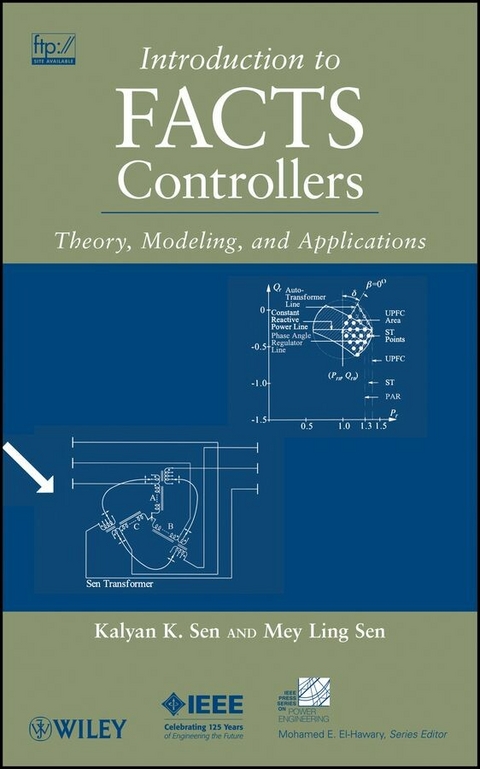
Introduction to FACTS Controllers (eBook)
544 Seiten
John Wiley & Sons (Verlag)
978-0-470-52473-2 (ISBN)
control and power flow problems
Flexible alternating current transmission systems (FACTS)
controllers represent one of the most important technological
advances in recent years, both enhancing controllability and
increasing power transfer capacity of electric power transmission
networks. This timely publication serves as an applications manual,
offering readers clear instructions on how to model, design, build,
evaluate, and install FACTS controllers. Authors Kalyan Sen and Mey
Ling Sen share their two decades of experience in FACTS controller
research and implementation, including their own pioneering FACTS
design breakthroughs.
Readers gain a solid foundation in all aspects of FACTS
controllers, including:
* Basic underlying theories
* Step-by-step evolution of FACTS controller development
* Guidelines for selecting the right FACTS controller
* Sample computer simulations in EMTP programming language
* Key differences in modeling such FACTS controllers as the
voltage regulating transformer, phase angle regulator, and unified
power flow controller
* Modeling techniques and control implementations for the three
basic VSC-based FACTS controllers--STATCOM, SSSC, and UPFC
In addition, the book describes a new type of FACTS controller,
the Sen Transformer, which is based on technology developed by the
authors. An appendix presents all the sample models that are
discussed in the book, and the accompanying FTP site offers many
more downloadable sample models as well as the full-color
photographs that appear throughout the book.
This book is essential reading for practitioners and students of
power engineering around the world, offering viable solutions to
the increasing problems of grid congestion and power flow
limitations in electric power transmission systems.
Kalyan K. Sen, PhD, PE, was a key member of the FACTS development team at Westinghouse Science & Technology Center, where he developed some of the basic concepts of FACTS technology. With more than twenty years of experience in academia and industry, he has twenty-five patents and publications in the areas of FACTS and power electronics. He served as the technical program chair of the 2008 Power & Energy Society General Meeting. He has been serving as an IEEE Distinguished Lecturer since 2002. Mey Ling Sen, Mee, was a consultant engineer at the Westinghouse Electro-Mechanical Division Technology Center. Currently, she is the President of SEN Engineering Solutions. Ms. Sen is the co-inventor of the Sen transformer, which is the most efficient, reliable, and cost-effective FACTS controller.
Foreword.
Preface.
Acknowledgements.
Nomenclature.
1. Applications of FACTS Controllers.
2. Power Flow Control Concepts.
2.1 Theory.
2.2 Implementation of Power Flow Control Concepts.
2.3 Interline Power Flow Concept.
3. Modeling Principles.
3.1 The Modeling in EMTP.
3.2 Vector Phase-Locked Loop (VPLL).
3.3 Transmission Line Steady-State Resistance Calculator.
3.4 Simulation of an Independent PFC in a Single Line
Application.
4. Transformer-Based FACTS Controllers.
4.1 Voltage Regulating Transformer (VRT).
4.2 Phase Angle Regulator (PAR).
5. Mechanically Switched FACTS controllers.
5.1 Shunt Compensation.
5.2 Series Compensation.
Chapter 6: Voltage-Sourced Converter (VSC).
6.1 Modeling an Ideal VSC.
6.2 DC-to-AC VSC.
6.3 Discussion.
7. Two-Level Pole Design.
7.1 A Three-Phase, Six-Pulse VSC with Two-Level Poles.
7.2 Analysis of a Pole.
8. VSC-Based FACTS Controllers.
8.1 Shunt Compensation.
8.2 Series Compensation.
8.3 Shunt-Series Compensation Using a Unified Power Flow
Controller (UPFC).
9. Sen Transformer.
9.1 Existing Solutions.
9.2 Desired Solution.
9.3 Comparison Among the VRT, PAR, UPFC, and ST.
9.4 Multiline Sen Transformer.
9.5 Flexible Operation of the ST.
9.6 ST with Shunt-Connected Compensating Voltages.
9.7 Limited Angle Operation of the ST with Shunt-Connected
Compensating Voltages.
9.8 MST with Shunt-Connected Compensating Voltages.
9.9 Generalized Sen Transformer.
9.10 Summary.
Appendix A. Miscellaneous.
Appendix B. Power Flow Control Equation in a Lossy Transmission
Line.
Appendix C. EMTP Files.
Bibliography.
Index.
About he Authors.
| Erscheint lt. Verlag | 4.11.2009 |
|---|---|
| Reihe/Serie | IEEE Press Series on Power Engineering | IEEE Press Series on Power Engineering |
| Sprache | englisch |
| Themenwelt | Technik ► Elektrotechnik / Energietechnik |
| Schlagworte | Electrical & Electronics Engineering • Elektrotechnik u. Elektronik • Energie • Energietechnik • Energy • Leistungselektronik • Power Electronics • Power Technology & Power Engineering • Qualität u. Zuverlässigkeit • Qualität u. Zuverlässigkeit • Quality & Reliability |
| ISBN-10 | 0-470-52473-1 / 0470524731 |
| ISBN-13 | 978-0-470-52473-2 / 9780470524732 |
| Informationen gemäß Produktsicherheitsverordnung (GPSR) | |
| Haben Sie eine Frage zum Produkt? |
 PDF (Adobe DRM)
Kopierschutz: Adobe-DRM
Adobe-DRM ist ein Kopierschutz, der das eBook vor Mißbrauch schützen soll. Dabei wird das eBook bereits beim Download auf Ihre persönliche Adobe-ID autorisiert. Lesen können Sie das eBook dann nur auf den Geräten, welche ebenfalls auf Ihre Adobe-ID registriert sind.
Details zum Adobe-DRM
Dateiformat: PDF (Portable Document Format)
Mit einem festen Seitenlayout eignet sich die PDF besonders für Fachbücher mit Spalten, Tabellen und Abbildungen. Eine PDF kann auf fast allen Geräten angezeigt werden, ist aber für kleine Displays (Smartphone, eReader) nur eingeschränkt geeignet.
Systemvoraussetzungen:
PC/Mac: Mit einem PC oder Mac können Sie dieses eBook lesen. Sie benötigen eine
eReader: Dieses eBook kann mit (fast) allen eBook-Readern gelesen werden. Mit dem amazon-Kindle ist es aber nicht kompatibel.
Smartphone/Tablet: Egal ob Apple oder Android, dieses eBook können Sie lesen. Sie benötigen eine
Geräteliste und zusätzliche Hinweise
Buying eBooks from abroad
For tax law reasons we can sell eBooks just within Germany and Switzerland. Regrettably we cannot fulfill eBook-orders from other countries.
aus dem Bereich