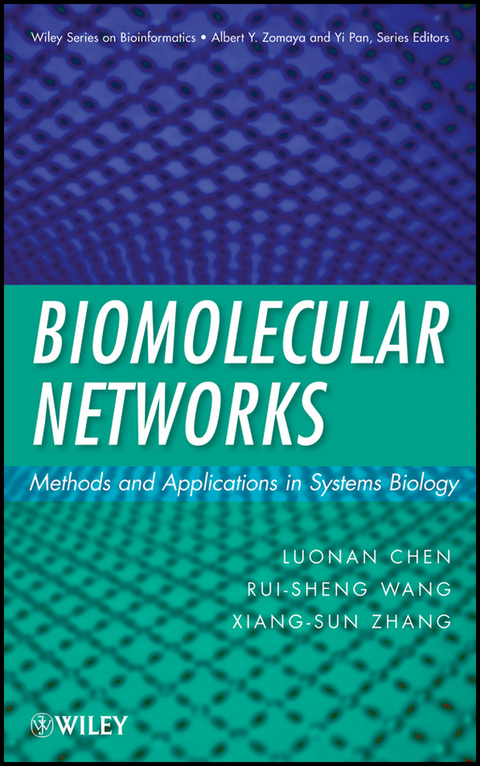
Biomolecular Networks (eBook)
416 Seiten
John Wiley & Sons (Verlag)
978-0-470-48805-8 (ISBN)
networks
With the recent rapid advances in molecular biology,
high-throughput experimental methods have resulted in enormous
amounts of data that can be used to study biomolecular networks in
living organisms. With this development has come recognition of the
fact that a complicated living organism cannot be fully understood
by merely analyzing individual components. Rather, it is the
interactions of components or biomolecular networks that are
ultimately responsible for an organism's form and function. This
book addresses the important need for a new set of computational
tools to reveal essential biological mechanisms from a systems
biology approach.
Readers will get comprehensive coverage of analyzing
biomolecular networks in cellular systems based on available
experimental data with an emphasis on the aspects of network,
system, integration, and engineering. Each topic is treated in
depth with specific biological problems and novel computational
methods:
* GENE NETWORKS--Transcriptional regulation; reconstruction
of gene regulatory networks; and inference of transcriptional
regulatory networks
* PROTEIN INTERACTION NETWORKS--Prediction of protein-protein
interactions; topological structure of biomolecular networks;
alignment of biomolecular networks; and network-based prediction of
protein function
* METABOLIC NETWORKS AND SIGNALING NETWORKS--Analysis,
reconstruction, and applications of metabolic networks; modeling
and inference of signaling networks; and other topics and new
trends
In addition to theoretical results and methods, many
computational software tools are referenced and available from the
authors' Web sites. Biomolecular Networks is an indispensable
reference for researchers and graduate students in bioinformatics,
computational biology, systems biology, computer science, and
applied mathematics.
LUONAN CHEN, PhD, is a full professor in the Department of Electrical Engineering and Electronics, Osaka Sangyo University, Osaka, Japan, and he is also the founding director of Institute of Systems Biology, Shanghai University, Shanghai, China. Dr. Chen's fields of interest include systems biology, bioinformatics, and nonlinear dynamics. RUI-SHENG WANG, PhD, is an assistant professor in the School of Information, Renmin University of China. Dr. Wang's research interests include bioinformatics, computational systems biology, and complex networks. XIANG-SUN ZHANG is a full research professor in the Institute of Applied Math-ematics, Chinese Academy of Sciences. Professor Zhang's research interests include bioinformatics, systems biology, optimization theory, and related computational mathematics.
PREFACE.
ACKNOWLEDGMENTS.
LIST OF ILLUSTRATIONS.
ACRONYMS.
1 Introduction.
1.1 Basic Concepts in Molecular Biology.
1.2 Biomolecular Networks in Cells.
1.3 Network Systems Biology.
1.4 About This Book.
I GENE NETWORKS.
2 Transcription Regulation: Networks and Models.
2.1 Transcription Regulation and Gene Expression.
2.2 Networks in Transcription Regulation.
2.3 Nonlinear Models Based on Biochemical Reactions.
2.4 Integrated Models for Regulatory Networks.
2.5 Summary.
3 Reconstruction of Gene Regulatory Networks.
3.1 Mathematical Models of Gene Regulatory Network.
3.2 Reconstructing Gene Regulatory Networks.
3.3 Inferring Gene Networks from Multiple Datasets.
3.4 Gene Network-Based Drug Target Identification.
3.5 Summary.
4 Inference of Transcriptional Regulatory Networks.
4.1 Predicting TF Binding Sites and Promoters.
4.2 Inference of Transcriptional Interactions.
4.3 Identifying Combinatorial Regulations of TFs.
4.4 Inferring Cooperative Regulatory Networks.
4.5 Prediction of Transcription Factor Activity.
4.6 Summary.
II PROTEIN INTERACTION NETWORKS.
5 Prediction of Protein-Protein Interactions.
5.1 Experimental Protein-Protein Interactions.
5.2 Prediction of Protein-Protein Interactions.
5.3 Protein Interaction Prediction Based on MultidomainPairs.
5.4 Domain Interaction Prediction Methods.
5.5 Summary.
6 Topological Structure of Biomolecular Networks.
6.1 Statistical Properties of Biomolecular Networks.
6.2 Evolution of Protein Interaction Networks.
6.3 Hubs, Motifs, and Modularity in Biomolecular Networks.
6.4 Explorative Roles of Hubs and Network Motifs.
6.5 Modularity Evaluation of Biomolecular Networks.
6.6 Summary.
7 Alignment of Biomolecular Networks.
7.1 Biomolecular Networks from Multiple Species.
7.2 Pairwise Alignment of Biomolecular Networks.
7.3 Network Alignment by Mathematical Programming.
7.4 Multiple Alignment of Biomolecular Networks.
7.5 Subnetwork and Pathway Querying.
7.6 Summary.
8 Network-Based Prediction of Protein Function.
8.1 Protein Function and Annotation.
8.2 Protein Functional Module Detection.
8.3 Functional Linkage for Protein Function Annotation.
8.4 Protein Function Prediction from High-Throughput Data.
8.5 Function Annotation Methods for Domains.
8.6 Summary.
III METABOLIC NETWORKS AND SIGNALING NETWORKS.
9 Metabolic Networks: Analysis, Reconstruction, andApplication.
9.1 Cellular Metabolism and Metabolic Pathways.
9.2 Metabolic Network Analysis and Modeling.
9.3 Reconstruction of Metabolic Networks.
9.4 Drug Target Detection in Metabolic Networks.
9.5 Summary.
10 Signaling Networks: Modeling and Inference.
10.1 Signal Transduction in Cellular Systems.
10.2 Modeling of Signal Transduction Pathways.
10.3 Inferring Signaling Networks from High-Throughput Data.
10.4 Inferring Signaling Networks by Linear Programming.
10.5 Inferring Signaling Networks from ExperimentalEvidence.
10.6 Summary.
11 Other Topics and New Trends.
11.1 Network-Based Protein Structural Analysis.
11.2 Integration of Biomolecular Networks.
11.3 Posttranscriptional Regulation of Noncoding RNAs.
11.4 Biomolecular Interactions and Human Diseases.
11.5 Summary.
REFERENCES.
INDEX.
| Erscheint lt. Verlag | 30.6.2009 |
|---|---|
| Reihe/Serie | Wiley Series in Bioinformatics | Wiley Series in Bioinformatics |
| Mitarbeit |
Herausgeber (Serie): Albert Y. Zomaya, Yi Pan |
| Sprache | englisch |
| Themenwelt | Mathematik / Informatik ► Informatik ► Netzwerke |
| Mathematik / Informatik ► Informatik ► Theorie / Studium | |
| Naturwissenschaften ► Biologie | |
| Technik ► Elektrotechnik / Energietechnik | |
| Schlagworte | Bioinformatics & Computational Biology • Bioinformatik • Bioinformatik u. Computersimulationen in der Biowissenschaften • Biowissenschaften • Computational Biology • Computer Architecture • Computerarchitektur • Computer Science • Informatik • Life Sciences • Mathematics • Mathematik • Mathematik in der Biologie |
| ISBN-10 | 0-470-48805-0 / 0470488050 |
| ISBN-13 | 978-0-470-48805-8 / 9780470488058 |
| Informationen gemäß Produktsicherheitsverordnung (GPSR) | |
| Haben Sie eine Frage zum Produkt? |
 PDF (Adobe DRM)
Kopierschutz: Adobe-DRM
Adobe-DRM ist ein Kopierschutz, der das eBook vor Mißbrauch schützen soll. Dabei wird das eBook bereits beim Download auf Ihre persönliche Adobe-ID autorisiert. Lesen können Sie das eBook dann nur auf den Geräten, welche ebenfalls auf Ihre Adobe-ID registriert sind.
Details zum Adobe-DRM
Dateiformat: PDF (Portable Document Format)
Mit einem festen Seitenlayout eignet sich die PDF besonders für Fachbücher mit Spalten, Tabellen und Abbildungen. Eine PDF kann auf fast allen Geräten angezeigt werden, ist aber für kleine Displays (Smartphone, eReader) nur eingeschränkt geeignet.
Systemvoraussetzungen:
PC/Mac: Mit einem PC oder Mac können Sie dieses eBook lesen. Sie benötigen eine
eReader: Dieses eBook kann mit (fast) allen eBook-Readern gelesen werden. Mit dem amazon-Kindle ist es aber nicht kompatibel.
Smartphone/Tablet: Egal ob Apple oder Android, dieses eBook können Sie lesen. Sie benötigen eine
Geräteliste und zusätzliche Hinweise
Buying eBooks from abroad
For tax law reasons we can sell eBooks just within Germany and Switzerland. Regrettably we cannot fulfill eBook-orders from other countries.
aus dem Bereich