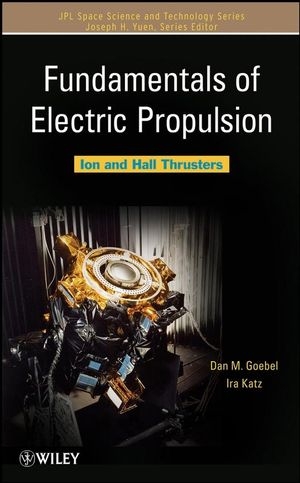
Fundamentals of Electric Propulsion (eBook)
526 Seiten
John Wiley & Sons (Verlag)
978-0-470-43626-4 (ISBN)
considered the technology of the future. Now, the future has
arrived.
This important new book explains the fundamentals of electric
propulsion for spacecraft and describes in detail the physics and
characteristics of the two major electric thrusters in use today,
ion and Hall thrusters. The authors provide an introduction to
plasma physics in order to allow readers to understand the models
and derivations used in determining electric thruster performance.
They then go on to present detailed explanations of:
* Thruster principles
* Ion thruster plasma generators and accelerator grids
* Hollow cathodes
* Hall thrusters
* Ion and Hall thruster plumes
* Flight ion and Hall thrusters
Based largely on research and development performed at the Jet
Propulsion Laboratory (JPL) and complemented with scores of tables,
figures, homework problems, and references, Fundamentals of
Electric Propulsion: Ion and Hall Thrusters is an indispensable
textbook for advanced undergraduate and graduate students who are
preparing to enter the aerospace industry. It also serves as an
equally valuable resource for professional engineers already at
work in the field.
Dan M. Goebel, PhD, is a Senior Research Scientist in the Advanced Propulsion Technology Group at JPL in Pasadena, California. Since joining JPL in 2003, he has worked on the development of high-efficiency ion thrusters, advanced long life cathodes and grids, and electric-thruster life models for deep space missions. He is a world-recognized expert in ion thrusters, cathodes, advanced plasma sources, microwave sources, high-voltage engineering, and pulsed power switches.? Ira Katz, PhD, has led the Advanced Propulsion Technology Group at NASA JPL since 2001. Group accomplishments during his tenure include the development and testing of the 25 kW NEXIS ion thruster, successful completion of the world's longest electric thruster life test, development of technology and support for precision formation flying missions (ST7, Lisa, TPF-I), and laboratory investigations and computer modeling of fundamental electric propulsion physics. Dr. Katz is recognized as a world leader in computer modeling of spacecraft-plasma interactions, spacecraft charging, and ion thruster physics.
Note from the Series Editor.
Foreword.
Preface.
Acknowledgments.
Chapter 1: Introduction.
1.1 Electric Propulsion Background.
1.2 Electric Thruster Types.
1.3 Ion Thruster Geometry.
1.4 Hall Thruster Geometry.
1.5 Beam/Plume Characteristics.
References.
Chapter 2: Thruster Principles.
2.1 The Rocket Equation.
2.2 Force Transfer in Ion and Hall Thrusters.
2.3 Thrust.
2.4 Specific Impulse.
2.5 Thruster Efficiency.
2.6 Power Dissipation.
2.7 Neutral Densities and Ingestion in Electric Thrusters.
References.
Problems.
Chapter 3: Basic Plasma Physics.
3.1 Introduction.
3.2 Maxwell's Equations.
3.3 Single Particle Motions.
3.4 particle Energies and Velocities.
3.5 Plasma as a Fluid.
3.6 Diffusion in Partially Ionized Gases.
3.7 Sheaths at the Boundaries of Plasmas.
References.
Problems.
Chapter 4: Ion Thruster Plasma Generators.
4.1 Introduction.
4.2 Idealized Ion Thruster Plasma Generator.
4.3 DC Discharge Ion Thruster.
4.4 Kaufman Ion Thrusters.
4.5 rf Ion Thrusters.
4.6 Microwave Ion Thrusters.
4.7 2-D Computer Models of the Ion Thruster Discharge
Chamber.
References.
Problems.
Chapter 5: Ion Thruster Accelerator Grids.
5.1 Grid Configurations.
5.2 Ion Accelerator Basics.
5.3 Ion Optics.
5.4 Electron Backstreaming.
5.5 High-Voltage Considerations.
5.6 Ion Accelerator Grid Life.
References.
Problems.
Chapter 6: Hollow Cathodes.
6.1 Introduction.
6.2 Cathode Configurations.
6.3 Thermionic Electron Emitter Characteristics.
6.4 Insert Region Plasma.
6.5 Orifice Region Plasma.
6.6 Hollow cathode Thermal Models.
6.7 Cathode Plume-Region Plasma.
6.8 Hollow Cathode Life.
6.9 Keeper Wear and Life.
6.10 Hollow Cathode Operation.
References.
Problems.
Chapter 7: Hall Thrusters.
7.1 Introduction.
7.2 Thruster Operating Principles and Scaling.
7.3 Hall Thruster Performance Models.
7.4 Channel Physics and Numerical Modeling.
7.5 Hall Thruster Life.
References.
Problems.
Chapter 8: Ion and Hall Thruster Plumes.
8.1 Introduction.
8.2 Plume Physics.
8.3 Plume Models.
8.4 Spacecraft Interactions.
8.5 Interactions with Payloads.
References.
Problems.
Chapter 9: Flight Ion and Hall Thrusters.
9.1 Introduction.
9.2 Ion Thrusters.
9.3 Hall Thrusters.
References.
Appendices.
A: Nomenclature.
B: Gas Flow Unit Conversions and Cathode Pressure Estimates.
C: Energy Loss by Electrons.
D: Ionization and Excitation Cross Sections for Xenon.
E: Ionization and Excitation Reaction Rates for Xenon in
Maxwellian Plasmas.
F: Electron Relaxation and Thermalization Times.
G: Clausing Factor Monte Carlo Calculation.
Index..
| Erscheint lt. Verlag | 23.12.2008 |
|---|---|
| Reihe/Serie | JPL Space Science and Technology Series | JPL Space Science and Technology Series |
| Sprache | englisch |
| Themenwelt | Technik ► Elektrotechnik / Energietechnik |
| Technik ► Luft- / Raumfahrttechnik | |
| Technik ► Maschinenbau | |
| Schlagworte | Aeronautic & Aerospace Engineering • electricity • Elektrizität • Elektrizitätslehre • Elektrizität • Elektrizitätslehre • Energie • Energietechnik • Energy • Luft- u. Raumfahrttechnik • Maschinenbau • mechanical engineering • Physics • Physik • Power Technology & Power Engineering |
| ISBN-10 | 0-470-43626-3 / 0470436263 |
| ISBN-13 | 978-0-470-43626-4 / 9780470436264 |
| Informationen gemäß Produktsicherheitsverordnung (GPSR) | |
| Haben Sie eine Frage zum Produkt? |
 PDF (Adobe DRM)
Kopierschutz: Adobe-DRM
Adobe-DRM ist ein Kopierschutz, der das eBook vor Mißbrauch schützen soll. Dabei wird das eBook bereits beim Download auf Ihre persönliche Adobe-ID autorisiert. Lesen können Sie das eBook dann nur auf den Geräten, welche ebenfalls auf Ihre Adobe-ID registriert sind.
Details zum Adobe-DRM
Dateiformat: PDF (Portable Document Format)
Mit einem festen Seitenlayout eignet sich die PDF besonders für Fachbücher mit Spalten, Tabellen und Abbildungen. Eine PDF kann auf fast allen Geräten angezeigt werden, ist aber für kleine Displays (Smartphone, eReader) nur eingeschränkt geeignet.
Systemvoraussetzungen:
PC/Mac: Mit einem PC oder Mac können Sie dieses eBook lesen. Sie benötigen eine
eReader: Dieses eBook kann mit (fast) allen eBook-Readern gelesen werden. Mit dem amazon-Kindle ist es aber nicht kompatibel.
Smartphone/Tablet: Egal ob Apple oder Android, dieses eBook können Sie lesen. Sie benötigen eine
Geräteliste und zusätzliche Hinweise
Buying eBooks from abroad
For tax law reasons we can sell eBooks just within Germany and Switzerland. Regrettably we cannot fulfill eBook-orders from other countries.
aus dem Bereich