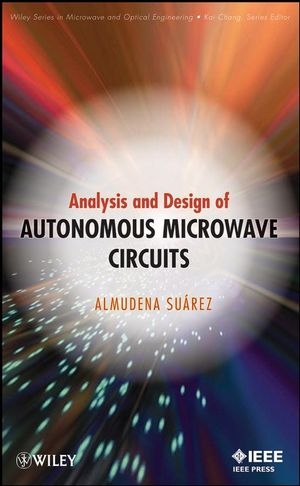
Analysis and Design of Autonomous Microwave Circuits (eBook)
728 Seiten
John Wiley & Sons (Verlag)
978-0-470-38589-0 (ISBN)
designers' control over the oscillationin autonomous circuits
This book facilitates a sound understanding of the free-running
oscillation mechanism, the start-up from the noise level, and the
establishment of the steady-state oscillation. It deals with the
operation principles and main characteristics of free-running and
injection-locked oscillators, coupled oscillators, and parametric
frequency dividers.
Analysis and Design of Autonomous Microwave Circuits
provides:
* An exploration of the main nonlinear-analysis methods, with
emphasis on harmonic balance and envelope transient methods
* Techniques for the efficient simulation of the most common
autonomous regimes
* A presentation and comparison of the main stability-analysis
methods in the frequency domain
* A detailed examination of the instabilization mechanisms that
delimit the operation bands of autonomous circuits
* Coverage of techniques used to eliminate common types of
undesired behavior, such as spurious oscillations, hysteresis, and
chaos
* A thorough presentation of the oscillator phase noise
* A comparison of the main methodologies of phase-noise
analysis
* Techniques for autonomous circuit optimization, based on
harmonic balance
* A consideration of different design objectives: presetting the
oscillation frequency and output power, increasing efficiency,
modifying the transient duration, and imposing operation bands
Analysis and Design of Autonomous Microwave Circuits is a
valuable resource for microwave designers, oscillator designers,
and graduate students in RF microwave design.
Almudena Suárez, PhD, is a Full Professor at the University of Cantabria, Spain, and a member of its Communications Engineering Department since 1993. She coauthored the book Stability Analysis of Nonlinear Microwave Circuits and contributed two articles to the Encyclopedia of RF and Microwave Engineering (Wiley). Professor Suárez has published dozens of papers in international journals and has been the leading researcher in several R&D projects. Her areas of interest include the nonlinear design of microwave circuits and, especially, stability and phase-noise analysis. She is a Distinguished Microwave Lecturer of IEEE.
Preface.
1. Oscillator Dynamics.
1.1. Introduction.
1.2. Operational Principle of Free-Running Oscillators.
1.3. Impedance-Admittance Analysis of an Oscillator.
1.4. Frequency-Domain Formulation of an Oscillator Circuit.
1.5. Oscillator Dynamics.
1.6. Phase Noise.
2. Phase Noise.
2.1. Introduction.
2.2. Random Variable and random Processes.
2.3. Noise Sources in Electronic Circuits.
2.4. Derivation of the Oscillator Noise Spectrum Using
Time-Domain Analysis.
2.5. Frequency-Domain Analysis of a Noisy Oscillator.
3. Bifurcation Analysis.
3.1. Introduction.
3.2. Representation of Solutions.
3.3. Bifurcations.
4. Injected Oscillators and Frequency Dividers.
4.1. Introduction.
4.2. Injection-Locked Oscillators.
4.3. Frequency Dividers.
4.4. Subharmonically and Ultrasubharmonically Injection-Locked
Oscillators.
4.5. Self-Oscillating Mixers.
5. Nonlinear Circuit Simulation.
5.1. Introduction.
5.2. Time-Domain Integration.
5.3. Fast Time-Domain Techniques.
5.4. Harmonic Balance.
5.5. Harmonic Balance Analysis of Autonomous and Synchronized
Circuit.
5.6. Envelope Transient.
5.7. Conversion Matrix Approach.
6. Stability Analysis Using Harmonic Balance.
6.1. Introduction.
6.2. Local Stability Analysis.
6.3. Stability Analysis of Free-Running Oscillators.
6.4. Solution Curves Versus a Circuit Parameter.
6.5.Global Stability Analysis.
6.6. Bifurcation Synthesis and Control.
7. Noise Analysis Using Harmonic Balance.
7.1. Introduction.
7.2. Noise in Semiconductor Devices.
7.3. Decoupled Analysis of Phase and Amplitude Perturbations in
a Harmonic Balance System.
7.4. Coupled Phase and Amplitude Noise Calculation.
7.5. Carrier Modulation Approach.
7.6. Conversion Matrix Approach.
7.7. Noise in Synchronized Oscillators.
8. Harmonic Balance Techniques for Oscillator Design.
8.1. Introduction.
8.2. Oscillator Synthesis.
8.3. Design of Voltage-Controlled Oscillators.
8.4. Maximization of Oscillator Efficiency.
8.5. Control of Oscillator Transients.
8.6. Phase Noise Reduction.
9. Stabilization Techniques for Phase Noise
Reduction.
9.1. Introduction.
9.2. Self-Injection Topology.
9.3. Use of High-Q Resonators.
9.4. Stabilization Loop.
9.5. Transistor-Based Oscillators.
10. Coupled-Oscillator Systems.
10.1. Introduction.
10.2. Oscillator Systems with Global Coupling.
10.3. Coupled-Oscillator Systems for Beam Steering.
11. Simulation Techniques for Frequency-Divider
Design.
11.1. Introduction.
11.2. Types of frequency dividers.
11.3. Design of Transistor-Based Regenerative Frequency
Dividers.
11.4. Design of Harmonic Injection Dividers.
11.5. Extension of the Techniques to Subharmonic Injection
Oscillators.
12. Circuit Stabilization.
12.1. Introduction.
12.2. Unstable Class AB Amplifier Using Power Combiners.
12.3. Unstable Class E/F Amplifier.
12.4. Unstable Class E Amplifier.
12.5. Stabilization of Oscillator Circuits.
12.6. Stabilization of Multifunction MMIC Chips.
Index.
| Erscheint lt. Verlag | 18.2.2009 |
|---|---|
| Reihe/Serie | Wiley Series in Microwave and Optical Engineering | Wiley Series in Microwave and Optical Engineering |
| Sprache | englisch |
| Themenwelt | Technik ► Elektrotechnik / Energietechnik |
| Schlagworte | Circuit Theory & Design • Communication technology • Electrical & Electronics Engineering • Elektrotechnik u. Elektronik • Kommunikationstechnik • Mikrowellentechnik • Mikrowellen- u. Hochfrequenztechnik u. Theorie • RF / Microwave Theory & Techniques • Schaltkreise - Theorie u. Entwurf • Schaltungsentwurf |
| ISBN-10 | 0-470-38589-8 / 0470385898 |
| ISBN-13 | 978-0-470-38589-0 / 9780470385890 |
| Informationen gemäß Produktsicherheitsverordnung (GPSR) | |
| Haben Sie eine Frage zum Produkt? |
 PDF (Adobe DRM)
Kopierschutz: Adobe-DRM
Adobe-DRM ist ein Kopierschutz, der das eBook vor Mißbrauch schützen soll. Dabei wird das eBook bereits beim Download auf Ihre persönliche Adobe-ID autorisiert. Lesen können Sie das eBook dann nur auf den Geräten, welche ebenfalls auf Ihre Adobe-ID registriert sind.
Details zum Adobe-DRM
Dateiformat: PDF (Portable Document Format)
Mit einem festen Seitenlayout eignet sich die PDF besonders für Fachbücher mit Spalten, Tabellen und Abbildungen. Eine PDF kann auf fast allen Geräten angezeigt werden, ist aber für kleine Displays (Smartphone, eReader) nur eingeschränkt geeignet.
Systemvoraussetzungen:
PC/Mac: Mit einem PC oder Mac können Sie dieses eBook lesen. Sie benötigen eine
eReader: Dieses eBook kann mit (fast) allen eBook-Readern gelesen werden. Mit dem amazon-Kindle ist es aber nicht kompatibel.
Smartphone/Tablet: Egal ob Apple oder Android, dieses eBook können Sie lesen. Sie benötigen eine
Geräteliste und zusätzliche Hinweise
Buying eBooks from abroad
For tax law reasons we can sell eBooks just within Germany and Switzerland. Regrettably we cannot fulfill eBook-orders from other countries.
aus dem Bereich