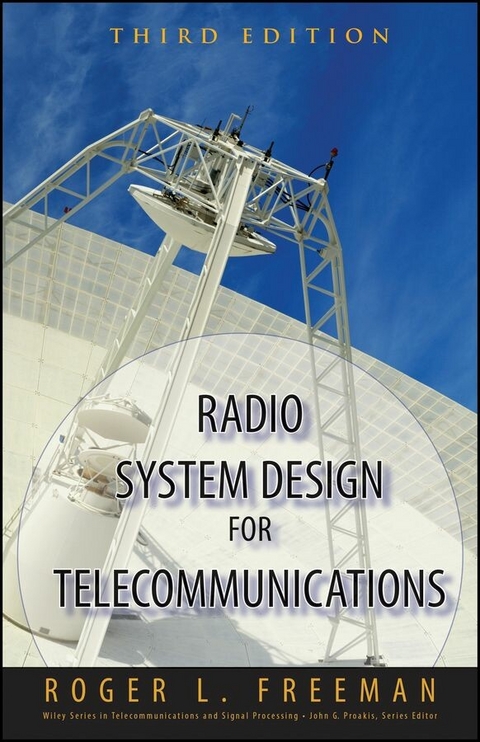
Radio System Design for Telecommunications (eBook)
John Wiley & Sons (Verlag)
978-0-470-05043-9 (ISBN)
The Third Edition of Radio System Design for Telecommunications brings this highly acclaimed book fully up to date with the latest technological advances and new applications. At the same time, the hallmarks of the previous editions, including the text's popular tutorial presentation, have been retained. Readers therefore get all the tools and guidance they need to master an essential set of current design techniques for radio systems that operate at frequencies of 3 MHz to 100 GHz.
Using simple mathematics, the author illustrates design concepts and applications. The book's logical organization, beginning with a discussion of radio propagation problems, enables readers to progressively develop the skills and knowledge needed to advance in the text. Topics that are new to the Third Edition include:
- Chapter devoted to wireless LANs (WLANs) as detailed in IEEE 802.11
- Subsections covering IEEE 802.15, 802.16, 802.20, and the wireless metropolitan area network (WMAN)
- WiFi, WiMax, and UWB applications that have recently experienced explosive growth
- Broadband radio in telecommunications, as well as offset frequency division multiplex (OFDM), a new technique for transmitting information in an interference environment
- The use of very small aperture satellite terminal (VSAT) systems as an economical alternative to public switched telecommunication networks (PSTN)
Review questions and problems at the end of each chapter engage readers' newfound skills and knowledge and help them assess whether they are ready to progress to the next chapter. References are provided for readers who want to investigate particular topics in greater depth.
Students in wireless telecommunications will find the book's tutorial style ideal for learning all the ins and outs of radio system design, whereas professionals in the industry will want to refer to the Third Edition for its clear explanations of the latest technology and applications.
Step-by-step tutorial to master current design techniques for wireless communication systems The Third Edition of Radio System Design for Telecommunications brings this highly acclaimed book fully up to date with the latest technological advances and new applications. At the same time, the hallmarks of the previous editions, including the text's popular tutorial presentation, have been retained. Readers therefore get all the tools and guidance they need to master an essential set of current design techniques for radio systems that operate at frequencies of 3 MHz to 100 GHz. Using simple mathematics, the author illustrates design concepts and applications. The book's logical organization, beginning with a discussion of radio propagation problems, enables readers to progressively develop the skills and knowledge needed to advance in the text. Topics that are new to the Third Edition include: Chapter devoted to wireless LANs (WLANs) as detailed in IEEE 802.11 Subsections covering IEEE 802.15, 802.16, 802.20, and the wireless metropolitan area network (WMAN) WiFi, WiMax, and UWB applications that have recently experienced explosive growth Broadband radio in telecommunications, as well as offset frequency division multiplex (OFDM), a new technique for transmitting information in an interference environment The use of very small aperture satellite terminal (VSAT) systems as an economical alternative to public switched telecommunication networks (PSTN) Review questions and problems at the end of each chapter engage readers' newfound skills and knowledge and help them assess whether they are ready to progress to the next chapter. References are provided for readers who want to investigate particular topics in greater depth. Students in wireless telecommunications will find the book's tutorial style ideal for learning all the ins and outs of radio system design, whereas professionals in the industry will want to refer to the Third Edition for its clear explanations of the latest technology and applications.
Roger L. Freeman is founder and Principal of Roger Freeman Associates, independent consultants in telecommunications, specializing in systems engineering in the United States, Canada, and Hispanic America. In the course of over forty-five years' experience in telecommunications operations, maintenance, and engineering, he has served as principal engineer for advanced system planning at the Raytheon Company, technical manager for ITT Marine Europe, and regional planning expert for the International Telecommunications Union (ITU), among other positions. In addition to the previous edition of Radio System Design, Mr. Freeman has written six other popular books on various aspects of telecommunications engineering: Reference Manual for Telecommunications Engineering, Third Edition; Fiber-Optic Systems for Telecommunications; Telecommunication System Engineering, Fourth Edition; Fundamentals of Telecommunications, Second Edition; Practical Data Communications, Second Edition; and Telecommunications Transmission Handbook, Fourth Edition, all published by Wiley. A senior life member of the IEEE, Mr. Freeman has lectured at numerous professional conferences and published widely in international telecommunication journals.
Preface.
Chapter 1. Radio Propagation.
Chapter 2. Line-of-Sight Microwave Radiolinks.
Chapter 3. Digital Line-of-Sight Microwave Radiolinks.
Chapter 4. Forward Error Correction and Advanced Digital
Waveforms.
Chapter 5. Over-the-Horizon Radiolinks.
Chapter 6. Basic Principles of Satellite Communications.
Chapter 7. Digital Communications by Satellite.
Chapter 8. Very Small Aperture Terminals.
Chapter 9. Radio System Design Above 10 GHz.
Chapter 10. Mobile Communications: Cellular Radio and Personal
Communication Services.
Chapter 11. Wireless LANs.
Chapter 12. High-Frequency (HF) Transmission Links.
Chapter 13. Meteor Burst Communication.
Chapter 14. Interference Issues in Radio Communications.
Chapter 15. Radio Terminal Design Considerations.
Appendix 1: Availability of a line-of-Sight Microwave Link.
Appendix 2: References Fields and Theoretical References;
Converting RF Field Strength to Power.
Appendix 3: Glossary of Acronyms and Abbreviations.
Index.
| Erscheint lt. Verlag | 18.4.2007 |
|---|---|
| Reihe/Serie | Wiley Series in Telecommunications and Signal Processing |
| Wiley Series in Telecommunications and Signal Processing | Wiley Series in Telecommunications and Signal Processing |
| Sprache | englisch |
| Themenwelt | Technik ► Elektrotechnik / Energietechnik |
| Technik ► Nachrichtentechnik | |
| Schlagworte | Communication • Current • Design • design techniques • Drahtlose Kommunikation • Edition • Editions • Electrical & Electronics Engineering • Elektrotechnik u. Elektronik • Essential • Hallmarks • Master • Mobile & Wireless Communications • popular tutorial presentation • previous • Radio • stepbystep • System • techniques • telecommunications • texts • Third • Time • Tools • Tutorial • Wireless |
| ISBN-10 | 0-470-05043-8 / 0470050438 |
| ISBN-13 | 978-0-470-05043-9 / 9780470050439 |
| Informationen gemäß Produktsicherheitsverordnung (GPSR) | |
| Haben Sie eine Frage zum Produkt? |
 PDF (Adobe DRM)
Kopierschutz: Adobe-DRM
Adobe-DRM ist ein Kopierschutz, der das eBook vor Mißbrauch schützen soll. Dabei wird das eBook bereits beim Download auf Ihre persönliche Adobe-ID autorisiert. Lesen können Sie das eBook dann nur auf den Geräten, welche ebenfalls auf Ihre Adobe-ID registriert sind.
Details zum Adobe-DRM
Dateiformat: PDF (Portable Document Format)
Mit einem festen Seitenlayout eignet sich die PDF besonders für Fachbücher mit Spalten, Tabellen und Abbildungen. Eine PDF kann auf fast allen Geräten angezeigt werden, ist aber für kleine Displays (Smartphone, eReader) nur eingeschränkt geeignet.
Systemvoraussetzungen:
PC/Mac: Mit einem PC oder Mac können Sie dieses eBook lesen. Sie benötigen eine
eReader: Dieses eBook kann mit (fast) allen eBook-Readern gelesen werden. Mit dem amazon-Kindle ist es aber nicht kompatibel.
Smartphone/Tablet: Egal ob Apple oder Android, dieses eBook können Sie lesen. Sie benötigen eine
Geräteliste und zusätzliche Hinweise
Buying eBooks from abroad
For tax law reasons we can sell eBooks just within Germany and Switzerland. Regrettably we cannot fulfill eBook-orders from other countries.
aus dem Bereich