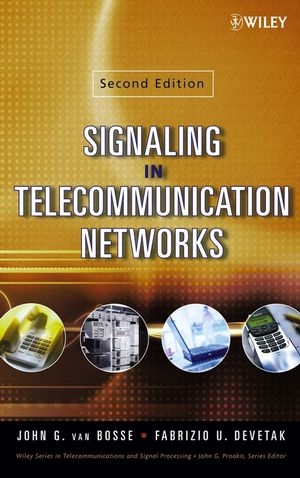
Signaling in Telecommunication Networks (eBook)
832 Seiten
John Wiley & Sons (Verlag)
9780470048139 (ISBN)
structures and signaling protocols
The Second Edition of Signaling in Telecommunication
Networks has been thoroughly updated, offering new chapters and
sections that cover the most recent developments in signaling
systems and procedures. This acclaimed book covers subscriber and
network signaling in both fixed and mobile networks.
Coverage begins with an introduction to circuit-switched
telephone networks, including an examination of trunks, exchanges,
access systems, transmission systems, and other basic components.
Next, the authors introduce signaling concepts, beginning with
older Channel Associated Signaling (CAS) systems and progressing to
today's Common Channel Signaling (CCS) systems. The book then
examines packet networks and their use in transmitting voice
(VoIP), TCP/IP protocols, VoIP signaling protocols, and ATM
protocols.
Throughout the book, the authors emphasize functionality,
particularly the roles of individual protocols and how they fit in
network architectures, helping readers grasp even the most complex
network structures and signaling protocols. Highlights of the
Second Edition include:
* Coverage of the latest developments and topics, including new
chapters on access networks, intelligent network application part,
signaling for voice communication in packet networks, and ATM
signaling
* Drawings and tables that help readers understand and visualize
complex systems
* Comprehensive, updated references for further study
* Examples to help readers make the bridge from theory to
application
With the continued growth and expansion of the
telecommunications industry, the Second Edition is essential
reading for telecommunications students as well as anyone involved
in this dynamic industry needing a solid understanding of the
different signaling systems and how they work. Moreover, the book
helps readers wade through the voluminous and complex technical
standards by providing the essential structure, terminology, and
functionality needed to understand them.
JOHN G. VAN BOSSE, MS, is an electrical engineer with almost forty years in telecommunications. He worked at the Automatic Electric Laboratories of General Telephone and Electronics, Inc. over a twenty-year period in several capacities, including development engineer, department head, and consultant. He then joined AT&T Bell Laboratories (now Lucent Technologies), from which he retired in 1991 as a DMTS (Distinguished Member of Technical Staff). He is the author of several papers on telecommunications switching and traffic. FABRIZIO U. DEVETAK, MS, studied electrical engineering at the Politecnico di Milano, where he earned his degree in 1972. In the same year, he joined General Telephone and Electronics, Inc., working first in Italy and later in their U.S. laboratories. In 1984, he began working at AT&T Bell Laboratories (Lucent), where he met Mr. van Bosse. After retiring in 2001 as Technical Manager, he completed a course on packet networking and obtained Certified Network Associate (CCNA) and Certified Network Professional (CCNP) technical certifications from Cisco Systems, a leading manufacturer of packet-switched telecommunications equipment.
"I recommend this book as a perfect guide to state-of-the-art
telecommunications signaling, especially as an advanced
undergraduate course book." (Computing Reviews.com, August
6, 2007)
"If you need to understand the topic of telecommunications
signaling or want to update your knowledge of some of the new or
expanded technologies, then...[it] may be the only book you need."
(Blogcritics.org, March 2, 2007)
| Erscheint lt. Verlag | 4.1.2007 |
|---|---|
| Reihe/Serie | Wiley Series in Telecommunications and Signal Processing | Wiley Series in Telecommunications and Signal Processing |
| Sprache | englisch |
| Themenwelt | Technik ► Elektrotechnik / Energietechnik |
| Technik ► Nachrichtentechnik | |
| Schlagworte | Electrical & Electronics Engineering • Elektrotechnik u. Elektronik • Signal Processing • Signalverarbeitung • Telekommunikation • Telekommunikationsnetz • Vermittlungstechnik |
| ISBN-13 | 9780470048139 / 9780470048139 |
| Informationen gemäß Produktsicherheitsverordnung (GPSR) | |
| Haben Sie eine Frage zum Produkt? |
 PDF (Adobe DRM)
Kopierschutz: Adobe-DRM
Adobe-DRM ist ein Kopierschutz, der das eBook vor Mißbrauch schützen soll. Dabei wird das eBook bereits beim Download auf Ihre persönliche Adobe-ID autorisiert. Lesen können Sie das eBook dann nur auf den Geräten, welche ebenfalls auf Ihre Adobe-ID registriert sind.
Details zum Adobe-DRM
Dateiformat: PDF (Portable Document Format)
Mit einem festen Seitenlayout eignet sich die PDF besonders für Fachbücher mit Spalten, Tabellen und Abbildungen. Eine PDF kann auf fast allen Geräten angezeigt werden, ist aber für kleine Displays (Smartphone, eReader) nur eingeschränkt geeignet.
Systemvoraussetzungen:
PC/Mac: Mit einem PC oder Mac können Sie dieses eBook lesen. Sie benötigen eine
eReader: Dieses eBook kann mit (fast) allen eBook-Readern gelesen werden. Mit dem amazon-Kindle ist es aber nicht kompatibel.
Smartphone/Tablet: Egal ob Apple oder Android, dieses eBook können Sie lesen. Sie benötigen eine
Geräteliste und zusätzliche Hinweise
Buying eBooks from abroad
For tax law reasons we can sell eBooks just within Germany and Switzerland. Regrettably we cannot fulfill eBook-orders from other countries.
aus dem Bereich