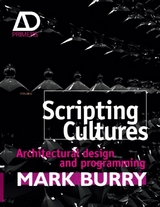
Scripting Cultures (eBook)
John Wiley & Sons (Verlag)
978-1-119-97927-2 (ISBN)
This book:
- Investigates the application of scripting for productivity, experimentation and design speculation.
- Offers detailed exploration of the scripting of Gaudí's final realised design for the Sagrada Família, leading to file-to-factory digital fabrication.
- Features projects and commentary from over 30 contemporary scripting leaders, including Evan Douglis, Marc Fornes, Sawako Kaijima, Achim Menges, Neri Oxman, Casey Reas and Hugh Whitehead of Foster + Partners.
With scripting, computer programming becomes integral to the digital design process. It provides unique opportunities for innovation, enabling the designer to customise the software around their own predilections and modes of working. It liberates the designer by automating many routine aspects and repetitive activities of the design process, freeing-up the designer to spend more time on design thinking. Software that is modified through scripting offers a range of speculations that are not possible using the software only as the manufacturers intended it to be used. There are also significant economic benefits to automating routines and coupling them with emerging digital fabrication technologies, as time is saved at the front-end and new file-to-factory protocols can be taken advantage of. Most significantly perhaps, scripting as a computing program overlay enables the tool user (designer) to become the new tool maker (software engineer). Though scripting is not new to design, it is only recently that it has started to be regarded as integral to the designer's skill set rather than a technical speciality. Many designers are now aware of its potential, but remain hesitant. This book treats scripting not only as a technical challenge, requiring clear description, guidance and training, but also, and more crucially, answers the question as to why designers should script in the first place, and what the cultural and theoretical implications are. This book: Investigates the application of scripting for productivity, experimentation and design speculation. Offers detailed exploration of the scripting of Gaud 's final realised design for the Sagrada Fam lia, leading to file-to-factory digital fabrication. Features projects and commentary from over 30 contemporary scripting leaders, including Evan Douglis, Marc Fornes, Sawako Kaijima, Achim Menges, Neri Oxman, Casey Reas and Hugh Whitehead of Foster + Partners.
Mark Burry is Professor of Innovation (Spatial Information Architecture) at RMIT in Melbourne, Australia, where he is also Director of the Spatial Information Architecture Laboratory and Director of the Design Research Institute. He is an Australian Research Council Federation Fellow and Member of the Advisory Board of Gehry Technologies in Los Angeles and has collaborated with leading international architectural and engineering practices. Burry is probably best known for his work on Antoni Gaudí's Sagrada Família in Barcelona, where he is Executive Architect and Researcher, and has been working for thirty years on the realisation of the completion of Gaudí's vision through computer-aided techniques. www.wiley.com/extras/scripting
Chapter 1 Scripting cultures 008
Chapter 2 Contextual summary of computing, scripting and
speculative design 013
Chapter 3 Cultural defence 027
Chapter 4 Resources 072
Chapter 5 Dimensions 089
Chapter 6 Scripted productivity: Gaudí's rose windows
126
Chapter 7 Composition and form 152
Chapter 8 Simplifying complexity for fabrication 171
Chapter 9 Scripting narrative space: Our World and The Third
Policeman 190
Chapter 10 Performative scripting 224
Chapter 11 Cultural account: scripting and shifts in authorship
246
Glossary 256
Scripting tools 260
Recommended reading 265
Index 267
Picture credits 271
| Erscheint lt. Verlag | 25.1.2013 |
|---|---|
| Reihe/Serie | Architectural Design Primer |
| Architectural Design Primer | Architectural Design Primer |
| Sprache | englisch |
| Themenwelt | Technik ► Architektur |
| Schlagworte | Activities • Architecture • Architektur • Aspects • Bauwerk • Computer • customise • Design • Designer • design process • digital • Innovation • Integral • many routine • modes • Opportunities • possible • predilections • programming • Range • Software • Time • Unique • working |
| ISBN-10 | 1-119-97927-7 / 1119979277 |
| ISBN-13 | 978-1-119-97927-2 / 9781119979272 |
| Informationen gemäß Produktsicherheitsverordnung (GPSR) | |
| Haben Sie eine Frage zum Produkt? |
 PDF (Adobe DRM)
Kopierschutz: Adobe-DRM
Adobe-DRM ist ein Kopierschutz, der das eBook vor Mißbrauch schützen soll. Dabei wird das eBook bereits beim Download auf Ihre persönliche Adobe-ID autorisiert. Lesen können Sie das eBook dann nur auf den Geräten, welche ebenfalls auf Ihre Adobe-ID registriert sind.
Details zum Adobe-DRM
Dateiformat: PDF (Portable Document Format)
Mit einem festen Seitenlayout eignet sich die PDF besonders für Fachbücher mit Spalten, Tabellen und Abbildungen. Eine PDF kann auf fast allen Geräten angezeigt werden, ist aber für kleine Displays (Smartphone, eReader) nur eingeschränkt geeignet.
Systemvoraussetzungen:
PC/Mac: Mit einem PC oder Mac können Sie dieses eBook lesen. Sie benötigen eine
eReader: Dieses eBook kann mit (fast) allen eBook-Readern gelesen werden. Mit dem amazon-Kindle ist es aber nicht kompatibel.
Smartphone/Tablet: Egal ob Apple oder Android, dieses eBook können Sie lesen. Sie benötigen eine
Geräteliste und zusätzliche Hinweise
Buying eBooks from abroad
For tax law reasons we can sell eBooks just within Germany and Switzerland. Regrettably we cannot fulfill eBook-orders from other countries.
aus dem Bereich