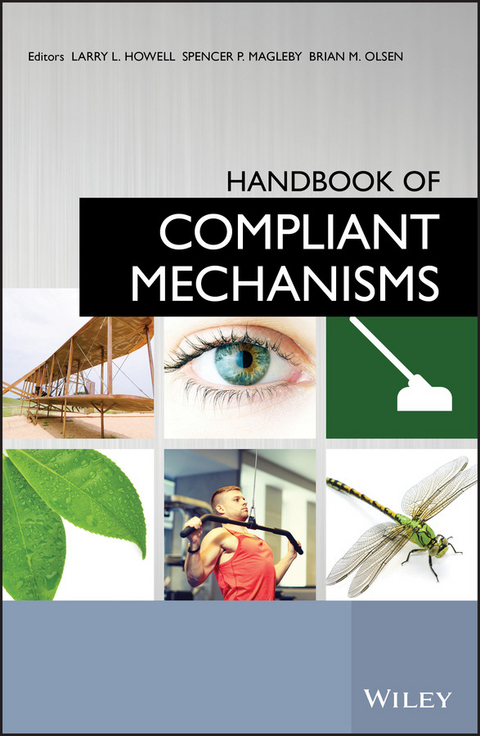
Handbook of Compliant Mechanisms (eBook)
John Wiley & Sons (Verlag)
978-1-118-51650-8 (ISBN)
A fully illustrated reference book giving an easy-to-understand introduction to compliant mechanisms
A broad compilation of compliant mechanisms to give inspiration and guidance to those interested in using compliant mechanisms in their designs, the Handbook of Compliant Mechanisms includes graphics and descriptions of many compliant mechanisms. It comprises an extensive categorization of devices that can be used to help readers identify compliant mechanisms related to their application. It also provides chapters on the basic background in compliant mechanisms, the categories of compliant mechanisms, and an example of how the Compendium can be used to facilitate compliant mechanism design.
- Fully illustrated throughout to be easily understood and accessible at introductory levels
- Covers all aspects pertaining to classification, elements, mechanisms and applications of compliant mechanisms
- Summarizes a vast body of knowledge in easily understood diagrams and explanations
- Helps readers appreciate the advantages that compliant mechanisms have to offer
- Practical approach is ideal for potential practitioners who would like to realize designs with compliant mechanisms, members and elements
- Breadth of topics covered also makes the book a useful reference for more advanced readers
Intended as an introduction to the area, the Handbook avoids technical jargon to assist non engineers involved in product design, inventors and engineers in finding clever solutions to problems of design and function.
Editors LARRY L. HOWELL and SPENCER P. MAGLEBY, Brigham Young University, USA BRIAN M. OLSEN, Los Alamos National Laboratory, USA
A fully illustrated reference book giving an easy-to-understand introduction to compliant mechanisms A broad compilation of compliant mechanisms to give inspiration and guidance to those interested in using compliant mechanisms in their designs, the Handbook of Compliant Mechanisms includes graphics and descriptions of many compliant mechanisms. It comprises an extensive categorization of devices that can be used to help readers identify compliant mechanisms related to their application. It also provides chapters on the basic background in compliant mechanisms, the categories of compliant mechanisms, and an example of how the Compendium can be used to facilitate compliant mechanism design. Fully illustrated throughout to be easily understood and accessible at introductory levels Covers all aspects pertaining to classification, elements, mechanisms and applications of compliant mechanisms Summarizes a vast body of knowledge in easily understood diagrams and explanations Helps readers appreciate the advantages that compliant mechanisms have to offer Practical approach is ideal for potential practitioners who would like to realize designs with compliant mechanisms, members and elements Breadth of topics covered also makes the book a useful reference for more advanced readers Intended as an introduction to the area, the Handbook avoids technical jargon to assist non engineers involved in product design, inventors and engineers in finding clever solutions to problems of design and function.
Editors LARRY L. HOWELL and SPENCER P. MAGLEBY, Brigham Young University, USA BRIAN M. OLSEN, Los Alamos National Laboratory, USA
Acknowledgement of Contributors
Preface
Part One Introduction to Compliant Mechanisms
1 Introduction to Compliant Mechanisms
2 Using the Handbook to Design Devices
Part Two Modeling of Compliant Mechanisms
3 Modeling of Intermediate Deflection Flexures
4 Modeling of Large Deflection Members
5 Modeling Mechanisms using the Pseudo-Rigid-Body Model
5A Pseudo-Rigid-Body Example
Part Three Synthesis of Compliant Mechanisms
6 Synthesis through Freedom and Constraint Topologies
7 Synthesis through Topology Optimization
8 Synthesis through Rigid-Body Replacement
9 Synthesis through Use of Building Blocks
Part Four Library of Compliant Mechanisms
10 Library Organization
11 Elements of Mechanisms
12 Mechanisms
13 Example Application
References
| Erscheint lt. Verlag | 25.1.2013 |
|---|---|
| Sprache | englisch |
| Themenwelt | Technik ► Architektur |
| Technik ► Maschinenbau | |
| Schlagworte | advantages • compared • Compliant Mechanisms • Cost • Designers • Device • devices • difficult • Example • Handbook • Lower • Manufacture • Maschinenbau • Maschinenbau - Entwurf • Mechanical • mechanical engineering • Mechanical Engineering - Design • Mechanical Engineering Special Topics • Mech Engineering Special Topics • Nano • New • Performance • possible • Precision • Spezialthemen Maschinenbau • Traditional • Work |
| ISBN-10 | 1-118-51650-8 / 1118516508 |
| ISBN-13 | 978-1-118-51650-8 / 9781118516508 |
| Informationen gemäß Produktsicherheitsverordnung (GPSR) | |
| Haben Sie eine Frage zum Produkt? |
 PDF (Adobe DRM)
Kopierschutz: Adobe-DRM
Adobe-DRM ist ein Kopierschutz, der das eBook vor Mißbrauch schützen soll. Dabei wird das eBook bereits beim Download auf Ihre persönliche Adobe-ID autorisiert. Lesen können Sie das eBook dann nur auf den Geräten, welche ebenfalls auf Ihre Adobe-ID registriert sind.
Details zum Adobe-DRM
Dateiformat: PDF (Portable Document Format)
Mit einem festen Seitenlayout eignet sich die PDF besonders für Fachbücher mit Spalten, Tabellen und Abbildungen. Eine PDF kann auf fast allen Geräten angezeigt werden, ist aber für kleine Displays (Smartphone, eReader) nur eingeschränkt geeignet.
Systemvoraussetzungen:
PC/Mac: Mit einem PC oder Mac können Sie dieses eBook lesen. Sie benötigen eine
eReader: Dieses eBook kann mit (fast) allen eBook-Readern gelesen werden. Mit dem amazon-Kindle ist es aber nicht kompatibel.
Smartphone/Tablet: Egal ob Apple oder Android, dieses eBook können Sie lesen. Sie benötigen eine
Geräteliste und zusätzliche Hinweise
Buying eBooks from abroad
For tax law reasons we can sell eBooks just within Germany and Switzerland. Regrettably we cannot fulfill eBook-orders from other countries.
aus dem Bereich