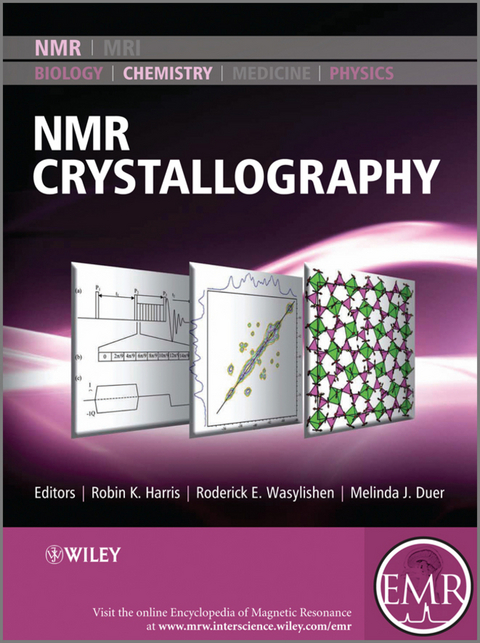
NMR Crystallography (eBook)
John Wiley & Sons (Verlag)
978-1-118-58733-1 (ISBN)
The content of this volume has been added to eMagRes (formerly Encyclopedia of Magnetic Resonance) - the ultimate online resource for NMR and MRI.
The term 'NMR Crystallography' has only recently come into common usage, and even now causes raised eyebrows within some parts of the diffraction community. The power of solid-state NMR to give crystallographic information has considerably increased since the CPMAS suite of techniques was introduced in 1976. In the first years of the 21st century, the ability of NMR to provide information to support and facilitate the analysis of single-crystal and powder diffraction patterns has become widely accepted. Indeed, NMR can now be used to refine diffraction results and, in favorable cases, to solve crystal structures with minimal (or even no) diffraction data. The increasing ability to relate chemical shifts (including the tensor components) to the crystallographic location of relevant atoms in the unit cell via computational methods has added significantly to the practice of NMR crystallography. Diffraction experts will increasingly welcome NMR as an allied technique in their structural analyses. Indeed, it may be that in the future crystal structures will be determined by simultaneously fitting diffraction patterns and NMR spectra.
This Handbook is organised into six sections. The first contains an overview and some articles on fundamental NMR topics, followed by a section concentrating on chemical shifts, and one on coupling interactions. The fourth section contains articles describing how NMR results relate to fundamental crystallography concepts and to diffraction methods. The fifth section concerns specific aspects of structure, such as hydrogen bonding. Finally, four articles in the sixth section give applications of NMR crystallography to structural biology, organic & pharmaceutical chemistry, inorganic & materials chemistry, and geochemistry.
About EMR Handbooks / eMagRes Handbooks
The Encyclopedia of Magnetic Resonance (up to 2012) and eMagRes (from 2013 onward) publish a wide range of online articles on all aspects of magnetic resonance in physics, chemistry, biology and medicine. The existence of this large number of articles, written by experts in various fields, is enabling the publication of a series of EMR Handbooks / eMagRes Handbooks on specific areas of NMR and MRI. The chapters of each of these handbooks will comprise a carefully chosen selection of articles from eMagRes. In consultation with the eMagRes Editorial Board, the EMR Handbooks / eMagRes Handbooks are coherently planned in advance by specially-selected Editors, and new articles are written (together with updates of some already existing articles) to give appropriate complete coverage. The handbooks are intended to be of value and interest to research students, postdoctoral fellows and other researchers learning about the scientific area in question and undertaking relevant experiments, whether in academia or industry.
Have the content of this Handbook and the complete content of eMagRes at your fingertips!
Visit: www.wileyonlinelibrary.com/ref/eMagRes
View other eMagRes publications here
Robin Kingsley Harris, Emeritus Professor of Chemistry, University of Durham, UK
Editor-in-Chief of the Encyclopedia of NMR 1st Edition and the Encyclopedia of MR 2nd Edition.
Roderick Wasylishen, Professor, University of Alberta, Edmonton, Alberta, CANADA.
Dr Melinda Duer, Department of Chemistry, University of Cambridge, UK.
The content of this volume has been added to eMagRes (formerly Encyclopedia of Magnetic Resonance) - the ultimate online resource for NMR and MRI. The term "e;NMR Crystallography"e; has only recently come into common usage, and even now causes raised eyebrows within some parts of the diffraction community. The power of solid-state NMR to give crystallographic information has considerably increased since the CPMAS suite of techniques was introduced in 1976. In the first years of the 21st century, the ability of NMR to provide information to support and facilitate the analysis of single-crystal and powder diffraction patterns has become widely accepted. Indeed, NMR can now be used to refine diffraction results and, in favorable cases, to solve crystal structures with minimal (or even no) diffraction data. The increasing ability to relate chemical shifts (including the tensor components) to the crystallographic location of relevant atoms in the unit cell via computational methods has added significantly to the practice of NMR crystallography. Diffraction experts will increasingly welcome NMR as an allied technique in their structural analyses. Indeed, it may be that in the future crystal structures will be determined by simultaneously fitting diffraction patterns and NMR spectra. This Handbook is organised into six sections. The first contains an overview and some articles on fundamental NMR topics, followed by a section concentrating on chemical shifts, and one on coupling interactions. The fourth section contains articles describing how NMR results relate to fundamental crystallography concepts and to diffraction methods. The fifth section concerns specific aspects of structure, such as hydrogen bonding. Finally, four articles in the sixth section give applications of NMR crystallography to structural biology, organic & pharmaceutical chemistry, inorganic & materials chemistry, and geochemistry. About EMR Handbooks / eMagRes Handbooks The Encyclopedia of Magnetic Resonance (up to 2012) and eMagRes (from 2013 onward) publish a wide range of online articles on all aspects of magnetic resonance in physics, chemistry, biology and medicine. The existence of this large number of articles, written by experts in various fields, is enabling the publication of a series of EMR Handbooks / eMagRes Handbooks on specific areas of NMR and MRI. The chapters of each of these handbooks will comprise a carefully chosen selection of articles from eMagRes. In consultation with the eMagRes Editorial Board, the EMR Handbooks / eMagRes Handbooks are coherently planned in advance by specially-selected Editors, and new articles are written (together with updates of some already existing articles) to give appropriate complete coverage. The handbooks are intended to be of value and interest to research students, postdoctoral fellows and other researchers learning about the scientific area in question and undertaking relevant experiments, whether in academia or industry. Have the content of this Handbook and the complete content of eMagRes at your fingertips! Visit: www.wileyonlinelibrary.com/ref/eMagRes View other eMagRes publications here
Robin Kingsley Harris, Emeritus Professor of Chemistry, University of Durham, UK Editor-in-Chief of the Encyclopedia of NMR 1st Edition and the Encyclopedia of MR 2nd Edition. Roderick Wasylishen, Professor, University of Alberta, Edmonton, Alberta, CANADA. Dr Melinda Duer, Department of Chemistry, University of Cambridge, UK.
Contributors.
Series Preface.
Volume Preface.
Part A: Introduction.
1 Crystallography & NMR: an Overview (Robin K.
Harris).
2 Tensors in NMR (S. Chandra Shekar, Alexej
Jerschow).
3 Computation of Magnetic Resonance Parameters for Crystalline
Systems: Principles (Jonathan R. Yates, Chris J.
Pickard).
4 Experimental Characterization of Nuclear Spin Interaction
Tensors (Jeremy J. Titman).
Part B: Chemical Shifts.
5 Magnetic Shielding & Chemical Shifts: Basics (Julio C.
Facelli, Anita M. Orendt).
6 Symmetry Effects at the Local Level (Matthias Bechmann,
Angelika Sebald).
7 Chemical Shift Computations for Crystalline Molecular Systems:
Practice (Robin K. Harris, Paul Hodgkinson, Chris J. Pickard,
Jonathan R. Yates, Vadim Zorin).
8 Chemical Shifts & Solid-state Molecular-level Structure
(Anita M. Orendt, Julio C. Facelli).
9 Chemical Shift Anisotropy & Asymmetry: Relationships to
Crystal Structure (James K. Harper).
Part C: Coupling Interactions.
10 Dipolar & Indirect Coupling: Basics (Roderick E.
Wasylishen).
11 Dipolar Recoupling: Heteronuclear (Christopher P.
Jaroniec).
12 Dipolar Recoupling: Homonuclear (Robert Tycko).
13 Dipolar Coupling: Molecular-level Mobility (Detlef
Reichert, Kay Saalwächter).
14 Spin Diffusion in Crystalline Solids (Lyndon
Emsley).
15 Indirect Coupling & Connectivity (Anne
Lesage).
16 Nuclear Quadrupole Coupling: An Introduction &
Crystallographic Aspects (Sharon E. Ashbrook, Stephen
Wimperis).
Part D: Crystal Structure Determination using NMR.
17 Fundamental Principles of NMR Crystallography (Francis
Taulelle).
18 Interplay between NMR & Single-crystal X-ray Diffraction
(Darren H. Brouwer).
19 Combined Analysis of NMR & Powder Diffraction Data
(Kenneth D.M. Harris, Mingcan Xu).
20 Tensor Interplay (David L. Bryce).
Part E: Properties of the Crystalline State.
21 Intermolecular Interactions & Structural Motifs
(Lindsay S. Cahill, Gillian R. Goward).
22 Hydrogen Bonding in Crystalline Organic Solids (Steven P.
Brown).
23 Inorganic Non-stoichiometric Crystalline Systems & Atomic
Ordering (Mark E. Smith).
24 Rotational & Translational Dynamics (Christopher I.
Ratcliffe).
25 Intramolecular Motion in Crystalline Organic Solids (Paul
Hodgkinson).
26 Structural Phase Transitions (Kenneth R. Jeffrey, Glenn H.
Penner).
Part F: Applications of NMR to Crystalline Solids.
27 Structural Biology (David A. Middleton).
28 Organic & Pharmaceutical Chemistry (Marek J.
Potrzebowski).
29 Inorganic & Materials Chemistry (Ray Dupree).
30 Geochemistry (Brian L. Phillips).
Index.
"In summing up my book review, I would again quote
Professor Harris from reference (2): 'Perhaps now is the time
to consider constituting a division of NMR crystallography within
the International Union of Crystallography. Certainly a formal or
semi-formal link with the solid-state NMR community is
desirable'. Forearmed with this book, I would support that
proposal. This book, I would also conclude, should be in the
library of crystallographic laboratories, across all the
disciplines." (Crystallography Reviews, 14
February 2012)
| Erscheint lt. Verlag | 19.12.2012 |
|---|---|
| Reihe/Serie | eMagRes Books |
| EMR Books | EMR Books |
| Sprache | englisch |
| Themenwelt | Naturwissenschaften ► Chemie ► Analytische Chemie |
| Naturwissenschaften ► Geowissenschaften ► Mineralogie / Paläontologie | |
| Naturwissenschaften ► Physik / Astronomie | |
| Technik | |
| Schlagworte | Chemie • Chemistry • NMR Spectroscopy / MRI / Imaging • NMR-Spektroskopie • NMR-Spektroskopie / MRT / Bildgebende Verfahren • nuclear magnetic resonance, NMR, NMR crystallography, crystallography, X-ray crystallography, solid-state physics, solid-state chemistry |
| ISBN-10 | 1-118-58733-2 / 1118587332 |
| ISBN-13 | 978-1-118-58733-1 / 9781118587331 |
| Informationen gemäß Produktsicherheitsverordnung (GPSR) | |
| Haben Sie eine Frage zum Produkt? |
 PDF (Adobe DRM)
Kopierschutz: Adobe-DRM
Adobe-DRM ist ein Kopierschutz, der das eBook vor Mißbrauch schützen soll. Dabei wird das eBook bereits beim Download auf Ihre persönliche Adobe-ID autorisiert. Lesen können Sie das eBook dann nur auf den Geräten, welche ebenfalls auf Ihre Adobe-ID registriert sind.
Details zum Adobe-DRM
Dateiformat: PDF (Portable Document Format)
Mit einem festen Seitenlayout eignet sich die PDF besonders für Fachbücher mit Spalten, Tabellen und Abbildungen. Eine PDF kann auf fast allen Geräten angezeigt werden, ist aber für kleine Displays (Smartphone, eReader) nur eingeschränkt geeignet.
Systemvoraussetzungen:
PC/Mac: Mit einem PC oder Mac können Sie dieses eBook lesen. Sie benötigen eine
eReader: Dieses eBook kann mit (fast) allen eBook-Readern gelesen werden. Mit dem amazon-Kindle ist es aber nicht kompatibel.
Smartphone/Tablet: Egal ob Apple oder Android, dieses eBook können Sie lesen. Sie benötigen eine
Geräteliste und zusätzliche Hinweise
Buying eBooks from abroad
For tax law reasons we can sell eBooks just within Germany and Switzerland. Regrettably we cannot fulfill eBook-orders from other countries.
aus dem Bereich