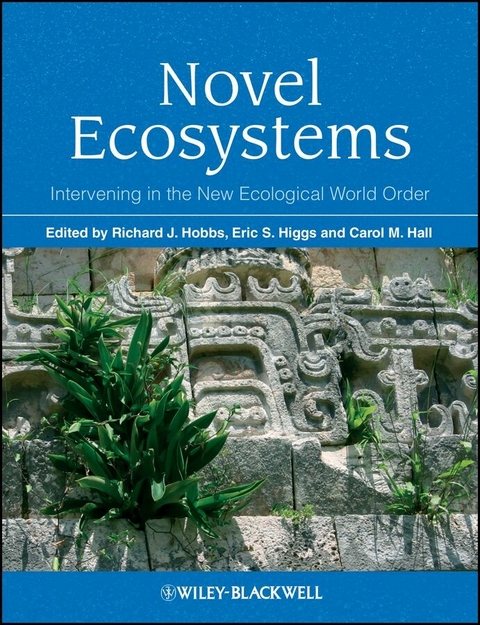
Novel Ecosystems (eBook)
John Wiley & Sons (Verlag)
978-1-118-35421-6 (ISBN)
Land conversion, climate change and species invasions are contributing to the widespread emergence of novel ecosystems, which demand a shift in how we think about traditional approaches to conservation, restoration and environmental management. They are novel because they exist without historical precedents and are self-sustaining. Traditional approaches emphasizing native species and historical continuity are challenged by novel ecosystems that deliver critical ecosystems services or are simply immune to practical restorative efforts. Some fear that, by raising the issue of novel ecosystems, we are simply paving the way for a more laissez-faire attitude to conservation and restoration. Regardless of the range of views and perceptions about novel ecosystems, their existence is becoming ever more obvious and prevalent in today's rapidly changing world. In this first comprehensive volume to look at the ecological, social, cultural, ethical and policy dimensions of novel ecosystems, the authors argue these altered systems are overdue for careful analysis and that we need to figure out how to intervene in them responsibly. This book brings together researchers from a range of disciplines together with practitioners and policy makers to explore the questions surrounding novel ecosystems. It includes chapters on key concepts and methodologies for deciding when and how to intervene in systems, as well as a rich collection of case studies and perspective pieces. It will be a valuable resource for researchers, managers and policy makers interested in the question of how humanity manages and restores ecosystems in a rapidly changing world.
A companion website with additional resources is available at www.wiley.com/go/hobbs/ecosystems
Richard J. Hobbs is Professor of Restoration Ecology and Australian Laureate Fellow at the University of Western Australia, where he leads the Ecosystem Restoration and Intervention Ecology Research Group. His current research focuses on pulling together different disciplines including restoration ecology, conservation biology and landscape ecology to develop a more effective ecology for the 21st century.
Eric S. Higgs is Professor of Environmental Studies at the University of Victoria (Canada), and director of the Mountain Legacy research project. Author of Nature by Design: People, Natural Process and Ecological Restoration, he focuses on advancing principles and practice of ecological restoration in a rapidly changing world.
Carol Hall has worked on community conservation issues in North America and Africa during the past 15 years. She is a co-author of the World Commission on Protected Areas' Ecological Restoration for Protected Areas: Principles, guidelines and best practices (in press, Gland, Switzerland: IUCN), and currently Program Director for the Restoration Institute, University of Victoria.
Land conversion, climate change and species invasions are contributing to the widespread emergence of novel ecosystems, which demand a shift in how we think about traditional approaches to conservation, restoration and environmental management. They are novel because they exist without historical precedents and are self-sustaining. Traditional approaches emphasizing native species and historical continuity are challenged by novel ecosystems that deliver critical ecosystems services or are simply immune to practical restorative efforts. Some fear that, by raising the issue of novel ecosystems, we are simply paving the way for a more laissez-faire attitude to conservation and restoration. Regardless of the range of views and perceptions about novel ecosystems, their existence is becoming ever more obvious and prevalent in today s rapidly changing world. In this first comprehensive volume to look at the ecological, social, cultural, ethical and policy dimensions of novel ecosystems, the authors argue these altered systems are overdue for careful analysis and that we need to figure out how to intervene in them responsibly. This book brings together researchers from a range of disciplines together with practitioners and policy makers to explore the questions surrounding novel ecosystems. It includes chapters on key concepts and methodologies for deciding when and how to intervene in systems, as well as a rich collection of case studies and perspective pieces. It will be a valuable resource for researchers, managers and policy makers interested in the question of how humanity manages and restores ecosystems in a rapidly changing world. A companion website with additional resources is available at www.wiley.com/go/hobbs/ecosystems
Richard J. Hobbs is Professor of Restoration Ecology and Australian Laureate Fellow at the University of Western Australia, where he leads the Ecosystem Restoration and Intervention Ecology Research Group. His current research focuses on pulling together different disciplines including restoration ecology, conservation biology and landscape ecology to develop a more effective ecology for the 21st century. Eric S. Higgs is Professor of Environmental Studies at the University of Victoria (Canada), and director of the Mountain Legacy research project. Author of Nature by Design: People, Natural Process and Ecological Restoration, he focuses on advancing principles and practice of ecological restoration in a rapidly changing world. Carol Hall has worked on community conservation issues in North America and Africa during the past 15 years. She is a co-author of the World Commission on Protected Areas' Ecological Restoration for Protected Areas: Principles, guidelines and best practices (in press, Gland, Switzerland: IUCN), and currently Program Director for the Restoration Institute, University of Victoria.
"The convergence of popular and technical literature
reinforces the impression that a paradigm shift in
conservation/restoration is underway. Novel Ecosystems provides an
entry to this novel world view." (Ecological
Management & Restoration, 17 September 2014)
"Overall, this is a timely book that thoroughly addresses
a critical issue in the management of ecosystems in a dynamically
changing world. Its strength lies in its treatment of decision
making processes and its real?]world illustrations through case
studies." (Frontiers of Biogeography, 1 November
2013)
"In conclusion, I recommend this book to all researchers
and practitioners working on man-made ecosystems."
(Basic and Applied Ecology, 1 October 2013)
"If this dialogue takes place, with the inclusion of
''classic,''
''traditional,'' and
''orthodox'' restoration ecology, at least
with regards historical knowledge (a paradigm change rather than a
paradigm shift), as well as the issues concerning novel ecosystems,
then this provocative book will remain an interesting and
stimulating standard work for a long time."
(Restoration Ecology, 1 July 2013)
"Summing Up: Recommended. All academic and professional
audiences." (Choice, 1 October 2013)
"Although the authors' new terminology does not seem a
step forward, Novel Ecosystemsprovides relevant and stimulating
ideas for discussion and integration into conservation and
restoration methods, strategies, and goals."
(Science, 2 August 2013)
| Erscheint lt. Verlag | 4.1.2013 |
|---|---|
| Sprache | englisch |
| Themenwelt | Naturwissenschaften ► Biologie ► Ökologie / Naturschutz |
| Naturwissenschaften ► Geowissenschaften ► Geologie | |
| Technik | |
| Schlagworte | Ãkosystem • Angewandte Ãkologie • Angewandte Ökologie • Applied Ecology • APPROACHES • Biowissenschaften • Climate • conservation • Conservation Science • Continuity • contributing • Critical • Ecosystems • emphasizing • Environmental Management, Policy & Planning • Environmental Studies • Historical • invasions • Land • Life Sciences • Native • Naturschutzbiologie • Novel • Ökosystem • Shift • Traditional • Umweltforschung • Umweltmanagement, Politik u. -Planung • widespread emergence |
| ISBN-10 | 1-118-35421-4 / 1118354214 |
| ISBN-13 | 978-1-118-35421-6 / 9781118354216 |
| Informationen gemäß Produktsicherheitsverordnung (GPSR) | |
| Haben Sie eine Frage zum Produkt? |
 PDF (Adobe DRM)
Kopierschutz: Adobe-DRM
Adobe-DRM ist ein Kopierschutz, der das eBook vor Mißbrauch schützen soll. Dabei wird das eBook bereits beim Download auf Ihre persönliche Adobe-ID autorisiert. Lesen können Sie das eBook dann nur auf den Geräten, welche ebenfalls auf Ihre Adobe-ID registriert sind.
Details zum Adobe-DRM
Dateiformat: PDF (Portable Document Format)
Mit einem festen Seitenlayout eignet sich die PDF besonders für Fachbücher mit Spalten, Tabellen und Abbildungen. Eine PDF kann auf fast allen Geräten angezeigt werden, ist aber für kleine Displays (Smartphone, eReader) nur eingeschränkt geeignet.
Systemvoraussetzungen:
PC/Mac: Mit einem PC oder Mac können Sie dieses eBook lesen. Sie benötigen eine
eReader: Dieses eBook kann mit (fast) allen eBook-Readern gelesen werden. Mit dem amazon-Kindle ist es aber nicht kompatibel.
Smartphone/Tablet: Egal ob Apple oder Android, dieses eBook können Sie lesen. Sie benötigen eine
Geräteliste und zusätzliche Hinweise
Buying eBooks from abroad
For tax law reasons we can sell eBooks just within Germany and Switzerland. Regrettably we cannot fulfill eBook-orders from other countries.
aus dem Bereich