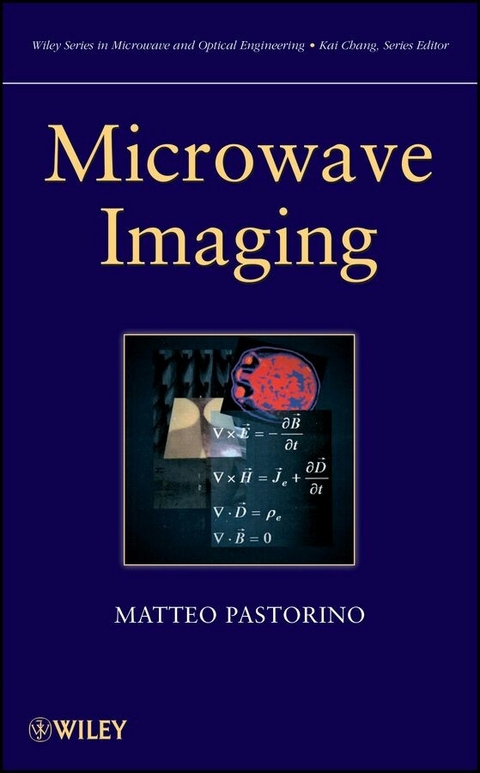
Microwave Imaging (eBook)
304 Seiten
John Wiley & Sons (Verlag)
978-0-470-60247-8 (ISBN)
aspects of modern microwave imaging approaches
Microwave imaging--a technique used in sensing a given
scene by means of interrogating microwaves--has recently
proven its usefulness in providing excellent diagnostic
capabilities in several areas, including civil and industrial
engineering, nondestructive testing and evaluation, geophysical
prospecting, and biomedical engineering.
Microwave Imaging offers comprehensive descriptions of
the most important techniques so far proposed for short-range
microwave imaging--including reconstruction procedures and
imaging systems and apparatus--enabling the reader to use
microwaves for diagnostic purposes in a wide range of applications.
This hands-on resource features:
* A review of the electromagnetic inverse scattering problem
formulation, written from an engineering perspective and with
notations
* The most effective reconstruction techniques based on diffracted
waves, including time- and frequency-domain methods, as well as
deterministic and stochastic space-domain procedures
* Currently proposed imaging apparatus, aimed at fast and accurate
measurements of the scattered field data
* Insight on near field probes, microwave axial tomographs, and
microwave cameras and scanners
* A discussion of practical applications with detailed
descriptions and discussions of several specific examples (e.g.,
materials evaluation, crack detection, inspection of civil and
industrial structures, subsurface detection, and medical
applications)
* A look at emerging techniques and future trends
Microwave Imaging is a practical resource for engineers,
scientists, researchers, and professors in the fields of civil and
industrial engineering, nondestructive testing and evaluation,
geophysical prospecting, and biomedical engineering.
MATTEO PASTORINO, PhD, is a Professor of Electromagnetic Fields and the Director of the Department of Biophysical and Electronic Engineering, University of Genoa, Italy. He teaches the university courses in electromagnetic fields and remote sensing and electromagnetic propagation. Professor Pastorino's main research interests are in the field of microwave and millimeter wave imaging, direct and inverse scattering problems, industrial and medical applications, smart antennas, and analytical and numerical methods in electromagnetism. He is the coauthor of more than 350 papers in international journals and proceedings of conferences.
1 Introduction.
2 Electromagnetic Scattering.
2.1 Maxwell's Equations.
2.2 Interface Conditions.
2.3 Constitutive Equations.
2.4 Wave Equations and Their Solutions.
2.5 Volume Scattering by Dielectric Targets.
2.6 Volume Equivalence Principle.
2.7 Integral Equations.
2.8 Surface Scattering by Perfectly Electric ConductingTargets.
References.
3 The Electromagnetic Inverse Scattering Problem.
3.1 Introduction.
3.2 Three-Dimensional Inverse Scattering.
3.3 Two-Dimensional Inverse Scattering.
3.4 Discretization of the Continuous Model.
3.5 Scattering by Canonical Objects: The Case of MultilayerElliptic Cylinders.
References.
4 Imaging Configurations and Model Approximations.
4.1 Objectives of the Reconstruction.
4.2 Multiillumination Approaches.
4.3 Tomographic Confi gurations.
4.4 Scanning Confi gurations.
4.5 Confi gurations for Buried-Object Detection.
4.6 Born-Type Approximations.
4.7 Extended Born Approximation.
4.8 Rytov Approximation.
4.9 Kirchhoff Approximation.
4.10 Green's Function for Inhomogeneous Structures.
References.
5 Qualitative Reconstruction Methods.
5.1 Introduction.
5.2 Generalized Solution of Linear Ill-Posed Problems.
5.3 Regularization Methods.
5.4 Singular Value Decomposition.
5.5 Singular Value Decomposition for Solving LinearProblems.
5.6 Regularized Solution of a Linear System Using Singular ValueDecomposition.
5.7 Qualitative Methods for Object Localization and Shaping.
5.8 The Linear Sampling Method.
5.9 Synthetic Focusing Techniques.
5.10 Qualitative Methods for Imaging Based onApproximations.
5.11 Diffraction Tomography.
5.12 Inversion Approaches Based on Born-Like Approximations.
5.13 The Born Iterative Method.
5.14 Reconstruction of Equivalent Current Density.
References.
6 Quantitative Deterministic Reconstruction Methods.
6.1 Introduction.
6.2 Inexact Newton Methods.
6.3 The Truncated Landweber Method.
6.4 Inexact Newton Method for Electric Field Integral EquationFormulation.
6.5 Inexact Newton Method for Contrast Source Formulation.
6.6 The Distorted Born Iterative Method.
6.7 Inverse Scattering as an Optimization Problem.
6.8 Gradient-Based Methods.
References.
7 Quantitative Stochastic Reconstruction Methods.
7.1 Introduction.
7.2 Simulated Annealing.
7.3 The Genetic Algorithm.
7.4 The Differential Evolution Algorithm.
7.5 Particle Swarm Optimization.
7.6 Ant Colony Optimization.
7.7 Code Parallelization.
References.
8 Hybrid Approaches.
8.1 Introduction.
8.2 The Memetic Algorithm.
8.3 Linear Sampling Method and Ant Colony Optimization.
References.
9 Microwave Imaging Apparatuses and Systems.
9.1 Introduction.
9.2 Scanning Systems for Microwave Tomography.
9.3 Antennas for Microwave Imaging.
9.4 The Modulated Scattering Technique and MicrowaveCameras.
References.
10 Applications of Microwave Imaging.
10.1 Civil and Industrial Applications.
10.2 Medical Applications of Microwave Imaging.
10.3 Shallow Subsurface Imaging.
References.
11 Microwave Imaging Strategies, Emerging Techniques, andFuture Trends.
11.1 Introduction.
11.2 Potentialities and Limitations of Three-DimensionalMicrowave Imaging.
11.3 Amplitude-Only Methods.
11.4 Support Vector Machines.
11.5 Metamaterials for Imaging Applications.
11.6 Through-Wall Imaging.
References.
INDEX.
| Erscheint lt. Verlag | 5.5.2010 |
|---|---|
| Reihe/Serie | Wiley Series in Microwave and Optical Engineering | Wiley Series in Microwave and Optical Engineering |
| Sprache | englisch |
| Themenwelt | Technik ► Elektrotechnik / Energietechnik |
| Schlagworte | Bildgebendes Verfahren • Bildgebende Systeme u. Verfahren • Electrical & Electronics Engineering • Electromagnetic theory • Elektromagnetismus • Elektrotechnik u. Elektronik • Imaging Systems & Technology • Mikrowellentechnik • Mikrowellen- u. Hochfrequenztechnik u. Theorie • RF / Microwave Theory & Techniques |
| ISBN-10 | 0-470-60247-3 / 0470602473 |
| ISBN-13 | 978-0-470-60247-8 / 9780470602478 |
| Informationen gemäß Produktsicherheitsverordnung (GPSR) | |
| Haben Sie eine Frage zum Produkt? |
 PDF (Adobe DRM)
Kopierschutz: Adobe-DRM
Adobe-DRM ist ein Kopierschutz, der das eBook vor Mißbrauch schützen soll. Dabei wird das eBook bereits beim Download auf Ihre persönliche Adobe-ID autorisiert. Lesen können Sie das eBook dann nur auf den Geräten, welche ebenfalls auf Ihre Adobe-ID registriert sind.
Details zum Adobe-DRM
Dateiformat: PDF (Portable Document Format)
Mit einem festen Seitenlayout eignet sich die PDF besonders für Fachbücher mit Spalten, Tabellen und Abbildungen. Eine PDF kann auf fast allen Geräten angezeigt werden, ist aber für kleine Displays (Smartphone, eReader) nur eingeschränkt geeignet.
Systemvoraussetzungen:
PC/Mac: Mit einem PC oder Mac können Sie dieses eBook lesen. Sie benötigen eine
eReader: Dieses eBook kann mit (fast) allen eBook-Readern gelesen werden. Mit dem amazon-Kindle ist es aber nicht kompatibel.
Smartphone/Tablet: Egal ob Apple oder Android, dieses eBook können Sie lesen. Sie benötigen eine
Geräteliste und zusätzliche Hinweise
Buying eBooks from abroad
For tax law reasons we can sell eBooks just within Germany and Switzerland. Regrettably we cannot fulfill eBook-orders from other countries.
aus dem Bereich