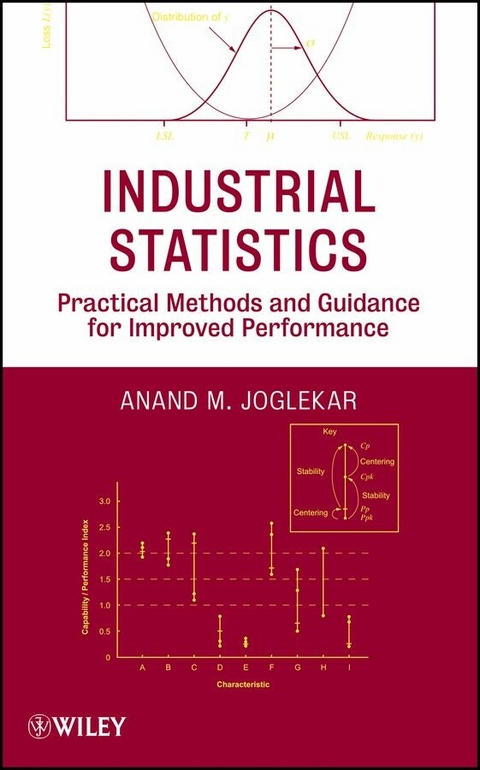
Industrial Statistics (eBook)
288 Seiten
John Wiley & Sons (Verlag)
9780470584125 (ISBN)
INDUSTRIAL PERFORMANCE
Industrial Statistics guides you through ten practical
statistical methods that have broad applications in many different
industries for enhancing research, product design, process design,
validation, manufacturing, and continuous improvement. As you
progress through the book, you'll discover some valuable methods
that are currently underutilized in industry as well as other
methods that are often not used correctly.
With twenty-five years of teaching and consulting experience,
author Anand Joglekar has helped a diverse group of companies
reduce costs, accelerate product development, and improve
operations through the effective implementation of statistical
methods. Based on his experience working with both clients and
students, Dr. Joglekar focuses on real-world problem-solving. For
each statistical method, the book:
* Presents the most important underlying concepts clearly and
succinctly
* Minimizes mathematical details that can be delegated to a
computer
* Illustrates applications with numerous practical examples
* Offers a "Questions to Ask" section at the end of each chapter
to assist you with implementation
The last chapter consists of 100 practical questions followed by
their answers. If you're already familiar with statistical methods,
you may want to take the test first to determine which methods to
focus on.
By helping readers fully leverage statistical methods to improve
industrial performance, this book becomes an ideal reference and
self-study guide for scientists, engineers, managers and other
technical professionals across a wide range of industries. In
addition, its clear explanations and examples make it highly suited
as a textbook for undergraduate and graduate courses in
statistics.
ANAND M. JOGLEKAR, PhD, is a leading statistics educator and consultant. In 1990, Dr. Joglekar founded Joglekar Associates, a firm dedicated to helping industrial organizations reach their goals through the effective implementation of statistical methods. He has taught statistical methods to thousands of industry participants through in-house seminars and seminars sponsored by associations such as the LifeScience Alley®, Institute of Food Technologists, and American Association of Cereal Chemists. Among his many publications, Dr. Joglekar is the author of Statistical Methods for Six Sigma in R&D and Manufacturing (also from Wiley).
PREFACE.
1. BASIC STATISTICS: HOW TO REDUCE FINANCIAL RISK?
1.1. Capital Market Returns.
1.2. Sample Statistics.
1.3. Population Parameters.
1.4. Confidence Intervals and Sample Sizes.
1.5. Correlation.
1.6. Portfolio Optimization.
1.7. Questions to Ask.
2. WHY NOT TO DO THE USUAL t-TEST AND WHAT TO REPLACE IT
WITH?
2.1. What is a t-Test and what is Wrong with It?
2.2. Confidence Interval is Better Than a t-Test.
2.3. How Much Data to Collect?
2.4. Reducing Sample Size.
2.5. Paired Comparison.
2.6. Comparing Two Standard Deviations.
2.7. Recommended Design and Analysis Procedure.
2.8. Questions to Ask.
3. DESIGN OF EXPERIMENTS: IS IT NOT GOING TO COST TOO MUCH
AND TAKE TOO LONG?
3.1. Why Design Experiments?
3.2. Factorial Designs.
3.3. Success Factors.
3.4. Fractional Factorial Designs.
3.5. Plackett-Burman Designs.
3.6. Applications.
3.7. Optimization Designs.
3.8. Questions to Ask.
4. WHAT IS THE KEY TO DESIGNING ROBUST PRODUCTS AND
PROCESSES?
4.1. The Key to Robustness.
4.2. Robust Design Method.
4.3. Signal-to-Noise Ratios.
4.4. Achieving Additivity.
4.5. Alternate Analysis Procedure.
4.6. Implications for R&D.
4.7. Questions to Ask.
5. SETTING SPECIFICATIONS: ARBITRARY OR IS THERE A METHOD TO
IT?
5.1. Understanding Specifications.
5.2. Empirical Approach.
5.3. Functional Approach.
5.4. Minimum Life Cycle Cost Approach.
5.5. Questions to Ask.
6. HOW TO DESIGN PRACTICAL ACCEPTANCE SAMPLING PLANS AND
PROCESS VALIDATION STUDIES?
6.1. Single-Sample Attribute Plans.
6.2. Selecting AQL and RQL.
6.3. Other Acceptance Sampling Plans.
6.4. Designing Validation Studies.
6.5. Questions to Ask.
7. MANAGING AND IMPROVING PROCESSES: HOW TO USE AN
AT-A-GLANCE-DISPLAY?
7.1. Statistical Logic of Control Limits.
7.2. Selecting Subgroup Size.
7.3. Selecting Sampling Interval.
7.4. Out-of-Control Rules.
7.5. Process Capability and Performance Indices.
7.6. At-A-Glance-Display.
7.7. Questions to Ask.
8. HOW TO FIND CAUSES OF VARIATION BY JUST LOOKING
SYSTEMATICALLY?
8.1. Manufacturing Application.
8.2. Variance Components Analysis.
8.3. Planning for Quality Improvement.
8.4. Structured Studies.
8.5. Questions to Ask.
9. IS MY MEASUREMENT SYSTEM ACCEPTABLE AND HOW TO DESIGN,
VALIDATE, AND IMPROVE IT?
9.1. Acceptance Criteria.
9.2. Designing Cost-Effective Sampling Schemes.
9.3. Designing a Robust Measurement System.
9.4. Measurement System Validation.
9.5. Repeatability and Reproducibility (R&R) Study.
9.6. Questions to Ask.
10. HOW TO USE THEORY EFFECTIVELY?
10.1. Empirical Models.
10.2. Mechanistic Models.
10.3. Mechanistic Model for Coat Weight CV.
10.4. Questions to Ask.
11. QUESTIONS AND ANSWERS.
11.1. Questions.
11.2. Answers.
APPENDIX: TABLES.
REFERENCES.
INDEX.
"This is one of the few statistic books that is "user friendly" and
enjoyable to read. That is because each chapter is clearly and
concisely written. But what really makes this book more valuable
than others of this type are the very practical applications and
the memorable "stories". These are human-interest stories that
illustrate how time and money is saved when statistics is used
properly and how large sums can be wasted when used improperly,
such as the t-test example that is provided.... This book could
save an industrial department considerable time and money. It would
help readers design experiments more effectively and efficiently,
solve problems and make difficult decisions based on limited data.
Those with a very limited budget can learn how to design their
experiments to maximize the information and correlations. The
actual problems that it will help readers solve are limitless, but
include finding the best formulation; conducting a proper design of
experiments, so that resources are efficiently used; using data to
solve a problem to determine why a product is suddenly out of
specification; what are the best process conditions to optimize
yield without sacrificing quality, etc. The book ends with useful
questions and answers that assist in testing the reader's knowledge
and finding which parts of the book require his or her
focus."
--Lothar W. Kleiner, Ph.D.
| Erscheint lt. Verlag | 5.5.2010 |
|---|---|
| Sprache | englisch |
| Themenwelt | Naturwissenschaften ► Chemie |
| Technik ► Maschinenbau | |
| Schlagworte | Chemie • Chemistry • Industrial Engineering • Industrial Engineering / Quality Control • Industrie • Industrielle Verfahrenstechnik • Qualität, Produktivität u. Zuverlässigkeit • Qualitätssicherung • Qualitätssicherung i. d. Industriellen Verfahrenstechnik • Qualitätssicherung in der Chemie • Qualität, Produktivität u. Zuverlässigkeit • Qualitätssicherung • Qualitätssicherung i. d. Industriellen Verfahrenstechnik • Qualitätssicherung in der Chemie • Quality assurance • Quality, Productivity & Reliability • Statistics • Statistik |
| ISBN-13 | 9780470584125 / 9780470584125 |
| Informationen gemäß Produktsicherheitsverordnung (GPSR) | |
| Haben Sie eine Frage zum Produkt? |
 PDF (Adobe DRM)
Kopierschutz: Adobe-DRM
Adobe-DRM ist ein Kopierschutz, der das eBook vor Mißbrauch schützen soll. Dabei wird das eBook bereits beim Download auf Ihre persönliche Adobe-ID autorisiert. Lesen können Sie das eBook dann nur auf den Geräten, welche ebenfalls auf Ihre Adobe-ID registriert sind.
Details zum Adobe-DRM
Dateiformat: PDF (Portable Document Format)
Mit einem festen Seitenlayout eignet sich die PDF besonders für Fachbücher mit Spalten, Tabellen und Abbildungen. Eine PDF kann auf fast allen Geräten angezeigt werden, ist aber für kleine Displays (Smartphone, eReader) nur eingeschränkt geeignet.
Systemvoraussetzungen:
PC/Mac: Mit einem PC oder Mac können Sie dieses eBook lesen. Sie benötigen eine
eReader: Dieses eBook kann mit (fast) allen eBook-Readern gelesen werden. Mit dem amazon-Kindle ist es aber nicht kompatibel.
Smartphone/Tablet: Egal ob Apple oder Android, dieses eBook können Sie lesen. Sie benötigen eine
Geräteliste und zusätzliche Hinweise
Buying eBooks from abroad
For tax law reasons we can sell eBooks just within Germany and Switzerland. Regrettably we cannot fulfill eBook-orders from other countries.
aus dem Bereich