Complex Surveys (eBook)
296 Seiten
John Wiley & Sons (Verlag)
9780470580059 (ISBN)
R
As survey analysis continues to serve as a core component of
sociological research, researchers are increasingly relying upon
data gathered from complex surveys to carry out traditional
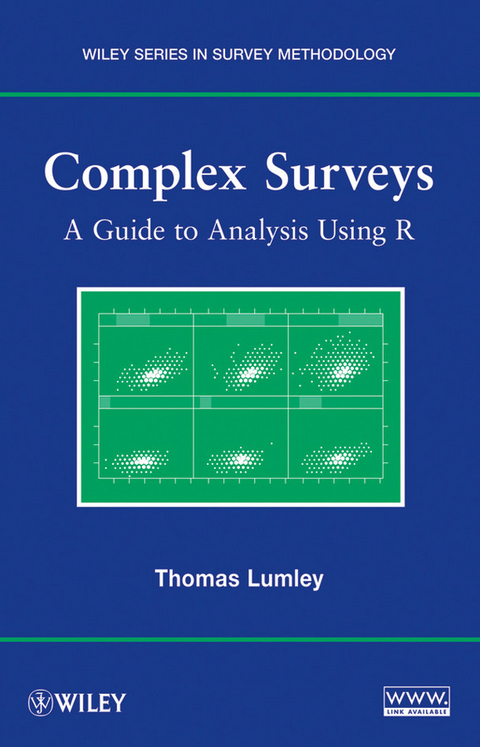
analyses. Complex Surveys is a practical guide to the
analysis of this kind of data using R, the freely available and
downloadable statistical programming language. As creator of the
specific survey package for R, the author provides the ultimate
presentation of how to successfully use the software for analyzing
data from complex surveys while also utilizing the most current
data from health and social sciences studies to demonstrate the
application of survey research methods in these fields.
The book begins with coverage of basic tools and topics within
survey analysis such as simple and stratified sampling, cluster
sampling, linear regression, and categorical data regression.
Subsequent chapters delve into more technical aspects of complex
survey analysis, including post-stratification, two-phase sampling,
missing data, and causal inference. Throughout the book, an
emphasis is placed on graphics, regression modeling, and two-phase
designs. In addition, the author supplies a unique discussion of
epidemiological two-phase designs as well as probability-weighting
for causal inference. All of the book's examples and figures are
generated using R, and a related Web site provides the R code that
allows readers to reproduce the presented content. Each chapter
concludes with exercises that vary in level of complexity, and
detailed appendices outline additional mathematical and
computational descriptions to assist readers with comparing results
from various software systems.
Complex Surveys is an excellent book for courses on
sampling and complex surveys at the upper-undergraduate and
graduate levels. It is also a practical reference guide for applied
statisticians and practitioners in the social and health sciences
who use statistics in their everyday work.
THOMAS LUMLEY, PHD, is Associate Professor of Biostatistics at the University of Washington. He has published numerous journal articles in his areas of research interest, which include regression modeling, clinical trials, statistical computing, and survey research. Dr. Lumley created the survey package that currently accompanies the R software package, and he is also coauthor of Biostatistics: A Methodology for the Health Sciences, Second Edition, published by Wiley.
Acknowledgments.
Preface.
Acronyms.
1 Basic Tools.
1.1 Goals of inference.
1.2 An introduction to the data.
1.3 Obtaining the software.
1.4 Using R.
Exercises.
2 Simple and Stratified sampling.
2.1 Analysing simple random samples.
2.2 Stratified sampling.
2.3 Replicate weights.
2.4 Other population summaries.
2.5 Estimates in subpopulations.
2.6 Design of stratified samples.
Exercises.
3 Cluster sampling.
3.1 Introduction.
3.2 Describing multistage designs to R.
3.3 Sampling by size.
3.4 Repeated measurements.
Exercises.
4 Graphics.
4.1 Why is survey data different?
4.2 Plotting a table.
4.3 One continuous variable.
4.4 Two continuous variables.
4.5 Conditioning plots.
4.6 Maps.
Exercises.
5 Ratios and linear regression.
5.1 Ratio estimation.
5.2 Linear regression.
5.3 Is weighting needed in regression models?
6 Categorical data regression 109.
6.1 Logistic regression 110.
6.2 Ordinal regression 117.
6.3 Loglinear models 123.
7 Poststratification, raking and calibration.
7.1 Introduction.
7.2 Poststratification.
7.3 Raking.
7.4 Generalized raking, GREG estimation, and calibration.
7.5 Basu's elephants.
7.6 Selecting auxiliary variables for nonresponse.
Exercises.
8 Twophase sampling.
8.1 Multistage and multiphase sampling.
8.2 Sampling for stratification.
8.3 The case-control design.
8.4 Sampling from existing cohorts.
8.5 Using auxiliary information from phase one.
Exercises.
9 Missing data.
9.1 Item nonresponse.
9.2 Twophase estimation for missing data.
9.3 Imputation of missing data.
Exercises.
10 Causal inference.
10.1 IPTW estimators.
10.2 Marginal Structural Models.
Appendix A: Analytic details.
A.1 Asymptotics.
A.2 Variances by linearization.
A.3 Tests in contingency tables.
A.4 Multiple imputation.
A.5 Calibration and influence functions.
A.6 Calibration in randomized trials and ANCOVA.
Appendix B: Basic R.
B.1 Reading data.
B.2 Data manipulation.
B.3 Randomness.
B.4 Methods and objects.
B.5 Writing functions.
Appendix C: Computational details.
C.1 Linearization.
C.2 Replicate weights.
C.3 Scatterplot smoothers.
C.4 Quantiles.
C.5 Bug reports and feature requests.
Appendix D: Databasebacked design objects.
D.1 Large data.
D.2 Setting up database interfaces.
Appendix E: Extending the survey package.
E.1 A case study: negative binomial regression.
E.2 Using a Poisson model.
E.3 Replicate weights.
E.4 Linearization.
References.
Author Index.
Topic Index.
| Erscheint lt. Verlag | 20.9.2011 |
|---|---|
| Reihe/Serie | Wiley Series in Survey Methodology | Wiley Series in Survey Methodology |
| Sprache | englisch |
| Themenwelt | Mathematik / Informatik ► Mathematik ► Analysis |
| Mathematik / Informatik ► Mathematik ► Statistik | |
| Mathematik / Informatik ► Mathematik ► Wahrscheinlichkeit / Kombinatorik | |
| Technik | |
| Schlagworte | Datenerhebung • Methoden der Daten- u. Stichprobenerhebung • Statistics • Statistik • Survey Research Methods & Sampling |
| ISBN-13 | 9780470580059 / 9780470580059 |
| Informationen gemäß Produktsicherheitsverordnung (GPSR) | |
| Haben Sie eine Frage zum Produkt? |
 EPUB (Adobe DRM)
Größe: 17,3 MB
Kopierschutz: Adobe-DRM
Adobe-DRM ist ein Kopierschutz, der das eBook vor Mißbrauch schützen soll. Dabei wird das eBook bereits beim Download auf Ihre persönliche Adobe-ID autorisiert. Lesen können Sie das eBook dann nur auf den Geräten, welche ebenfalls auf Ihre Adobe-ID registriert sind.
Details zum Adobe-DRM
Dateiformat: EPUB (Electronic Publication)
EPUB ist ein offener Standard für eBooks und eignet sich besonders zur Darstellung von Belletristik und Sachbüchern. Der Fließtext wird dynamisch an die Display- und Schriftgröße angepasst. Auch für mobile Lesegeräte ist EPUB daher gut geeignet.
Systemvoraussetzungen:
PC/Mac: Mit einem PC oder Mac können Sie dieses eBook lesen. Sie benötigen eine
eReader: Dieses eBook kann mit (fast) allen eBook-Readern gelesen werden. Mit dem amazon-Kindle ist es aber nicht kompatibel.
Smartphone/Tablet: Egal ob Apple oder Android, dieses eBook können Sie lesen. Sie benötigen eine
Geräteliste und zusätzliche Hinweise
Buying eBooks from abroad
For tax law reasons we can sell eBooks just within Germany and Switzerland. Regrettably we cannot fulfill eBook-orders from other countries.
 PDF (Adobe DRM)
Kopierschutz: Adobe-DRM
Adobe-DRM ist ein Kopierschutz, der das eBook vor Mißbrauch schützen soll. Dabei wird das eBook bereits beim Download auf Ihre persönliche Adobe-ID autorisiert. Lesen können Sie das eBook dann nur auf den Geräten, welche ebenfalls auf Ihre Adobe-ID registriert sind.
Details zum Adobe-DRM
Dateiformat: PDF (Portable Document Format)
Mit einem festen Seitenlayout eignet sich die PDF besonders für Fachbücher mit Spalten, Tabellen und Abbildungen. Eine PDF kann auf fast allen Geräten angezeigt werden, ist aber für kleine Displays (Smartphone, eReader) nur eingeschränkt geeignet.
Systemvoraussetzungen:
PC/Mac: Mit einem PC oder Mac können Sie dieses eBook lesen. Sie benötigen eine
eReader: Dieses eBook kann mit (fast) allen eBook-Readern gelesen werden. Mit dem amazon-Kindle ist es aber nicht kompatibel.
Smartphone/Tablet: Egal ob Apple oder Android, dieses eBook können Sie lesen. Sie benötigen eine
Geräteliste und zusätzliche Hinweise
Buying eBooks from abroad
For tax law reasons we can sell eBooks just within Germany and Switzerland. Regrettably we cannot fulfill eBook-orders from other countries.
aus dem Bereich