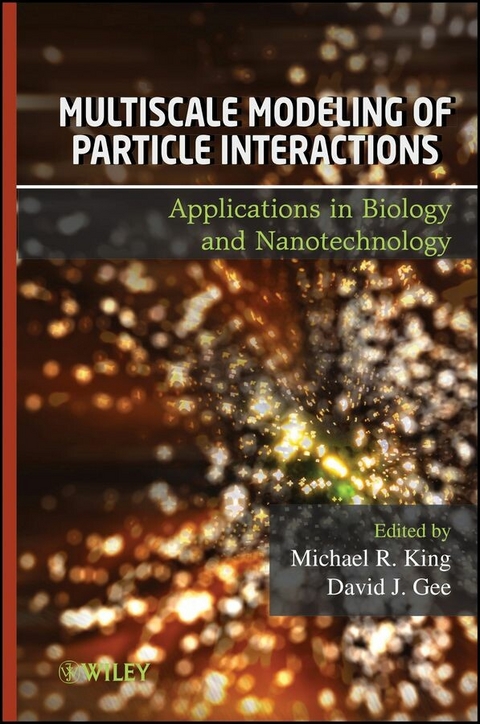
Multiscale Modeling of Particle Interactions (eBook)
John Wiley & Sons (Verlag)
978-0-470-57982-4 (ISBN)
With this book as their guide, readers will gain a new appreciation of the critical role that particle interactions play in advancing research and developing new applications in the biological sciences, chemical engineering, toxicology, medicine, and manufacturing technology The book explores particles ranging in size from cations to whole cells to tissues and processed materials. A focus on recreating complex, real-world dynamical systems helps readers gain a deeper understanding of cell and tissue mechanics, theoretical aspects of multiscale modeling, and the latest applications in biology and nanotechnology.
Following an introductory chapter, Multiscale Modeling of Particle Interactions is divided into two parts:
Part I, Applications in Nanotechnology, covers:
Multiscale modeling of nanoscale aggregation phenomena: applications in semiconductor materials processing
Multiscale modeling of rare events in self-assembled systems
Continuum description of atomic sheets
Coulombic dragging and mechanical propelling of molecules in nanofluidic systems
Molecular dynamics modeling of nanodroplets and nanoparticles
Modeling the interactions between compliant microcapsules and patterned surfaces
Part II, Applications in Biology, covers:
Coarse-grained and multiscale simulations of lipid bilayers
Stochastic approach to biochemical kinetics
In silico modeling of angiogenesis at multiple scales
Large-scale simulation of blood flow in microvessels
Molecular to multicellular deformation during adhesion of immune cells under flow
Each article was contributed by one or more leading experts and pioneers in the field. All readers, from chemists and biologists to engineers and students, will gain new insights into how the latest tools in computational science can improve our understanding of particle interactions and support the development of novel applications across the broad spectrum of disciplines in biology and nanotechnology.
MICHAEL R. KING, PhD, is an Associate Professor of Biomedical Engineering at Cornell University. King is an expert on the receptor-mediated adhesion of circulating cells, and has developed new computational and in vitro models to study the function of leukocytes, platelets, and stem, stem and cancer cells under flow. He is a former Whitaker investigator, a James D. Watson Investigator of New York State, and an NSF CAREER Award recipient. King received the 2008 ICNMM Outstanding Researcher Award from the American Society of Mechanical Engineers, was the 2007-2008 Professor of the Year in Engineering at the University of Rochester, and received the 2009 Outstanding Contribution for a Publication in the international journal Clinical Chemistry.
DAVID J. GEE, PhD, is an Assistant Professor of Mechanical Engineering at the Rochester Institute of Technology, where he studies the inflammatory response and investigates applications in receptor-mediated adhesion. Previously, Dr. Gee was a research assistant professor and postdoctoral fellow in the Department of Biomedical Engineering at the University of Rochester, where he studied inflammation, and has also served as a research engineer at the Institute for Advanced Technology at The University of Texas at Austin, where he specialized in impact mechanics and computational solid mechanics.
Discover how the latest computational tools are building our understanding of particle interactions and leading to new applications With this book as their guide, readers will gain a new appreciation of the critical role that particle interactions play in advancing research and developing new applications in the biological sciences, chemical engineering, toxicology, medicine, and manufacturing technology The book explores particles ranging in size from cations to whole cells to tissues and processed materials. A focus on recreating complex, real-world dynamical systems helps readers gain a deeper understanding of cell and tissue mechanics, theoretical aspects of multiscale modeling, and the latest applications in biology and nanotechnology. Following an introductory chapter, Multiscale Modeling of Particle Interactions is divided into two parts: Part I, Applications in Nanotechnology, covers: Multiscale modeling of nanoscale aggregation phenomena: applications in semiconductor materials processing Multiscale modeling of rare events in self-assembled systems Continuum description of atomic sheets Coulombic dragging and mechanical propelling of molecules in nanofluidic systems Molecular dynamics modeling of nanodroplets and nanoparticles Modeling the interactions between compliant microcapsules and patterned surfaces Part II, Applications in Biology, covers: Coarse-grained and multiscale simulations of lipid bilayers Stochastic approach to biochemical kinetics In silico modeling of angiogenesis at multiple scales Large-scale simulation of blood flow in microvessels Molecular to multicellular deformation during adhesion of immune cells under flow Each article was contributed by one or more leading experts and pioneers in the field. All readers, from chemists and biologists to engineers and students, will gain new insights into how the latest tools in computational science can improve our understanding of particle interactions and support the development of novel applications across the broad spectrum of disciplines in biology and nanotechnology.
MICHAEL R. KING, PhD, is an Associate Professor of Biomedical Engineering at Cornell University. King is an expert on the receptor-mediated adhesion of circulating cells, and has developed new computational and in vitro models to study the function of leukocytes, platelets, and stem, stem and cancer cells under flow. He is a former Whitaker investigator, a James D. Watson Investigator of New York State, and an NSF CAREER Award recipient. King received the 2008 ICNMM Outstanding Researcher Award from the American Society of Mechanical Engineers, was the 2007-2008 Professor of the Year in Engineering at the University of Rochester, and received the 2009 Outstanding Contribution for a Publication in the international journal Clinical Chemistry. DAVID J. GEE, PhD, is an Assistant Professor of Mechanical Engineering at the Rochester Institute of Technology, where he studies the inflammatory response and investigates applications in receptor-mediated adhesion. Previously, Dr. Gee was a research assistant professor and postdoctoral fellow in the Department of Biomedical Engineering at the University of Rochester, where he studied inflammation, and has also served as a research engineer at the Institute for Advanced Technology at The University of Texas at Austin, where he specialized in impact mechanics and computational solid mechanics.
CONTRIBUTORS.
1 Introduction (Michael R. King and David J. Gee).
PART I: APPLICATIONS IN NANOTECHNOLOGY.
2 Multiscale Modeling of Nanoscale Aggregation Phenomena:
Applications in Semiconductor Materials Processing (Talid
Sinno).
3 Multiscale Modeling of Rare Events in Self-Assembled Systems
(Dmitry I. Kopelevich).
4 Continuum Description of Atomic Sheets (Constantine
Pozrikidis).
5 Coulombic Dragging and Mechanical Propelling of Molecules in
Nanofluidic Systems (Petr Král and Boyang Wang).
6 Molecular Dynamics Modeling of Nanodroplets and Nanoparticles
(D. Lussier, N.M.P. Kakalis, and Y. T. Ventikos).
7 Modeling the Interactions Between Compliant Microcapsules and
Patterned Surfaces (Anna C. Balazs and Alexander
Alexeev).
PART II: APPLICATIONS IN BIOLOGY.
8 Coarse-Grained and Multiscale Simulations of Lipid Bilayers
(Harry A. Stern).
9 Stochastic Approach to Biochemical Kinetics (Ian J.
Laurenzi).
10 In Silico Modeling of Angiogenesis at Multiple Scales: From
Nanoscale to Organ System (Amina A. Qutub, Feilim Mac Gabhann,
Emmanouil D. Karagiannis, and Aleksander S. Popel).
11 Large-Scale Simulation of Blood Flow in Microvessels
(Prosenjit Bagchi).
12 Molecular to Multicellular Deformation During Adhesion of
Immune Cells Under Flow (David J. Gee and Michael R.
King).
INDEX.
| Erscheint lt. Verlag | 30.3.2010 |
|---|---|
| Sprache | englisch |
| Themenwelt | Naturwissenschaften ► Chemie ► Technische Chemie |
| Technik ► Umwelttechnik / Biotechnologie | |
| Schlagworte | Advancing • Applications • Appreciation • biomedical engineering • Biomedical Engineering Special Topics • Biomedizinische Technik • Biomedizintechnik • Book • Cations • Cells • chemical engineering • Chemie • Chemische Verfahrenstechnik • Chemistry • Computational • Computational Chemistry • Computational Chemistry & Molecular Modeling • Computational Chemistry u. Molecular Modeling • Critical • Discover • Explores • Interactions • Latest • Manufacturing • New • particle • particles • Readers • recreating • Research • Role • Size • Spezialthemen Biomedizintechnik • Tools • whole |
| ISBN-10 | 0-470-57982-X / 047057982X |
| ISBN-13 | 978-0-470-57982-4 / 9780470579824 |
| Informationen gemäß Produktsicherheitsverordnung (GPSR) | |
| Haben Sie eine Frage zum Produkt? |
 PDF (Adobe DRM)
Kopierschutz: Adobe-DRM
Adobe-DRM ist ein Kopierschutz, der das eBook vor Mißbrauch schützen soll. Dabei wird das eBook bereits beim Download auf Ihre persönliche Adobe-ID autorisiert. Lesen können Sie das eBook dann nur auf den Geräten, welche ebenfalls auf Ihre Adobe-ID registriert sind.
Details zum Adobe-DRM
Dateiformat: PDF (Portable Document Format)
Mit einem festen Seitenlayout eignet sich die PDF besonders für Fachbücher mit Spalten, Tabellen und Abbildungen. Eine PDF kann auf fast allen Geräten angezeigt werden, ist aber für kleine Displays (Smartphone, eReader) nur eingeschränkt geeignet.
Systemvoraussetzungen:
PC/Mac: Mit einem PC oder Mac können Sie dieses eBook lesen. Sie benötigen eine
eReader: Dieses eBook kann mit (fast) allen eBook-Readern gelesen werden. Mit dem amazon-Kindle ist es aber nicht kompatibel.
Smartphone/Tablet: Egal ob Apple oder Android, dieses eBook können Sie lesen. Sie benötigen eine
Geräteliste und zusätzliche Hinweise
Buying eBooks from abroad
For tax law reasons we can sell eBooks just within Germany and Switzerland. Regrettably we cannot fulfill eBook-orders from other countries.
aus dem Bereich