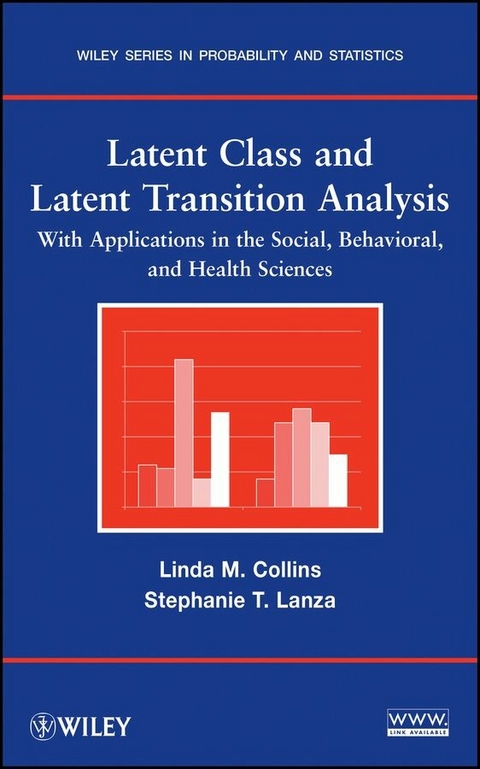
Latent Class and Latent Transition Analysis (eBook)
John Wiley & Sons (Verlag)
978-0-470-56732-6 (ISBN)

On a daily basis, researchers in the social, behavioral, and health sciences collect information and fit statistical models to the gathered empirical data with the goal of making significant advances in these fields. In many cases, it can be useful to identify latent, or unobserved, subgroups in a population, where individuals' subgroup membership is inferred from their responses on a set of observed variables. Latent Class and Latent Transition Analysis provides a comprehensive and unified introduction to this topic through one-of-a-kind, step-by-step presentations and coverage of theoretical, technical, and practical issues in categorical latent variable modeling for both cross-sectional and longitudinal data.
The book begins with an introduction to latent class and latent transition analysis for categorical data. Subsequent chapters delve into more in-depth material, featuring:
-
A complete treatment of longitudinal latent class models
-
Focused coverage of the conceptual underpinnings of interpretation and evaluationof a latent class solution
-
Use of parameter restrictions and detection of identification problems
-
Advanced topics such as multi-group analysis and the modeling and interpretation of interactions between covariates
The authors present the topic in a style that is accessible yet rigorous. Each method is presented with both a theoretical background and the practical information that is useful for any data analyst. Empirical examples showcase the real-world applications of the discussed concepts and models, and each chapter concludes with a 'Points to Remember' section that contains a brief summary of key ideas. All of the analyses in the book are performed using Proc LCA and Proc LTA, the authors' own software packages that can be run within the SAS® environment. A related Web site houses information on these freely available programs and the book's data sets, encouraging readers to reproduce the analyses and also try their own variations.
Latent Class and Latent Transition Analysis is an excellent book for courses on categorical data analysis and latent variable models at the upper-undergraduate and graduate levels. It is also a valuable resource for researchers and practitioners in the social, behavioral, and health sciences who conduct latent class and latent transition analysis in their everyday work.
Linda M. Collins, PhD, is Director of The Methodology Center and Professor of Human Development and Family Studies at The Pennsylvania State University. A Fellow of the American Psychological Association and the Association for Psychological Science, Dr. Collins has published numerous journal articles in her areas of research interest, which include experimental and non-experimental design and models for longitudinal data.
STEPHANIE T. LANZA, PhD, is Scientific Director and Senior Research Associate at The Methodology Center at The Pennsylvania State University. She currently focuses her research on latent class and latent transition analysis and their applications in the social, behavioral, and health sciences.
A modern, comprehensive treatment of latent class and latent transition analysis for categorical data On a daily basis, researchers in the social, behavioral, and health sciences collect information and fit statistical models to the gathered empirical data with the goal of making significant advances in these fields. In many cases, it can be useful to identify latent, or unobserved, subgroups in a population, where individuals' subgroup membership is inferred from their responses on a set of observed variables. Latent Class and Latent Transition Analysis provides a comprehensive and unified introduction to this topic through one-of-a-kind, step-by-step presentations and coverage of theoretical, technical, and practical issues in categorical latent variable modeling for both cross-sectional and longitudinal data. The book begins with an introduction to latent class and latent transition analysis for categorical data. Subsequent chapters delve into more in-depth material, featuring: A complete treatment of longitudinal latent class models Focused coverage of the conceptual underpinnings of interpretation and evaluationof a latent class solution Use of parameter restrictions and detection of identification problems Advanced topics such as multi-group analysis and the modeling and interpretation of interactions between covariates The authors present the topic in a style that is accessible yet rigorous. Each method is presented with both a theoretical background and the practical information that is useful for any data analyst. Empirical examples showcase the real-world applications of the discussed concepts and models, and each chapter concludes with a "e;Points to Remember"e; section that contains a brief summary of key ideas. All of the analyses in the book are performed using Proc LCA and Proc LTA, the authors' own software packages that can be run within the SAS environment. A related Web site houses information on these freely available programs and the book's data sets, encouraging readers to reproduce the analyses and also try their own variations. Latent Class and Latent Transition Analysis is an excellent book for courses on categorical data analysis and latent variable models at the upper-undergraduate and graduate levels. It is also a valuable resource for researchers and practitioners in the social, behavioral, and health sciences who conduct latent class and latent transition analysis in their everyday work.
Linda M. Collins, PhD, is Director of The Methodology Center and Professor of Human Development and Family Studies at The Pennsylvania State University. A Fellow of the American Psychological Association and the Association for Psychological Science, Dr. Collins has published numerous journal articles in her areas of research interest, which include experimental and non-experimental design and models for longitudinal data. STEPHANIE T. LANZA, PhD, is Scientific Director and Senior Research Associate at The Methodology Center at The Pennsylvania State University. She currently focuses her research on latent class and latent transition analysis and their applications in the social, behavioral, and health sciences.
| Erscheint lt. Verlag | 5.1.2010 |
|---|---|
| Reihe/Serie | Wiley Series in Probability and Statistics |
| Wiley Series in Probability and Statistics | Wiley Series in Probability and Statistics |
| Zusatzinfo | Charts: 19 B&W, 0 Color; Drawings: 3 B&W, 0 Color; Tables: 0 B&W, 0 Color; Graphs: 23 B&W, 0 Color |
| Sprache | englisch |
| Themenwelt | Mathematik / Informatik ► Mathematik ► Statistik |
| Mathematik / Informatik ► Mathematik ► Wahrscheinlichkeit / Kombinatorik | |
| Technik | |
| Schlagworte | Angewandte Wahrscheinlichkeitsrechnung u. Statistik • Angew. Wahrscheinlichkeitsrechn. u. Statistik / Modelle • Applied Probability & Statistics • Applied Probability & Statistics - Models • latent class analysis, latent transition analysis, LCA, LTA, latent class models, longitudinal data, longitudinal models, cross-sectional data, statistical computing, categorical data, multivariate categorical data • Spezialthemen Statistik • Statistics • Statistics Special Topics • Statistik • Statistische Analyse |
| ISBN-10 | 0-470-56732-5 / 0470567325 |
| ISBN-13 | 978-0-470-56732-6 / 9780470567326 |
| Informationen gemäß Produktsicherheitsverordnung (GPSR) | |
| Haben Sie eine Frage zum Produkt? |
 PDF (Adobe DRM)
Kopierschutz: Adobe-DRM
Adobe-DRM ist ein Kopierschutz, der das eBook vor Mißbrauch schützen soll. Dabei wird das eBook bereits beim Download auf Ihre persönliche Adobe-ID autorisiert. Lesen können Sie das eBook dann nur auf den Geräten, welche ebenfalls auf Ihre Adobe-ID registriert sind.
Details zum Adobe-DRM
Dateiformat: PDF (Portable Document Format)
Mit einem festen Seitenlayout eignet sich die PDF besonders für Fachbücher mit Spalten, Tabellen und Abbildungen. Eine PDF kann auf fast allen Geräten angezeigt werden, ist aber für kleine Displays (Smartphone, eReader) nur eingeschränkt geeignet.
Systemvoraussetzungen:
PC/Mac: Mit einem PC oder Mac können Sie dieses eBook lesen. Sie benötigen eine
eReader: Dieses eBook kann mit (fast) allen eBook-Readern gelesen werden. Mit dem amazon-Kindle ist es aber nicht kompatibel.
Smartphone/Tablet: Egal ob Apple oder Android, dieses eBook können Sie lesen. Sie benötigen eine
Geräteliste und zusätzliche Hinweise
Buying eBooks from abroad
For tax law reasons we can sell eBooks just within Germany and Switzerland. Regrettably we cannot fulfill eBook-orders from other countries.
aus dem Bereich