Thermal Analysis of Polymers (eBook)
704 Seiten
John Wiley & Sons (Verlag)
978-0-470-42377-6 (ISBN)
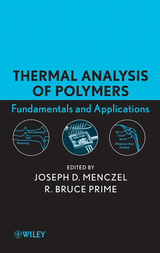
instrumentation, calibration, and application along with the
necessary theoretical background.
* Useful to chemists, physicists, materials scientists, and
engineers who are new to thermal analysis techniques, and to
existing users of thermal analysis who wish expand their experience
to new techniques and applications
* Topics covered include Differential Scanning Calorimetry and
Differential Thermal Analysis (DSC/DTA), Thermogravimetry,
Thermomechanical Analysis and Dilatometry, Dynamic Mechanical
Analysis, Micro-Thermal Analysis, Hot Stage Microscopy, and
Instrumentation.
* Written by experts in the various areas of thermal
analysis
* Relevant and detailed experiments and examples follow each
chapter.
Joseph D. Menczel, PhD, a recognized expert in thermal analysis of polymers with some thirty years of industrial and academic experience, is Assistant Technical Director at Alcon Laboratories. He has researched more than 120 polymeric systems in which he studied calibration of DSCs, glass transition, nucleation, crystallization, melting, stability, mechanical and micro-mechanical properties of polymers, and polymer-water interactions. Dr. Menczel holds six patents and is the author of seventy scholarly papers. He is the author of two chapters in the bookThermal Characterization of Polymeric Materials. In conducting DSC experiments, Dr. Menczel found a crystal/amorphous interface in semicrystalline polymers, which later became known as the rigid amorphous phase. He is also credited with developing the temperature calibration of DSCs for cooling experiments. R. Bruce Prime, PhD, is a consultant to industry and government and a recognized authority on the cure and properties of cross-linked polymer systems. During his thirty-year career with IBM, he led teams responsible for developing and implementing polymer applications for printer and information storage technologies. He holds four patents and is the author of more than fifty technical papers and the chapter on thermosets in Thermal Characterization of Polymeric Materials. Dr. Prime is a Fellow of SPE and NATAS and was the 1989 recipient of the Mettler-Toledo Award in Thermal Analysis. He maintains the Web site www.primethermosets.com.
Chapter I: Introduction (Joseph D. Menczel, R. Bruce Prime andPatrick K. Gallagher).
Chapter II: Differential Scanning Calorimetry (Joseph D.Menczel, Lawrence H. Judovits, R. Bruce Prime, Harvey E. Bair, MikeReading, and Steven Swier).
1. Introduction.
2. Elements of Thermodynamics in DSC.
3. The Basics of Differential Scanning Calorimetry.
4. Purity Determination of Low Molecular Mass Compounds byDSC.
5. Calibration of Differential Scanning Calorimeters.
6. The Measurement of Heat Capacity.
7. Phase Transitions in Amorphous and Crystalline Polymers.
8. DSC of Fibers.
9. Films.
10. Thermosets.
11. Differential Photocalorimetry (DPC).
12. Fast Scan DSC.
13. Modulated Temperature Differential Scanning Calorimetry(MTDSC).
14. How to Perform DSC Measurements .
15. Instrumentation.
References.
Chapter III: Thermogravimetric Analysis (TGA) (R. Bruce Prime,Harvey E. Bair, Sergey Vyazovkin, Patrick K. Gallagher, and AlanRiga).
1. Introduction.
2. Background Principles and Measurement Modes.
3. Calibration and Reference Materials.
4. Measurements and Analyses.
5. Kinetics.
6. Selected Applications.
7. Instrumentation.
Appendix.
References.
Chapter IV: Thermomechanical Analysis (TMA) andThermodilitometry (TD) (Harvey E. Bair, Ali E. Akinay, Joseph D.Menczel, R. Bruce Prime, and Michael Jaffe).
1. Introduction.
2. Principles and Theory.
3. Instrumental.
4. Calibration.
5. How to Perform a TMA Experiment.
6. Key Applications.
7. Selected Industrial Applications.
Appendix.
References.
Chapter V: Dynamic Mechanical Analysis (DMA) (Richard P.Chartoff, Joseph D. Menczel, and Steven H. Dillman).
1. Introduction.
2. Characterization of viscoelastic behavior.
3. Applications of dynamic mechanical analysis.
4. Examples of DMA characterization for thermoplastics.
5. Characteristics of fibers and thin films.
6. DMA characterization of cross-linked polymers.
7. Practical Aspects of Conducting DMA Experiments.
8. Commercial DMA Instrumentation.
Appendix.
References.
Chapter VI: Dielectric Analysis (DEA) (Aglaia Vassilikou-Dovaand Ioannis M. Kalogeras).
1. Introduction.
2. Theory and background of dielectric analysis.
3. Dielectric techniques.
4. Performing dielectric experiments.
5. Typical measurements on poly(methyl methacrylate) (PMMA).
6. Dielectric Analysis of Thermoplastics.
7. Dielectric Analysis of Thermosets.
8. Instrumentation.
Appendix.
References.
Chapter VII: Micro and Nano Scale Local Thermal Analysis(Valeriy V. Gorbunov, David Grandy, Mike Reading, and Vladimir V.Tsukruk).
1. Introduction.
2. The Atomic Force Microscope.
3. Scanning Thermal Microscopy.
4. Thermal Probe Design and Spatial Resolution.
5. Measuring Thermal Conductivity and Thermal Force-DistanceCurves.
6. Local Thermal Analysis.
7. Performing a Micro/Nano Thermal Analysis Experiment.
8. Examples of Micro/Nano Thermal Analysis Applications.
9. Overview of Local Thermal Analysis.
References.
"I have read it with great pleasure and it is my honor to provide
this short review. Let me congratulate the editors on the concept
of this book. They managed to tune the balance between basic
principles and practical information finely . . .In conclusion I
think that this book is very useful for students, PhDs, and
researchers who are dealing or intended to deal with thermal
analysis of polymers." (J Therm Anal Calorim, 2010)
| Erscheint lt. Verlag | 2.4.2009 |
|---|---|
| Sprache | englisch |
| Themenwelt | Naturwissenschaften ► Chemie ► Organische Chemie |
| Naturwissenschaften ► Chemie ► Physikalische Chemie | |
| Technik ► Maschinenbau | |
| Schlagworte | Analytical Chemistry • Analytische Chemie • Chemie • Chemistry • materials characterization • Materials Science • Materialwissenschaften • Polymere • Polymer Science & Technology • Polymerwissenschaft u. -technologie • Werkstoffprüfung • Werkstoffprüfung |
| ISBN-10 | 0-470-42377-3 / 0470423773 |
| ISBN-13 | 978-0-470-42377-6 / 9780470423776 |
| Informationen gemäß Produktsicherheitsverordnung (GPSR) | |
| Haben Sie eine Frage zum Produkt? |
 PDF (Adobe DRM)
Kopierschutz: Adobe-DRM
Adobe-DRM ist ein Kopierschutz, der das eBook vor Mißbrauch schützen soll. Dabei wird das eBook bereits beim Download auf Ihre persönliche Adobe-ID autorisiert. Lesen können Sie das eBook dann nur auf den Geräten, welche ebenfalls auf Ihre Adobe-ID registriert sind.
Details zum Adobe-DRM
Dateiformat: PDF (Portable Document Format)
Mit einem festen Seitenlayout eignet sich die PDF besonders für Fachbücher mit Spalten, Tabellen und Abbildungen. Eine PDF kann auf fast allen Geräten angezeigt werden, ist aber für kleine Displays (Smartphone, eReader) nur eingeschränkt geeignet.
Systemvoraussetzungen:
PC/Mac: Mit einem PC oder Mac können Sie dieses eBook lesen. Sie benötigen eine
eReader: Dieses eBook kann mit (fast) allen eBook-Readern gelesen werden. Mit dem amazon-Kindle ist es aber nicht kompatibel.
Smartphone/Tablet: Egal ob Apple oder Android, dieses eBook können Sie lesen. Sie benötigen eine
Geräteliste und zusätzliche Hinweise
Buying eBooks from abroad
For tax law reasons we can sell eBooks just within Germany and Switzerland. Regrettably we cannot fulfill eBook-orders from other countries.
aus dem Bereich