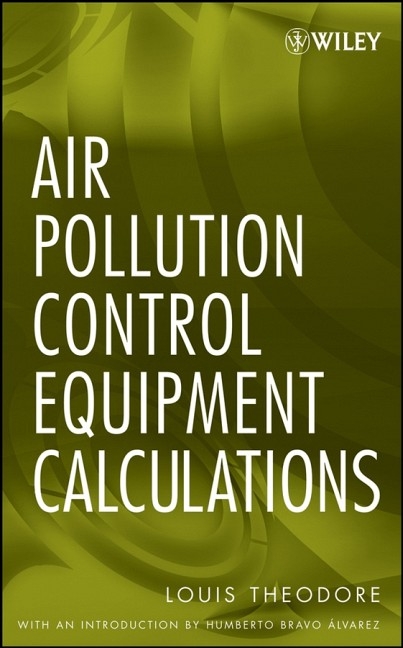
Air Pollution Control Equipment Calculations (eBook)
588 Seiten
John Wiley & Sons (Verlag)
978-0-470-25575-9 (ISBN)
broad range of calculations
This book's problem-and-solution approach enables readers to
quickly grasp the fundamentals of air pollution control equipment
and essential applications. Moreover, the author sets forth solid
principles for the design and selection of air pollution control
equipment as well as for its efficient operation and maintenance.
Readers gain a deep understanding of both the equipment itself and
the many factors affecting performance.
Following two introductory chapters, the book dedicates four
chapters to examining control equipment for gaseous pollutants,
including adsorption, absorption, and incineration equipment. The
remaining six chapters deal with equipment for managing airborne
particulate pollutants, including gravity settlers, cyclones,
electrostatic precipitators, scrubbers, and baghouses. The appendix
contains discussions of hybrid systems, the SI system (including
conversion constants), and a cost-equipment model.
Each chapter offers a short introduction to the control device
discussed. Next, progressively more difficult problems with
accompanying solutions enable readers to build their knowledge as
they advance through the chapter. Problems reflect the most recent
developments in pollution control and include a variety of
performance equations and operation and maintenance calculations.
Each problem includes a statement of the problem, the data used to
solve the problem, and a detailed solution. Readers may further
hone their skills by visiting the text's Web site for additional
problems and solutions.
This publication serves both as a textbook for engineering
students and as a reference for engineers and technicians who need
to ensure that air pollution control equipment operates efficiently
and enables their facility to meet all air pollution control
standards and regulations.
Louis Theodore, PhD, is a Professor in the Chemical Engineering Department at Manhattan College. He is a coauthor of Introduction to Hazardous Waste Incineration, Second Edition and Handbook of Chemical and Environmental Engineering Calculations (both from Wiley). Dr. Theodore has received awards from the International Air and Waste Management Association and the American Society for Engineering Education.
PREFACE xi
INTRODUCTION 1
1 AIR POLLUTION HISTORY 9
2 AIR POLLUTION REGULATORY FRAMEWORK 15
2.1 Introduction 15
2.2 The Regulatory System 16
2.3 Laws and Regulations: The Differences 17
2.4 The Clean Air Act 19
2.5 Provisions Relating to Enforcement 25
2.6 Closing Comments and Recent Developments 26
3 FUNDAMENTALS: GASES 27
3.1 Introduction 27
3.2 Measurement Fundamentals 27
3.3 Chemical and Physical Properties 29
3.4 Ideal Gas Law 37
3.5 Phase Equilibrium 41
3.6 Conservation Laws 42
Problems 44
4 INCINERATORS 69
4.1 Introduction 69
4.2 Design and Performance Equations 79
4.3 Operation and Maintenance, and Improving Performance 84
Problems 86
5 ABSORBERS 127
5.1 Introduction 127
5.2 Design and Performance Equations 131
5.3 Operation and Maintenance, and Improving Performance 142
Problems 143
6 ADSORBERS 185
6.1 Introduction 185
6.2 Design and Performance Equations 194
6.3 Operation and Maintenance, and Improving Performance 201
Problems 202
7 FUNDAMENTALS: PARTICULATES 247
7.1 Introduction 247
7.2 Particle Collection Mechanisms 249
7.3 Fluid-Particle Dynamics 252
7.4 Particle Sizing and Measurement Methods 260
7.5 Particle Size Distribution 262
7.6 Collection Efficiency 267
Problems 271
8 GRAVITY SETTLING CHAMBERS 315
8.1 Introduction 315
8.2 Design and Performance Equations 319
8.3 Operation and Maintenance, and Improving Performance 324
Problems 325
9 CYCLONES 361
9.1 Introduction 361
9.2 Design and Performance Equations 367
9.3 Operation and Maintenance, and Improving Performance 374
Problems 376
10 ELECTROSTATIC PRECIPITATORS 399
10.1 Introduction 399
10.2 Design and Performance Equations 406
10.3 Operation and Maintenance, and Improving Performance 410
Problems 415
11 VENTURI SCRUBBERS 451
11.1 Introduction 451
11.2 Design and Performance Equations 455
11.3 Operation and Maintenance, and Improving Performance 459
Problems 462
12 BAGHOUSES 503
12.1 Introduction 503
12.2 Design and Performance Equations 506
12.3 Operation and Maintenance, and Improving Performance 511
Problems 514
APPENDIX A HYBRID SYSTEMS 549
A.1 Introduction 549
A.2 Wet Electrostatic Precipitators 550
A.3 Ionizing Wet Scrubbers 550
A.4 Dry Scrubbers 551
A.5 Electrostatically Augmented Fabric Filtration 552
APPENDIX B SI UNITS 555
B.1 The Metric System 555
B.2 The SI System 557
B.3 SI Multiples and Prefixes 557
B.4 Conversion Constants (SI) 558
APPENDIX C EQUIPMENT COST MODEL 563
INDEX 567
"A detailed publication with technical data abound, this book is both a textbook for engineering students and a reference for engineers and technicians," (Environmentalist, February 2009)
| Erscheint lt. Verlag | 27.11.2008 |
|---|---|
| Sprache | englisch |
| Themenwelt | Naturwissenschaften ► Biologie ► Ökologie / Naturschutz |
| Naturwissenschaften ► Chemie | |
| Technik ► Bauwesen | |
| Technik ► Umwelttechnik / Biotechnologie | |
| Schlagworte | Bauingenieur- u. Bauwesen • chemical engineering • Chemische Verfahrenstechnik • Civil Engineering & Construction • Environmental Engineering • Environmental Science • Environmental Studies • Umweltforschung • Umwelttechnik • Umweltwissenschaften |
| ISBN-10 | 0-470-25575-7 / 0470255757 |
| ISBN-13 | 978-0-470-25575-9 / 9780470255759 |
| Informationen gemäß Produktsicherheitsverordnung (GPSR) | |
| Haben Sie eine Frage zum Produkt? |
 PDF (Adobe DRM)
Kopierschutz: Adobe-DRM
Adobe-DRM ist ein Kopierschutz, der das eBook vor Mißbrauch schützen soll. Dabei wird das eBook bereits beim Download auf Ihre persönliche Adobe-ID autorisiert. Lesen können Sie das eBook dann nur auf den Geräten, welche ebenfalls auf Ihre Adobe-ID registriert sind.
Details zum Adobe-DRM
Dateiformat: PDF (Portable Document Format)
Mit einem festen Seitenlayout eignet sich die PDF besonders für Fachbücher mit Spalten, Tabellen und Abbildungen. Eine PDF kann auf fast allen Geräten angezeigt werden, ist aber für kleine Displays (Smartphone, eReader) nur eingeschränkt geeignet.
Systemvoraussetzungen:
PC/Mac: Mit einem PC oder Mac können Sie dieses eBook lesen. Sie benötigen eine
eReader: Dieses eBook kann mit (fast) allen eBook-Readern gelesen werden. Mit dem amazon-Kindle ist es aber nicht kompatibel.
Smartphone/Tablet: Egal ob Apple oder Android, dieses eBook können Sie lesen. Sie benötigen eine
Geräteliste und zusätzliche Hinweise
Buying eBooks from abroad
For tax law reasons we can sell eBooks just within Germany and Switzerland. Regrettably we cannot fulfill eBook-orders from other countries.
aus dem Bereich