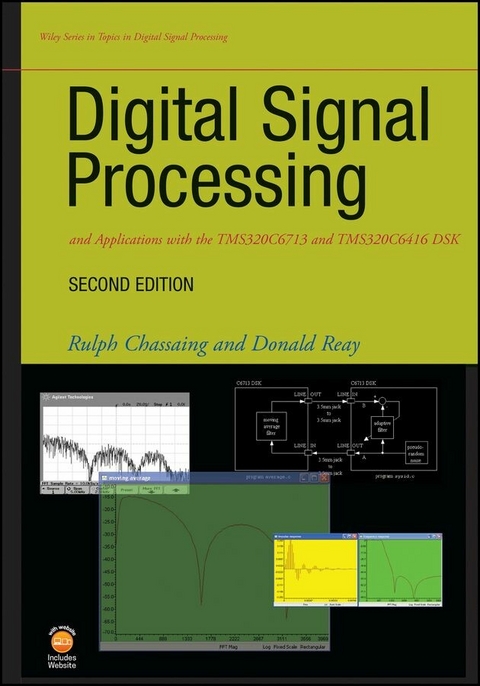
Digital Signal Processing and Applications with the TMS320C6713 and TMS320C6416 DSK (eBook)
John Wiley & Sons (Verlag)
978-0-470-23813-4 (ISBN)
Now in a new edition-the most comprehensive, hands-on introduction to digital signal processing
The first edition of Digital Signal Processing and Applications with the TMS320C6713 and TMS320C6416 DSK is widely accepted as the most extensive text available on the hands-on teaching of Digital Signal Processing (DSP). Now, it has been fully updated in this valuable Second Edition to be compatible with the latest version (3.1) of Texas Instruments Code Composer Studio (CCS) development environment. Maintaining the original's comprehensive, hands-on approach that has made it an instructor's favorite, this new edition also features:
- Added program examples that illustrate DSP concepts in real-time and in the laboratory
- Expanded coverage of analog input and output
- New material on frame-based processing
- A revised chapter on IIR, which includes a number of floating-point example programs that explore IIR filters more comprehensively
- More extensive coverage of DSP/BIOS
- All programs listed in the text-plus additional applications-which are available on a companion website
No other book provides such an extensive or comprehensive set of program examples to aid instructors in teaching DSP in a laboratory using audio frequency signals-making this an ideal text for DSP courses at the senior undergraduate and postgraduate levels. It also serves as a valuable resource for researchers, DSP developers, business managers, and technology solution providers who are looking for an overview and examples of DSP algorithms implemented using the TMS320C6713 and TMS320C6416 DSK.
The late RULPH CHASSAING, PHD, taught Real-Time DSP at Worcester Polytechnic Institute. In addition to offering many DSP training workshops and seminars, he authored four other books: DSP Applications Using C and the TMS320C6x DSK; Digital Signal Processing: Laboratory Experiments Using C and the TMS320C31 DSK; Digital Signal Processing with C and the TMS320C30; and Digital Signal Processing with C and the TMS320C25, all published by Wiley.
DONALD REAY, PHD, is a Lecturer in the School of Engineering and Physical Sciences at Heriot-Watt University in Edinburgh, Scotland.
Digital Signal Processing and Applications with the TMS320C6713 and TMS320C6416 DSK Now in a new edition the most comprehensive, hands-on introduction to digital signal processing The first edition of Digital Signal Processing and Applications with the TMS320C6713 and TMS320C6416 DSK is widely accepted as the most extensive text available on the hands-on teaching of Digital Signal Processing (DSP). Now, it has been fully updated in this valuable Second Edition to be compatible with the latest version (3.1) of Texas Instruments Code Composer Studio (CCS) development environment. Maintaining the original s comprehensive, hands-on approach that has made it an instructor s favorite, this new edition also features: Added program examples that illustrate DSP concepts in real-time and in the laboratory Expanded coverage of analog input and output New material on frame-based processing A revised chapter on IIR, which includes a number of floating-point example programs that explore IIR filters more comprehensively More extensive coverage of DSP/BIOS All programs listed in the text plus additional applications which are available on a companion website No other book provides such an extensive or comprehensive set of program examples to aid instructors in teaching DSP in a laboratory using audio frequency signals making this an ideal text for DSP courses at the senior undergraduate and postgraduate levels. It also serves as a valuable resource for researchers, DSP developers, business managers, and technology solution providers who are looking for an overview and examples of DSP algorithms implemented using the TMS320C6713 and TMS320C6416 DSK.
The late RULPH CHASSAING, PHD, taught Real-Time DSP at Worcester Polytechnic Institute. In addition to offering many DSP training workshops and seminars, he authored four other books: DSP Applications Using C and the TMS320C6x DSK; Digital Signal Processing: Laboratory Experiments Using C and the TMS320C31 DSK; Digital Signal Processing with C and the TMS320C30; and Digital Signal Processing with C and the TMS320C25, all published by Wiley. DONALD REAY, PHD, is a Lecturer in the School of Engineering and Physical Sciences at Heriot-Watt University in Edinburgh, Scotland.
"While there are numerous texts on DSP, this one is very useful due to the succinct style of presentation and the inclusion of many illustrative programming examples and student projects. The typesetting and layout are praiseworthy, and the coverage of topics is laudable." (Computing Reviews, October 1, 2008)
List of Examples
| 1.1 | Sine Wave Generation Using Eight Points with DIP Switch Control (sine8_LED) |
| 1.2 | Generation of Sinusoid and Plotting with CCS (sine8_buf) |
| 1.3 | Dot Product of Two Arrays (dotp4) |
| 2.1 | Basic Input and Output Using Polling (loop_poll) |
| 2.2 | Basic Input and Output Using Interrupts (loop_intr) |
| 2.3 | Modifying Program loop_intr.c to Create a Delay (delay) |
| 2.4 | Modifying Program loop_intr.c to Create an Echo (echo) |
| 2.5 | Echo with GEL Slider Control of Delay and Feedback (echo_control) |
| 2.6 | Loop Program with Input Data Stored in a Buffer (loop_buf) |
| 2.7 | Sine Wave Generation Using a Lookup Table (sine8_intr) |
| 2.8 | Sine Wave Generation Using sin() Function Call (sine_intr) |
| 2.9 | Sine Wave Generation with Stereo Output (sine_stereo) |
| 2.10 | Sine Wave Generation with Two Sliders for Amplitude and Frequency Control (sine2sliders) |
| 2.11 | Sweep Sinusoid Using Table with 8000 Points (sweep8000) |
| 2.12 | Generation of DTMF Tones Using a Lookup Table (sineDTMF_intr) |
| 2.13 | Sine Wave Generation with Table Values Generated Within Program (sinegen_table) |
| 2.14 | Sine Wave Generation with Table Created by MATLAB (sin1500MATL) |
| 2.15 | Sine Wave Generation with DIP Switch Control (sine_led_ctrl) |
| 2.16 | Signal Reconstruction, Aliasing, and the Properties of the AIC23 Codec |
| 2.17 | Square Wave Generation Using Lookup Table (squarewave) |
| 2.18 | Step and Impulse Responses of the DAC Reconstruction Filter (dimpulse) |
| 2.19 | Frequency Response of the DAC Reconstruction Filter Using Pseudorandom Noise (prandom) |
| 2.20 | Step Response of the AIC23 Codec Antialiasing Filter (loop_buf) |
| 2.21 | Demonstration of Aliasing (aliasing) |
| 2.22 | Identification of AIC23 Codec Bandwidth Using an Adaptive Filter (sysid) |
| 2.23 | Identification of AIC23 Codec Bandwidth Using Adaptive Filter (sysid16) |
| 2.24 | Ramp Generation (ramp) |
| 2.25 | Amplitude Modulation (am) |
| 2.26 | Use of External Memory to Record Voice (record) |
| 2.27 | Use of Flash Memory to Run an Application on Power Up (flash_sine) |
| 3.1 | Sum of n + (n − 1) + (n − 2) + · · · + 1, Using C Calling an Assembly Function (sum) |
| 3.2 | Factorial of a Number Using C Calling an Assembly Function (factorial) |
| 3.3 | 32-bit Pseudorandom Noise Generation Using C Calling an Assembly Function (Noisegen_casm) |
| 3.4 | Code Detection Using C Calling an ASM Function (code_casm) |
| 3.5 | Dot Product Using Assembly Program Calling an Assembly Function (dotp4a) |
| 3.6 | Dot Product Using C Function Calling a Linear Assembly Function (dotp4clasm) |
| 3.7 | Factorial Using C Calling a Linear Assembly Function (factclasm) |
| 4.1 | Moving Average Filter (average) |
| 4.2 | Moving Average Filter with Internally Generated Pseudorandom Noise as Input (averagen) |
| 4.3 | Identification of Moving Average Filter Frequency Response Using a Second DSK (sysid) |
| 4.4 | FIR Filter with Moving Average, Bandstop, and Bandpass Characteristics (fir) |
| 4.5 | FIR Implementation with a Pseudorandom Noise Sequence as Input to a Filter (firprn) |
| 4.6 | FIR Filter with Internally Generated Pseudorandom Noise as Input to a Filter and Output Stored in Memory (firprnbuf) |
| 4.7 | Effects on Voice or Music Using Three FIR Lowpass Filters (FIR3LP) |
| 4.8 | Implementation of Four Different Filters: Lowpass, Highpass, Bandpass, and Bandstop (fir4types) |
| 4.9 | Two Notch Filters to Recover a Corrupted Speech Recording (notch2) |
| 4.10 | FIR Implementation Using Two Different Methods (fir2ways) |
| 4.11 | Voice Scrambling Using Filtering and Modulation (scrambler) |
| 4.12 | FIR Implementation Using C Calling an ASM Function (FIRcasm) |
| 4.13 | FIR Implementation Using C Calling a Faster ASM Function (FIRcasmfast) |
| 4.14 | FIR Implementation Using C Calling an ASM Function with a Circular Buffer (FIRcirc) |
| 4.15 | FIR Implementation Using C Calling an ASM Function Using a Circular Buffer in External Memory (FIRcirc_ext) |
| 5.1 | Implementation of IIR Filter Using Cascaded Second Order Direct Form II Sections (iirsos) |
| 5.2 | Implementation of IIR Filter Using Cascaded Second Order Transposed Direct Form II Sections (iirsostr) |
| 5.3 | Estimating the Frequency Response of an IIR Filter Using Pseudorandom Noise as Input (iirsosprn) |
| 5.4 | Estimating the Frequency Response of an IIR Filter Using a Sequence of Impulses as Input (iirsosdelta) |
| 5.5 | Fourth Order Elliptical Lowpass IIR Filter Designed Using fdatool |
| 5.6 | Bandpass Filter Designed Using fdatool |
| 5.7 | Fixed-Point Implementation of IIR Filter (iir) |
| 5.8 | Generation of a Sine Wave Using a Difference Equation (sinegenDE) |
| 5.9 | Generation of DTMF Signal Using Difference Equations (sinegenDTMF) |
| 5.10 | Generation of a Swept Sinusoid Using a Difference Equation (sweepDE) |
| 5.11 | Sine Wave Generation Using a Difference Equation with C Calling an ASM Function (sinegencasm) |
| 6.1 | DFT of a Sequence of Real Numbers with Output in the CCS Graphical Display Window (dft) |
| 6.2 | Estimating Execution Times for DFT and FFT Functions (fft) |
| 6.3 | Frame-Based Processing (frames) |
| 6.4 | DFT of a Signal in Real-Time Using a DFT Function with Precalculated Twiddle Factors (dft128c) |
| 6.5 | FFT of a Real-Time Input Signal Using an FFT Function in C (fft128c.c) |
| 6.6 | FFT of a Sinusoidal Signal from a Table Using TI’s C Callable Optimized FFT Function (FFTsinetable) |
| 6.7 | FFT of Real-Time Input Using TI’s C Callable Optimized Radix-2 FFT Function (FFTr2) |
| 6.8 | Radix-4 FFT of Real-Time Input Using TI’s C Callable Optimized FFT Function (FFTr4) |
| 6.9 | Frame-Based Implementation of FIR Filters Using Time-Domain Convolution (timeconvdemo) |
| 6.10 | Real-Time Frame-Based Implementation of FIR Filters Using Time-Domain Convolution (timeconv) |
| 6.11 | Frame-Based Implementation of FIR Filters Using Frequency-Domain Convolution (fastconvdemo) |
| 6.12 | Real-Time Frame-Based Fast Convolution (fastconv) |
| 6.13 | Graphic Equalizer (graphicEQ) |
| 7.1 | Adaptive Filter Using C Code (adaptc) |
| 7.2 | Adaptive Filter for Sinusoidal Noise Cancellation (adaptnoise) |
| 7.3 | Adaptive FIR Filter for Noise Cancellation Using External Inputs (adaptnoise_2IN) |
| 7.4 | Adaptive FIR Filter for System ID of a Fixed FIR as an Unknown System (adaptIDFIR) |
| 7.5 | Adaptive FIR for System ID of a Fixed FIR as an Unknown System with Weights of an Adaptive Filter Initialized as an FIR Bandpass (adaptIDFIRw) |
| 7.6 | Adaptive FIR for System ID of Fixed IIR as an Unknown System (iirsosadapt) |
| 7.7 | Adaptive FIR Filter for System Identification of System External to DSK... |
| Erscheint lt. Verlag | 15.4.2008 |
|---|---|
| Reihe/Serie | Topics in Digital Signal Processing |
| Topics in Digital Signal Processing | Topics in Digital Signal Processing |
| Sprache | englisch |
| Themenwelt | Technik ► Elektrotechnik / Energietechnik |
| Technik ► Nachrichtentechnik | |
| Schlagworte | Computer Science • Computer Science Special Topics • Electrical & Electronics Engineering • Elektrotechnik u. Elektronik • Informatik • Signal Processing • Signalverarbeitung • Spezialthemen Informatik |
| ISBN-10 | 0-470-23813-5 / 0470238135 |
| ISBN-13 | 978-0-470-23813-4 / 9780470238134 |
| Informationen gemäß Produktsicherheitsverordnung (GPSR) | |
| Haben Sie eine Frage zum Produkt? |
 PDF (Adobe DRM)
Kopierschutz: Adobe-DRM
Adobe-DRM ist ein Kopierschutz, der das eBook vor Mißbrauch schützen soll. Dabei wird das eBook bereits beim Download auf Ihre persönliche Adobe-ID autorisiert. Lesen können Sie das eBook dann nur auf den Geräten, welche ebenfalls auf Ihre Adobe-ID registriert sind.
Details zum Adobe-DRM
Dateiformat: PDF (Portable Document Format)
Mit einem festen Seitenlayout eignet sich die PDF besonders für Fachbücher mit Spalten, Tabellen und Abbildungen. Eine PDF kann auf fast allen Geräten angezeigt werden, ist aber für kleine Displays (Smartphone, eReader) nur eingeschränkt geeignet.
Systemvoraussetzungen:
PC/Mac: Mit einem PC oder Mac können Sie dieses eBook lesen. Sie benötigen eine
eReader: Dieses eBook kann mit (fast) allen eBook-Readern gelesen werden. Mit dem amazon-Kindle ist es aber nicht kompatibel.
Smartphone/Tablet: Egal ob Apple oder Android, dieses eBook können Sie lesen. Sie benötigen eine
Geräteliste und zusätzliche Hinweise
Buying eBooks from abroad
For tax law reasons we can sell eBooks just within Germany and Switzerland. Regrettably we cannot fulfill eBook-orders from other countries.
aus dem Bereich