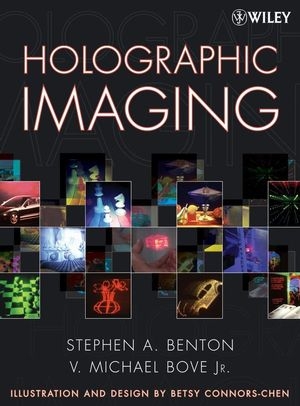
Holographic Imaging (eBook)
304 Seiten
John Wiley & Sons (Verlag)
978-0-470-22412-0 (ISBN)
fundamental principles to the most advanced concepts
While several existing texts cover different aspects of the
field of holography, none provides a complete, up-to-date, and
accessible view of its popular, scientific, and engineering
aspects. Now, from an author team that includes one of the world's
pioneers in the field, Holographic Imaging fills this need with a
single, comprehensive text that covers the subject from traditional
holography to the cutting-edge development of the world's most
advanced three-dimensional holographic images, holographic
printing, and holographic video.
Written in an engaging and easy-to-follow style, Holographic
Imaging promotes a hands-on approach to making holograms and
provides readers with a working understanding of how and why they
work. Following a brief introduction to the fundamentals of light
and diffraction, coverage includes: the diffraction efficiency of
gratings, "platonic" holography, a ray-tracing analysis of
holography, holographic lenses and in-line "Gabor" holography,
off-axis "Leith & Upatnieks" holography, non-laser illumination
of holograms, phase conjunction and real image projection,
full-aperture transfer holography, white-light transmission
"rainbow" holography, practical issues in rainbow holography,
in-line "Denisyuk" reflection holography, off-axis reflection
holography, edge-lit holography, computational display holography,
holographic printing, and holographic television.
Helpful diagrams and equations that summarize the mathematical
and physical principles for each technique discussed make this an
approachable resource for readers from a variety of backgrounds,
including undergraduate and postgraduate students with an interest
in optics, optoelectronics, and information display, as well as
researchers, scientists, engineers, and technology-savvy
artists.
V. Michael Bove Jr., PhD, is Head of the Object-Based Media Group at MIT's Media Laboratory and directs the consumer electronics program CELab. He is the author or coauthor of over fifty journal or conference papers and holds patents on inventions relating to video recording, hardcopy, interactive television, and medical imaging. Dr. Bove is on the Board of Editors of the Journal of the Society of Motion Picture and Television Engineers and is Associate Editor of Optical Engineering. He is a fellow of the Optics Society SPIE and is on the Board of Governors of the National Academy of Media Arts and Sciences.
Foreword: Holography xiiii
Charles M. Vest
Foreword: Nerd Pride xv
Nicholas Negroponte
Guide to Color Plates xix
Betsy Connors-Chen
Introduction: Why Holographic Imaging? 1
About This Volume 1
The Window View Upon Reality 2
References 3
Chapter 1: Holograms and Perception 5
Chapter 2: Light as Waves 15
Chapter 3: Waves and Phases 27
Chapter 4: Two-Beam Interference 33
Chapter 5: Diffraction 45
Chapter 6: Diffraction Efficiency of Gratings 57
Chapter 7: "Platonic" Holography 65
Chapter 8: Ray-Tracing Analysis of Holography Introduction 75
Chapter 9: Holographic Lenses and In-Line "Gabor" Holography 87
Chapter 10: Off-Axis "Leith & Upatnieks" Holography Introduction 103
Chapter 11: Non-Laser Illumination of Holograms 115
Chapter 12: Phase Conjugation and Real Image Projection 125
Chapter 13: Full-Aperture Transfer 137
Chapter 14: White-Light Transmission "Rainbow" Holography 145
Chapter 15: Practical Issues in Rainbow Holography 159
Chapter 16: In-line "Denisyuk" Reflection Holography Introduction 173
Chapter 17: Off-Axis Bollection Holography 181
Chapter 18: Edge-Lit Holography William Farmer 193
Chapter 19: Computational Display Holography 207
Chapter 20: Holographic Stereograms and Printing 233
Chapter 21: Holographic Television 247
Index 259
"This text successfully covers its subject, from theoretical holography, traditional technology, and widespread rainbow holograms, to the latest, cutting-edge technological developments of the holographic television and holographic computer displays. It does so with an easy-to-follow style, approachable mathematics, and helpful illustrations. This makes the book a valuable resource for readers from a variety of backgrounds, including students and researchers in optics, optoelectronics, computer science, and engineering." (Computing Reviews, December 2, 2008)
| Erscheint lt. Verlag | 12.7.2008 |
|---|---|
| Sprache | englisch |
| Themenwelt | Technik ► Elektrotechnik / Energietechnik |
| Schlagworte | Bildgebende Systeme u. Verfahren • Electrical & Electronics Engineering • Elektrotechnik u. Elektronik • Holographie • Imaging Systems & Technology |
| ISBN-10 | 0-470-22412-6 / 0470224126 |
| ISBN-13 | 978-0-470-22412-0 / 9780470224120 |
| Informationen gemäß Produktsicherheitsverordnung (GPSR) | |
| Haben Sie eine Frage zum Produkt? |
 PDF (Adobe DRM)
Kopierschutz: Adobe-DRM
Adobe-DRM ist ein Kopierschutz, der das eBook vor Mißbrauch schützen soll. Dabei wird das eBook bereits beim Download auf Ihre persönliche Adobe-ID autorisiert. Lesen können Sie das eBook dann nur auf den Geräten, welche ebenfalls auf Ihre Adobe-ID registriert sind.
Details zum Adobe-DRM
Dateiformat: PDF (Portable Document Format)
Mit einem festen Seitenlayout eignet sich die PDF besonders für Fachbücher mit Spalten, Tabellen und Abbildungen. Eine PDF kann auf fast allen Geräten angezeigt werden, ist aber für kleine Displays (Smartphone, eReader) nur eingeschränkt geeignet.
Systemvoraussetzungen:
PC/Mac: Mit einem PC oder Mac können Sie dieses eBook lesen. Sie benötigen eine
eReader: Dieses eBook kann mit (fast) allen eBook-Readern gelesen werden. Mit dem amazon-Kindle ist es aber nicht kompatibel.
Smartphone/Tablet: Egal ob Apple oder Android, dieses eBook können Sie lesen. Sie benötigen eine
Geräteliste und zusätzliche Hinweise
Buying eBooks from abroad
For tax law reasons we can sell eBooks just within Germany and Switzerland. Regrettably we cannot fulfill eBook-orders from other countries.
aus dem Bereich