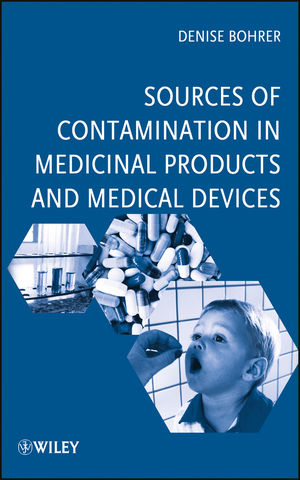
Sources of Contamination in Medicinal Products and Medical Devices (eBook)
592 Seiten
John Wiley & Sons (Verlag)
978-1-118-44905-9 (ISBN)
Most books dealing with contaminants in medicinal products often focus on analytical methods for detecting nonspecific impurities. Key to the work of the pharmaceutical chemist, this unique reference helps identify the sources of contamination in medicinal and pharmaceutical products and medical devices. Divided into three parts, Sources of Contamination in Medicinal Products and Medical Devices covers chemical, microbiological, and physical (particulate matter) contamination, including those originating from sterilization procedures.
As compelling as a medical documentary, the book sheds light on how impurities and contaminants can enter the human body transported via a specific product or treatment. Focusing on only those medicinal products and medical devices that may lead to exposure to contaminants harmful to human health, the book offers a comprehensive, systematic look at the entire universe of medical contamination:
* Chemical contaminants including residual solvents, catalyst residuals, and genotoxic impurities in active pharmaceutical ingredients (APIs)
* Diagnostic imaging agents (i.e., radiopharmaceuticals and contrast agents)
* Microbiological and endotoxin contamination involving single and multiple dose products, medical devices, and biofilms
* Contamination from sterilization procedures, residuals from radiation sterilization, ionizing radiation on packaging materials and medical devices
* Medicinal gases and volatile anesthetics
* Biopharmaceuticals including recombinant DNA technology products
* Extractables and leachables from containers made of glass, plastics, and metal
Each section of the book contains information on what contaminants could be expected in a particular product, and how they were generated and reached that product. With up-to-date regulatory guidelines for determining contamination, as well as methods for assessing, quantifying, avoiding and removing contaminants, Sources of Contamination in Medicinal Products and Medical Devices is essential to fully understanding the specific threats that undermine the safety of medicines and medical devices.
DENISE BOHRER, PhD, is Professor of Analytical Chemistry at the Federal University of Santa Maria, Brazil. Her research has focused on sources of contamination in pharmaceutical products, specifically, infusion solutions for patients with kidney disease and preterm infants. She has published sixty-eight papers and two book chapters on pharmaceutical manufacturing.
1. Introduction
2. Directives for contamination control
PART I: CHEMICAL CONTAMINATION
3. Raw Materials
3.1 Water
3.2 Inorganic Impurities
3.3 Organic Impurities
3.4 Additives
3.5 Residual solvents
Concluding remarks
References
4. Medicinal gases and volatile anesthetics
4.1 Medicinal gases
4.2 Volatile anesthetics
Concluding remarks
References
1. Introduction
2. Directives for contamination control
PART I: CHEMICAL CONTAMINATION
3. Raw Materials
3.1 Water
3.2 Inorganic Impurities
3.3 Organic Impurities
3.4 Additives
3.5 Residual solvents
Concluding remarks
References
4. Medicinal gases and volatile anesthetics
4.1 Medicinal gases
4.2 Volatile anesthetics
Concluding remarks
References
5. Diagnostic imaging agents
5.1 Radiopharmaceuticals
5.2 Contrast agents
Concluding remarks
References
6. Containers
6.1 Glass containers
6.2 Plastics containers
6.3 Metal containers
Concluding remarks
References
7. Closures
Concluding remarks
References
8. Delivery systems and filters
8.1 Delivery systems made of PVC
8.2 Delivery systems made of other plastic materials
8.3 Filters
Concluding remarks
References
9. Medical devices
9.1 General use devices
9.1.1 Medical gloves
9.1.2 Syringes
9.2 Extracorporeal circuits
9.3 Devices for administration of aerosolized drugs
9.4 Reprocessed medical devices
9.5 Tissue substitutes
Concluding remarks
References
PART II: PHYSICAL CONTAMINATION
10. Particulate matter
Concluding remarks
References
PART III: MICROBIOLOGICAL CONTAMINATION
11. Microbiological and endotoxin contamination
11.1 Water
11.2 Raw materials
11.3 Sterile products
11.4 Medicinal gases
11.5 Medical devices
11.6 Biofilms
11.7 Dialysis circuits
11.8 Nosocomial infections
Concluding remarks
References
PART IV: MISCELLANEOUS
12. Contamination from sterilization procedures
12.1 Residuals from radiation sterilization
12.2 Heat sterilization
12.3 Residuals from chemical disinfection/sterilization agents
Concluding remarks
References
13. Biotechnological products
13.1 DNA and Host cell proteins residuals
13.2 Viruses and mycoplasma
13.3 Endotoxin
13.4 Protein degradation
13.5 Protein aggregation
Concluding remarks
References
Appendix
| Erscheint lt. Verlag | 25.9.2012 |
|---|---|
| Sprache | englisch |
| Themenwelt | Naturwissenschaften ► Chemie |
| Technik | |
| Schlagworte | Analytical Chemistry • Analytische Chemie • Chemie • Chemistry • Kontamination • Medical Science • Medizin • Pharmaceutical & Medicinal Chemistry • Pharmacology & Pharmaceutical Medicine • Pharmakologie u. Pharmazeutische Medizin • Pharmazeutische Chemie • Pharmazeutische u. Medizinische Chemie |
| ISBN-10 | 1-118-44905-3 / 1118449053 |
| ISBN-13 | 978-1-118-44905-9 / 9781118449059 |
| Informationen gemäß Produktsicherheitsverordnung (GPSR) | |
| Haben Sie eine Frage zum Produkt? |
 EPUB (Adobe DRM)
Kopierschutz: Adobe-DRM
Adobe-DRM ist ein Kopierschutz, der das eBook vor Mißbrauch schützen soll. Dabei wird das eBook bereits beim Download auf Ihre persönliche Adobe-ID autorisiert. Lesen können Sie das eBook dann nur auf den Geräten, welche ebenfalls auf Ihre Adobe-ID registriert sind.
Details zum Adobe-DRM
Dateiformat: EPUB (Electronic Publication)
EPUB ist ein offener Standard für eBooks und eignet sich besonders zur Darstellung von Belletristik und Sachbüchern. Der Fließtext wird dynamisch an die Display- und Schriftgröße angepasst. Auch für mobile Lesegeräte ist EPUB daher gut geeignet.
Systemvoraussetzungen:
PC/Mac: Mit einem PC oder Mac können Sie dieses eBook lesen. Sie benötigen eine
eReader: Dieses eBook kann mit (fast) allen eBook-Readern gelesen werden. Mit dem amazon-Kindle ist es aber nicht kompatibel.
Smartphone/Tablet: Egal ob Apple oder Android, dieses eBook können Sie lesen. Sie benötigen eine
Geräteliste und zusätzliche Hinweise
Buying eBooks from abroad
For tax law reasons we can sell eBooks just within Germany and Switzerland. Regrettably we cannot fulfill eBook-orders from other countries.
aus dem Bereich