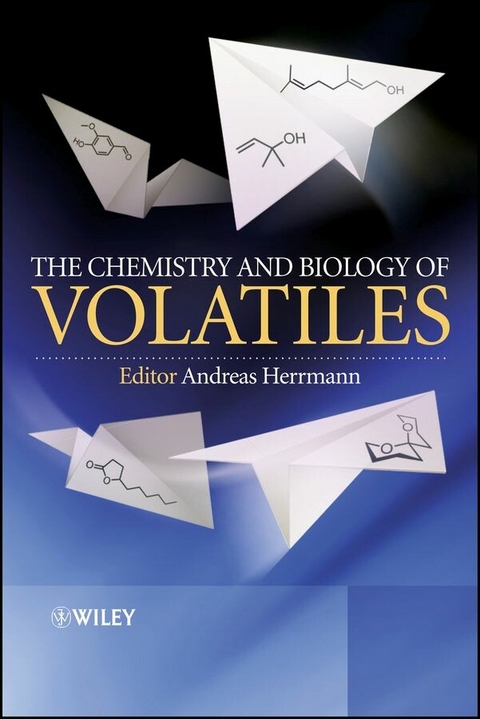
The Chemistry and Biology of Volatiles (eBook)
John Wiley & Sons (Verlag)
978-0-470-66955-6 (ISBN)
'... this book deserves to be a well-used reference in the library of any laboratory specialising in VOC'. -Chemistry World, 2011
Volatile compounds are molecules with a relatively low molecular weight allowing for an efficient evaporation into the air. They are found in many areas of our everyday-life: they are responsible for the communication between species such as plants, insects or mammals; they serve as flavours or fragrances in many food products or perfumed consumer articles; and they play an important role in atmospheric chemistry.
This book takes an interdisciplinary approach to volatile molecules. Review-style introductions to the main topics in volatile chemistry and biology are provided by international experts, building into a broad overview of this fascinating field.
Topics covered include:
- The structural variety of volatile compounds
- Biogeneration of volatiles
- Synthesis of natural and non-natural volatiles
- Analysis of volatiles
- Volatile compounds as semiochemicals in plant-plant or plant-insect interactions
- Volatiles in pest control
- Pheromones and the influence of volatiles on mammals
- Olfaction and human perception
- Volatiles as fragrances
- The generation of flavours and food aroma compounds
- Stabilisation and controlled release of volatiles
- The impact of volatiles on the environment and the atmosphere
Dr. Andreas Herrmann is a research chemist at Firmenich SA, an international flavour and fragrance company, in Genève (Switzerland), working on the development of new fragrance delivery systems. He has published a series of research papers on the chemical release of volatiles under mild reaction conditions. He is the author or co-author of about 30 scientific publications and 10 international patent applications.
"e;Coming to a conclusion, this wonderful, informative and very interesting book presents an excellent overview of small volatile organic compounds and their role in our life and environment. Really fascinating is the entirety of scientific disciplines which were addressed by this book."e; Flavour and Fragrance Journal, 2011 "e; this book deserves to be a well-used reference in the library of any laboratory specialising in VOC"e;. Chemistry World, 2011 Volatile compounds are molecules with a relatively low molecular weight allowing for an efficient evaporation into the air. They are found in many areas of our everyday-life: they are responsible for the communication between species such as plants, insects or mammals; they serve as flavours or fragrances in many food products or perfumed consumer articles; and they play an important role in atmospheric chemistry. This book takes an interdisciplinary approach to volatile molecules. Review-style introductions to the main topics in volatile chemistry and biology are provided by international experts, building into a broad overview of this fascinating field. Topics covered include: The structural variety of volatile compounds Biogeneration of volatiles Synthesis of natural and non-natural volatiles Analysis of volatiles Volatile compounds as semiochemicals in plant-plant or plant-insect interactions Volatiles in pest control Pheromones and the influence of volatiles on mammals Olfaction and human perception Volatiles as fragrances The generation of flavours and food aroma compounds Stabilisation and controlled release of volatiles The impact of volatiles on the environment and the atmosphere
Dr. Andreas Herrmann is a research chemist at Firmenich SA, an international flavour and fragrance company, in Genève (Switzerland), working on the development of new fragrance delivery systems. He has published a series of research papers on the chemical release of volatiles under mild reaction conditions. He is the author or co-author of about 30 scientific publications and 10 international patent applications.
Chapter 1: Volatiles - An Interdisciplinary Approach
A. Herrmann
(Firmenich SA, Genève)
Chapter 2: Biosynthesis and Emission of Isoprene, Methylbutanol and Other Volatile Plant Isoprenoids
H. K. Lichtenthaler
(Botanisches Institut, Universität Karlsruhe)
Chapter 3: Analysis of the Plant Volatile Fraction
P. Rubiolo, B. Sgorbini, E. Liberto, C. Cordero, C. Bicchi* (Dipartimento di Scienza e Tecnologia del Farmaco, Università degli Studi di Torino)
Chapter 4: Plant Volatile Signalling: Multitrophic Interactions in the Headspace
A. Kessler*, K. Morrell
(Department of Ecology & Evolutionary Biology, Cornell University, Ithaca)
Chapter 5: Pheromones in Chemical Communication
K. Mori
(The University of Tokyo)
Chapter 6: Use of Volatiles in Pest Control
J. R. M. Thacker*, M. R. Train
(Biological Sciences, University of the West of Scotland, Paisley)
Chapter 7: Challenges in the Synthesis of Natural and Non-Natural Volatiles
A. A. Birkbeck
(Firmenich SA, Genève)
Chapter 8: The Biosynthesis of Volatile Sulphur Flavour Compounds
M. G. Jones
(School of Biological Sciences, University of Liverpool)
Chapter 9: Thermal Generation of Aroma-Active Volatiles in Food
C. Cerny
(Firmenich SA, Meyrin)
Chapter 10: Human Olfactory Perception
A. Gelperin
(Monell Chemical Senses Center, Philadelphia, and Princeton Neuroscience Institute, Princeton University)
Chapter 11: Perfumery - The Wizardry of Volatile Molecules
C. Laudamiel
(New York)
Chapter 12: Microencapsulation Techniques for Food Flavour
Y. Byun, Y. T. Kim, K. G. H. Desai, H. J. Park* (Department of Packaging Science, Clemson University and Department of Food Technology, Korea University Seoul)
Chapter 13: Profragrances and Properfumes
A. Herrmann
(Firmenich SA, Genève)
Chapter 14: Reactions of Biogenic Volatile Organic Compounds in the Atmosphere
R. K. Monson
(Department of Ecology & Evolutionary Biology and Cooperative Institute for Research in Environmental Sciences, University of Colorado)
"Coming to a conclusion, this wonderful, informative and very
interesting book presents an excellent overview of small volatile
organic compounds and their role in our life and environment.
Really fascinating is the entirety of scientific disciplines which
were addressed by this book." (Flavour and Fragrance Journal,
2011)
"In spite of its few shortcomings, this book deserves to be a
well-used reference in the library of any laboratory specialising
in VOC". (Chemistry World, 1 May 2011)
"The Chemistry and Biology of Volatiles takes an
interdisciplinary approach to volatile molecules". (Small Business
VoIP, 14 December 2010)
| Erscheint lt. Verlag | 9.9.2010 |
|---|---|
| Sprache | englisch |
| Themenwelt | Naturwissenschaften ► Biologie ► Biochemie |
| Naturwissenschaften ► Chemie ► Organische Chemie | |
| Technik | |
| Schlagworte | Air • Areas • between species • Biochemie u. Chemische Biologie • Biochemistry (Chemical Biology) • Chemie • Chemistry • Communication • compounds • Efficient • evaporation • Everyday • Flüchtiger Stoff • Flavours • Flüchtiger Stoff • Food Science & Technology • fragrances • important • Interdisciplinary • Lebensmittelforschung u. -technologie • Life • Low • many • many food • molecular • Molecules • Organic Chemistry • Organische Chemie • plants • Products • relatively • responsible • Role • weight |
| ISBN-10 | 0-470-66955-1 / 0470669551 |
| ISBN-13 | 978-0-470-66955-6 / 9780470669556 |
| Informationen gemäß Produktsicherheitsverordnung (GPSR) | |
| Haben Sie eine Frage zum Produkt? |
 PDF (Adobe DRM)
Kopierschutz: Adobe-DRM
Adobe-DRM ist ein Kopierschutz, der das eBook vor Mißbrauch schützen soll. Dabei wird das eBook bereits beim Download auf Ihre persönliche Adobe-ID autorisiert. Lesen können Sie das eBook dann nur auf den Geräten, welche ebenfalls auf Ihre Adobe-ID registriert sind.
Details zum Adobe-DRM
Dateiformat: PDF (Portable Document Format)
Mit einem festen Seitenlayout eignet sich die PDF besonders für Fachbücher mit Spalten, Tabellen und Abbildungen. Eine PDF kann auf fast allen Geräten angezeigt werden, ist aber für kleine Displays (Smartphone, eReader) nur eingeschränkt geeignet.
Systemvoraussetzungen:
PC/Mac: Mit einem PC oder Mac können Sie dieses eBook lesen. Sie benötigen eine
eReader: Dieses eBook kann mit (fast) allen eBook-Readern gelesen werden. Mit dem amazon-Kindle ist es aber nicht kompatibel.
Smartphone/Tablet: Egal ob Apple oder Android, dieses eBook können Sie lesen. Sie benötigen eine
Geräteliste und zusätzliche Hinweise
Buying eBooks from abroad
For tax law reasons we can sell eBooks just within Germany and Switzerland. Regrettably we cannot fulfill eBook-orders from other countries.
aus dem Bereich