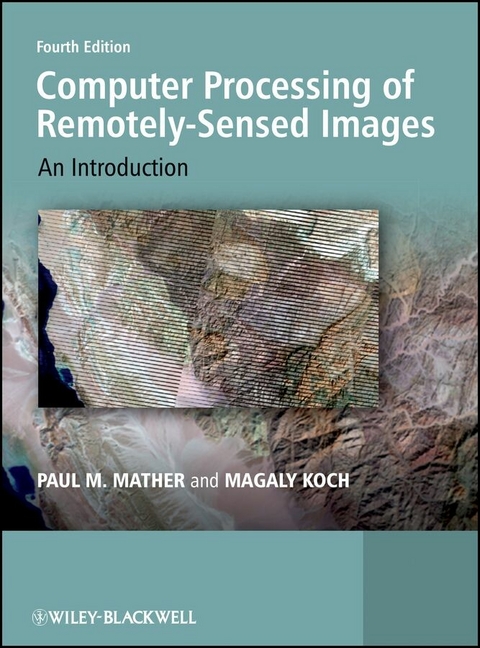
Computer Processing of Remotely-Sensed Images (eBook)
John Wiley & Sons (Verlag)
978-0-470-66650-0 (ISBN)
New and updated material includes:
- A website at www.wiley.com/go/mather4 that provides access to an updated and expanded version of the MIPS image processing software for Microsoft Windows, PowerPoint slideshows of the figures from each chapter, and case studies, including full data sets,
- Includes new chapter on Remote Sensing and Environmental GIS that provides insights into the ways in which remotely-sensed data can be used synergistically with other spatial data sets, including hydrogeological and archaeological applications,
- New section on image processing from a computer science perspective presented in a non-technical way, including some remarks on statistics,
- New material on image transforms, including the analysis of temporal change and data fusion techniques,
- New material on image classification including decision trees, support vector machines and independent components analysis, and
- Now in full colour throughout.
This book provides the material required for a single semester course in Environmental Remote Sensing plus additional, more advanced, reading for students specialising in some aspect of the subject. It is written largely in non-technical language yet it provides insights into more advanced topics that some may consider too difficult for a non-mathematician to understand. The case studies available from the website are fully-documented research projects complete with original data sets. For readers who do not have access to commercial image processing software, MIPS provides a licence-free, intuitive and comprehensive alternative.
Paul M. Mather is the author of Computer Processing of Remotely-Sensed Images: An Introduction, 4th Edition, published by Wiley.
Magaly Koch is the author of Computer Processing of Remotely-Sensed Images: An Introduction, 4th Edition, published by Wiley.
This fourth and full colour edition updates and expands a widely-used textbook aimed at advanced undergraduate and postgraduate students taking courses in remote sensing and GIS in Geography, Geology and Earth/Environmental Science departments. Existing material has been brought up to date and new material has been added. In particular, a new chapter, exploring the two-way links between remote sensing and environmental GIS, has been added. New and updated material includes: A website at www.wiley.com/go/mather4 that provides access to an updated and expanded version of the MIPS image processing software for Microsoft Windows, PowerPoint slideshows of the figures from each chapter, and case studies, including full data sets, Includes new chapter on Remote Sensing and Environmental GIS that provides insights into the ways in which remotely-sensed data can be used synergistically with other spatial data sets, including hydrogeological and archaeological applications, New section on image processing from a computer science perspective presented in a non-technical way, including some remarks on statistics, New material on image transforms, including the analysis of temporal change and data fusion techniques, New material on image classification including decision trees, support vector machines and independent components analysis, and Now in full colour throughout. This book provides the material required for a single semester course in Environmental Remote Sensing plus additional, more advanced, reading for students specialising in some aspect of the subject. It is written largely in non-technical language yet it provides insights into more advanced topics that some may consider too difficult for a non-mathematician to understand. The case studies available from the website are fully-documented research projects complete with original data sets. For readers who do not have access to commercial image processing software, MIPS provides a licence-free, intuitive and comprehensive alternative.
Paul M. Mather is the author of Computer Processing of Remotely-Sensed Images: An Introduction, 4th Edition, published by Wiley. Magaly Koch is the author of Computer Processing of Remotely-Sensed Images: An Introduction, 4th Edition, published by Wiley.
"As well as dikes, sills, and laccoliths, there is an
exceptionally clear and finely illustrated explanation of
ophiolites, a topic routinely ignored in many Earth science texts
despite their significance. Add later chapters on
kimberlites, volcanic climate modification over time, and a look at
how we monitor volcanoes, and you have a very well-done enjoyable
"little" book." (The Leading Edge, 1
August 2012)
| Erscheint lt. Verlag | 29.12.2010 |
|---|---|
| Sprache | englisch |
| Themenwelt | Naturwissenschaften ► Geowissenschaften ► Geografie / Kartografie |
| Naturwissenschaften ► Geowissenschaften ► Geologie | |
| Technik | |
| Schlagworte | earth • earths atmosphere • earth sciences • earthsurface • Edition • Electromagnetic • Fernerkundung • First • Geographie • Geography • Geowissenschaften • GIS & Remote Sensing • GIS, Fernerkundung u. Kartographie • GIS, Remote Sensing & Cartography • GIS u. Fernerkundung • interaction • Materials • platforms • preface • Radiation • reflectance • Second • Sources • Spectral • Surface • Third |
| ISBN-10 | 0-470-66650-1 / 0470666501 |
| ISBN-13 | 978-0-470-66650-0 / 9780470666500 |
| Informationen gemäß Produktsicherheitsverordnung (GPSR) | |
| Haben Sie eine Frage zum Produkt? |
 PDF (Adobe DRM)
Kopierschutz: Adobe-DRM
Adobe-DRM ist ein Kopierschutz, der das eBook vor Mißbrauch schützen soll. Dabei wird das eBook bereits beim Download auf Ihre persönliche Adobe-ID autorisiert. Lesen können Sie das eBook dann nur auf den Geräten, welche ebenfalls auf Ihre Adobe-ID registriert sind.
Details zum Adobe-DRM
Dateiformat: PDF (Portable Document Format)
Mit einem festen Seitenlayout eignet sich die PDF besonders für Fachbücher mit Spalten, Tabellen und Abbildungen. Eine PDF kann auf fast allen Geräten angezeigt werden, ist aber für kleine Displays (Smartphone, eReader) nur eingeschränkt geeignet.
Systemvoraussetzungen:
PC/Mac: Mit einem PC oder Mac können Sie dieses eBook lesen. Sie benötigen eine
eReader: Dieses eBook kann mit (fast) allen eBook-Readern gelesen werden. Mit dem amazon-Kindle ist es aber nicht kompatibel.
Smartphone/Tablet: Egal ob Apple oder Android, dieses eBook können Sie lesen. Sie benötigen eine
Geräteliste und zusätzliche Hinweise
Buying eBooks from abroad
For tax law reasons we can sell eBooks just within Germany and Switzerland. Regrettably we cannot fulfill eBook-orders from other countries.
aus dem Bereich