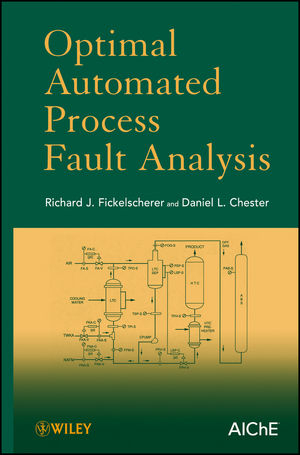
Optimal Automated Process Fault Analysis (eBook)
224 Seiten
John Wiley & Sons (Verlag)
978-1-118-48193-6 (ISBN)
fault analyzers
Process fault analyzers monitor process operations in order to
identify the underlying causes of operational problems. Several
diagnostic strategies exist for automating process fault analysis;
however, automated fault analysis is still not widely used within
the processing industries due to problems of cost and performance
as well as the difficulty of modeling process behavior at needed
levels of detail.
In response, this book presents the method of minimal evidence
(MOME), a model-based diagnostic strategy that facilitates the
development and implementation of optimal automated process fault
analyzers. MOME was created at the University of Delaware by the
researchers who developed the FALCON system, a real-time, online
process fault analyzer. The authors demonstrate how MOME is used to
diagnose single and multiple fault situations, determine the
strategic placement of process sensors, and distribute fault
analyzers within large processing systems.
Optimal Automated Process Fault Analysis begins by
exploring the need to automate process fault analysis. Next, the
book examines:
* Logic of model-based reasoning as used in MOME
* MOME logic for performing single and multiple fault
diagnoses
* Fuzzy logic algorithms for automating MOME
* Distributing process fault analyzers throughout large
processing systems
* Virtual SPC analysis and its use in FALCONEER(TM) IV
* Process state transition logic and its use in FALCONEER(TM)
IV
The book concludes with a summary of the lessons learned by
employing FALCONEER(TM) IV in actual process applications,
including the benefits of "intelligent supervision" of process
operations.
With this book as their guide, readers have a powerful new tool
for ensuring the safety and reliability of any chemical processing
system.
Dr. Richard J. Fickelscherer is currently a licensed Professional Engineer and is a principal owner of FALCONEER Technologies, LLC. He has developed and implemented programs which provide various supervisory control functions for DuPont, Exxon-Mobile, Merck Pharmaceuticals, Koch Industries, the FMC Corporation and many other client companies. Dr. Daniel L. Chester joined the Department of Computer and Information Sciences at the University of Delaware in 1980, where he soon became one of the principal investigators on the FALCON project. He is currently Associate Chair in the computer science department at the University of Delaware. He has been involved in the creation and development of three companies, one of which is FALCONEER Technologies, LLC. He is also co-inventor in five U.S. patents.
Dedication
Table of Contents
Foreword
Preface
Acknowledgements
Chapter 1. Motivations for Automating Process Fault Analysis
1.1 Introduction
1.2 CPI Trends to Date
1.3 The Changing Role for the Process Operators in Plant Operations
1.4 Methods Currently Used to Perform Process Fault Management
1.5 Limitations of Human Operators in Performing Process Fault Management
1.6 The Role of Automated Process Fault Analysis
1.7 Anticipated Future CPI Trends
1.8 Process Fault Analysis Concept Terminology
Chapter 2. Method of Minimal Evidence: Model-Based Reasoning
2.1 Overview
2.2 Introduction
2.3 Method of Minimal Evidence Overview
2.4 Verifying the Validity and Accuracy of the Various Primary Models
2.5 Summary
Chapter 3. Method of Minimal Evidence: Diagnostic Strategy Details
3.1 Overview
3.2 Introduction
3.3 MOME Diagnostic Strategy
3.4 A General Procedure for Developing and Verifying Competent Model-based
3.5 MOME SV & PFA Diagnostic Logic Compiler Motivations
3.6 MOME Diagnostic Strategy Summary
Chapter 4. Method of Minimal Evidence: Fuzzy Logic Algorithm
4.1 Overview
4.2 Introduction
4.3 Fuzzy Logic Overview
4.4 MOME Fuzzy Logic Algorithm
4.5 Certainty Factor Calculation Review
4.6 MOME Fuzzy Logic Algorithm Summary
Chapter 5. Method of Minimal Evidence: Criteria for Shrewdly Distribution Fault Analyzers and Strategic Process Sensor Placement
5.1 Overview
5.2 Criteria for Shrewdly Distributing Process Fault Analyzers
5.3 Criteria for Strategic Process Sensor Placement
Chapter 6. Virtual SPC Analysis and Its Routine Use in Falconeer(TM) IV
6.1 Overview
6.2 Introduction
6.3 EWMA Calculations and Specific Virtual SPC Analysis Configurations
6.4 Virtual SPC Alarm Trigger Summary
6.5 Virtual SPC Analysis Conclusions
Chapter 7. Process State Transistion Logic and Its Routine Use in Falconeer(TM) IV
7.1 Temporal Reasoning Philosophy
7.2 Introduction
7.3 State Identification Analysis Currently Used in Falconeer(TM) IV
7.4 State Identification Analysis Summary
Chapter 8. Conclusions
8.1 Overview
8.2 Summary of the MOME Diagnostic Strategy
8.3 FALCON, FALCONEER and FALCONEER(TM) IV Actual KBS Application Performance Results
8.4 FALCONEER(TM) IV KBS Application Project Procedure
8.5 Optimal Automated Process Fault Analysis Conclusions
Appendix A. Various Diagnostic Strategies for Automating Process Fault Analysis
Appendix B. The Falcon Project
Appendix C. Process State Transition Logic Used by the Original Falconeer KBS
Appendix D. Falconeer(TM) IV Real-Time Suite Process Performance Solutions Demo Description
| Erscheint lt. Verlag | 10.12.2012 |
|---|---|
| Sprache | englisch |
| Themenwelt | Naturwissenschaften ► Chemie |
| Technik ► Bauwesen | |
| Schlagworte | Arbeitssicherheit u. Umweltschutz i. d. Chemie • Bauingenieur- u. Bauwesen • Chemical and Environmental Health and Safety • chemical engineering • Chemie • Chemische Verfahrenstechnik • Chemistry • Civil Engineering & Construction • Environmental Engineering • Process Safety • Prozesssicherheit • Umwelttechnik |
| ISBN-10 | 1-118-48193-3 / 1118481933 |
| ISBN-13 | 978-1-118-48193-6 / 9781118481936 |
| Informationen gemäß Produktsicherheitsverordnung (GPSR) | |
| Haben Sie eine Frage zum Produkt? |
 PDF (Adobe DRM)
Kopierschutz: Adobe-DRM
Adobe-DRM ist ein Kopierschutz, der das eBook vor Mißbrauch schützen soll. Dabei wird das eBook bereits beim Download auf Ihre persönliche Adobe-ID autorisiert. Lesen können Sie das eBook dann nur auf den Geräten, welche ebenfalls auf Ihre Adobe-ID registriert sind.
Details zum Adobe-DRM
Dateiformat: PDF (Portable Document Format)
Mit einem festen Seitenlayout eignet sich die PDF besonders für Fachbücher mit Spalten, Tabellen und Abbildungen. Eine PDF kann auf fast allen Geräten angezeigt werden, ist aber für kleine Displays (Smartphone, eReader) nur eingeschränkt geeignet.
Systemvoraussetzungen:
PC/Mac: Mit einem PC oder Mac können Sie dieses eBook lesen. Sie benötigen eine
eReader: Dieses eBook kann mit (fast) allen eBook-Readern gelesen werden. Mit dem amazon-Kindle ist es aber nicht kompatibel.
Smartphone/Tablet: Egal ob Apple oder Android, dieses eBook können Sie lesen. Sie benötigen eine
Geräteliste und zusätzliche Hinweise
Buying eBooks from abroad
For tax law reasons we can sell eBooks just within Germany and Switzerland. Regrettably we cannot fulfill eBook-orders from other countries.
aus dem Bereich