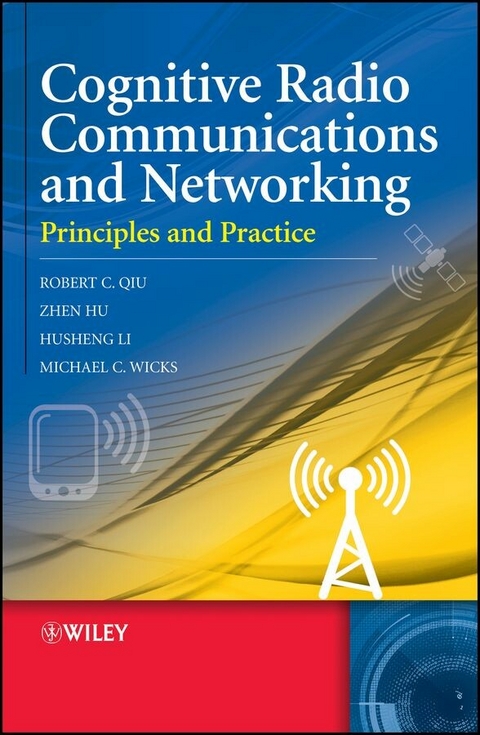
The author presents a unified treatment of this highly interdisciplinary topic to help define the notion of cognitive radio. The book begins with addressing issues such as the fundamental system concept and basic mathematical tools such as spectrum sensing and machine learning, before moving on to more advanced concepts and discussions about the future of cognitive radio. From the fundamentals in spectrum sensing to the applications of cognitive algorithms to radio communications, and discussion of radio platforms and testbeds to show the applicability of the theory to practice, the author aims to provide an introduction to a fast moving topic for students and researchers seeking to develop a thorough understanding of cognitive radio networks.
- Examines basic mathematical tools before moving on to more advanced concepts and discussions about the future of cognitive radio
- Describe the fundamentals of cognitive radio, providing a step by step treatment of the topics to enable progressive learning
- Includes questions, exercises and suggestions for extra reading at the end of each chapter
- Companion website hosting MATLAB codes, and supplementary material including exercises
Topics covered in the book include: Spectrum Sensing: Basic Techniques; Cooperative Spectrum Sensing Wideband Spectrum Sensing; Agile Transmission Techniques: Orthogonal Frequency Division Multiplexing Multiple Input Multiple Output for Cognitive Radio; Convex Optimization for Cognitive Radio; Cognitive Core (I): Algorithms for Reasoning and Learning; Cognitive Core (II): Game Theory; Cognitive Radio Network IEEE 802.22: The First Cognitive Radio Wireless Regional Area Network Standard, and Radio Platforms and Testbeds.
The author presents a unified treatment of this highly interdisciplinary topic to help define the notion of cognitive radio. The book begins with addressing issues such as the fundamental system concept and basic mathematical tools such as spectrum sensing and machine learning, before moving on to more advanced concepts and discussions about the future of cognitive radio. From the fundamentals in spectrum sensing to the applications of cognitive algorithms to radio communications, and discussion of radio platforms and testbeds to show the applicability of the theory to practice, the author aims to provide an introduction to a fast moving topic for students and researchers seeking to develop a thorough understanding of cognitive radio networks. Examines basic mathematical tools before moving on to more advanced concepts and discussions about the future of cognitive radio Describe the fundamentals of cognitive radio, providing a step by step treatment of the topics to enable progressive learning Includes questions, exercises and suggestions for extra reading at the end of each chapter Topics covered in the book include: Spectrum Sensing: Basic Techniques; Cooperative Spectrum Sensing Wideband Spectrum Sensing; Agile Transmission Techniques: Orthogonal Frequency Division Multiplexing Multiple Input Multiple Output for Cognitive Radio; Convex Optimization for Cognitive Radio; Cognitive Core (I): Algorithms for Reasoning and Learning; Cognitive Core (II): Game Theory; Cognitive Radio Network IEEE 802.22: The First Cognitive Radio Wireless Regional Area Network Standard, and Radio Platforms and Testbeds.
Robert C. Qiu, Department of Electrical and Computer Engineering, Tennessee Technological University, USA Professor Qiu is currently Director of the Wireless Networking System Laboratory at Tennessee Technological University, USA. He was Founder-CEO and President of Wiscom Technologies, Inc., manufacturing and marketing WCDMA chipsets. Wiscom was acquired by Intel in 2003. Prior to Wiscom, he worked for GTE Labs, Inc. (now Verizon), Waltham, MA, and Bell Labs, Lucent, Whippany, NJ. He holds 5 U.S. patents (another two pending) in WCDMA. He is co-editor of Ultra-Wideband Wireless Communications and Networks (Wiley), and? has authored over 80 technical (journal/conference) papers and contributed 6 book chapters. Professor Qiu has contributed to 3GPP and IEEE standards bodies, and delivered invited seminars to institutions including Princeton University and the U.S. Army Research Lab. Dr. Qiu serves as Associate Editor, IEEE Transaction on Vehicular Technology, International Journal of Sensor Networks and Wireless Communication and Mobile Computing.
| Erscheint lt. Verlag | 16.8.2012 |
|---|---|
| Sprache | englisch |
| Themenwelt | Technik ► Elektrotechnik / Energietechnik |
| Technik ► Nachrichtentechnik | |
| Schlagworte | Cognitive Radio Communication and Networking, Robert Caiming Qiu, Zhen Hu, Husheng Li, Spectrum Sensing, Cooperative Spectrum Sensing Wideband Spectrum Sensing, Agile Transmission Techniques, Orthogonal Frequency Division • Communication Technology - Networks • Drahtlose Kommunikation • Electrical & Electronics Engineering • Elektrotechnik u. Elektronik • Kommunikationsnetz • Kommunikationsnetze • Mobile & Wireless Communications |
| ISBN-13 | 9781118376287 / 9781118376287 |
| Informationen gemäß Produktsicherheitsverordnung (GPSR) | |
| Haben Sie eine Frage zum Produkt? |
 PDF (Adobe DRM)
Kopierschutz: Adobe-DRM
Adobe-DRM ist ein Kopierschutz, der das eBook vor Mißbrauch schützen soll. Dabei wird das eBook bereits beim Download auf Ihre persönliche Adobe-ID autorisiert. Lesen können Sie das eBook dann nur auf den Geräten, welche ebenfalls auf Ihre Adobe-ID registriert sind.
Details zum Adobe-DRM
Dateiformat: PDF (Portable Document Format)
Mit einem festen Seitenlayout eignet sich die PDF besonders für Fachbücher mit Spalten, Tabellen und Abbildungen. Eine PDF kann auf fast allen Geräten angezeigt werden, ist aber für kleine Displays (Smartphone, eReader) nur eingeschränkt geeignet.
Systemvoraussetzungen:
PC/Mac: Mit einem PC oder Mac können Sie dieses eBook lesen. Sie benötigen eine
eReader: Dieses eBook kann mit (fast) allen eBook-Readern gelesen werden. Mit dem amazon-Kindle ist es aber nicht kompatibel.
Smartphone/Tablet: Egal ob Apple oder Android, dieses eBook können Sie lesen. Sie benötigen eine
Geräteliste und zusätzliche Hinweise
Buying eBooks from abroad
For tax law reasons we can sell eBooks just within Germany and Switzerland. Regrettably we cannot fulfill eBook-orders from other countries.
aus dem Bereich