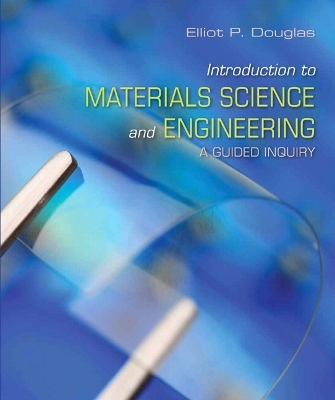
Introduction to Materials Science and Engineering
Pearson
978-0-13-335473-7 (ISBN)
- Titel ist leider vergriffen;
keine Neuauflage - Artikel merken
¿
This unique book is designed to serve as an active learning tool that uses carefully selected information and guided inquiry questions. Guided inquiry helps readers reach true understanding of concepts as they develop greater ownership over the material presented. First, background information or data is presented. Then, concept invention questions lead the students to construct their own understanding of the fundamental concepts represented. Finally, application questions provide the reader with practice in solving problems using the concepts that they have derived from their own valid conclusions.¿
¿
0133354733 / 9780133354737 Introduction to Materials Science and Engineering: A Guided Inquiry with Mastering Engineering with Pearson eText -- Access Card Package
Package consists of:¿¿¿
0132136422 / 9780132136426 Introduction to Materials Science and Engineering: A Guided Inquiry
0133411443 / 9780133411447 MasteringEngineering with Pearson eText -- Access Card -- Introduction to Materials Science
¿
Associate Chair and Associate Professor Distinguished Teaching Scholar Editor-in-Chief, Polymer Reviews Ph.D., Polymer Science and Engineering, University of Massachusetts - Amherst, 1992 S.B., Materials Science and Engineering, MIT, 1988 S.B., Humanities (Music) and Engineering (MSE), MIT, 1988 Elliot P. Douglas is Associate Professor, Dean’s Fellow for Engineering Education, and Distinguished Teaching Scholar in the Department of Materials Science and Engineering at the University of Florida. His research activities are in the areas of active learning, problem solving, critical thinking, and use of qualitative methodologies in engineering education. Specifically, he has published and presented work on the use of guided inquiry as an active learning technique for engineering; how critical thinking is used in practice by students; and how different epistemological stances are enacted in engineering education research. He has been involved in faculty development activities since 1998, through the ExCEEd Teaching Workshops of the American Society of Civil Engineers, the Essential Teaching Seminars of the American Society of Mechanical Engineers, and the US National Science Foundation-sponsored SUCCEED Coalition. He has received several awards for his work, including the Presidential Early Career Award for Scientists and Engineers, the Ralph Teetor Education Award from the Society of Automotive Engineers, being named the University of Florida Teacher of the Year for 2003-04 and the ASEE Southeastern Section Outstanding Teaching Award for 2013. He is a member of the American Society for Engineering Education and the American Educational Research Association and is currently Associate Editor for the Journal of Engineering Education.
Preface
Part I: Introduction
Chapter 1: What is Guided Inquiry?
1.1 First Law of Thermodynamics
1.2 Active Learning
Chapter 2: What is Materials Science and Engineering?
2.1 Types of Materials
2.2 The MSE Triangle
Part II: Atomic and Molecular Structure of Materials
Chapter 3: Bonding
3.1 Electronegativity
3.2 Primary Bonds
3.3 Non-Bonding Interactions
Chapter 4: Atomic Arrangements in Solids
4.1 Crystalline and Amorphous Materials
4.2 Unit Cells
4.3 Miller Indices
4.4 Planes and Directions in Crystals
4.5 Crystalline Defects
4.6 Ceramic Crystal Structures
4.7 Defects in Ceramic Crystals
4.8 Determining Crystal Structure: Diffraction
Chapter 5: The Structure of Polymers
5.1 Molecular Structure
5.2 Molecular Weight
5.3 Polymer Crystals
5.4 The Glass Transition
Chapter 6: Microstructure: Phase Diagrams
6.1 Defining Mixtures
6.2 Isomorphous Binary Phase Diagrams – The Lever Rule
6.3 Isomorphous Binary Phase Diagrams – Microstructure
6.4 Eutectic Phase Diagrams – Microstructure
6.5 Eutectic Phase Diagrams – Microconstituents
6.6 Peritectic Phase Diagrams
6.7 Intermetallic and Ceramic Phase Diagrams
Chapter 7: Diffusion
7.1 Diffusion Mechanisms
7.2 Diffusion Calculations: Fick’s Laws
Chapter 8: Microstructure: Kinetics
8.1 Nucleation and Growth
8.2 Heterogeneous Nucleation
8.3 Equilibrium vs. Nonequilibrium Cooling
8.4 Isothermal Transformation Diagrams
8.5 Continuous Cooling Transformation Diagrams
Part III: Properties and Uses of Materials
Chapter 9: Mechanical Behavior
9.1 Stress-Strain Curves
9.2 Bond-Force and Bond-Energy Curves
9.3 Strength of Metals
9.4 Strengthening Mechanisms for Metals
9.5 Structure-Property-Processing Relationships in Steel
9.6 Polymer Properties
9.7 Properties of Ceramics
9.8 Fracture
9.9 Fatigue
9.10 Hardness
9.11 Viscoelasticity
9.12 Composites
Chapter 10: Materials in the Environment
10.1 Electrochemistry: How Does a Battery Work?
10.2 Corrosion of Metals
10.3 Oxide Formation
10.4 Degradation of Polymers
Chapter 11: Electronic Behavior
11.1 Band Structure of Materials
11.2 Electronic Properties
11.3 Conductors
11.4 Semiconductors
11.5 Solid-State Devices
Chapter 12: Thermal Behavior
12.1 Heat Capacity
12.2 Thermal Expansion
12.3 Thermal Conductivity
Chapter 13: Materials Selection and Design
13.1 Ranking Procedures
13.2 Ashby Plots
| Erscheint lt. Verlag | 15.5.2013 |
|---|---|
| Sprache | englisch |
| Maße | 213 x 254 mm |
| Gewicht | 703 g |
| Themenwelt | Technik ► Maschinenbau |
| ISBN-10 | 0-13-335473-3 / 0133354733 |
| ISBN-13 | 978-0-13-335473-7 / 9780133354737 |
| Zustand | Neuware |
| Informationen gemäß Produktsicherheitsverordnung (GPSR) | |
| Haben Sie eine Frage zum Produkt? |
aus dem Bereich