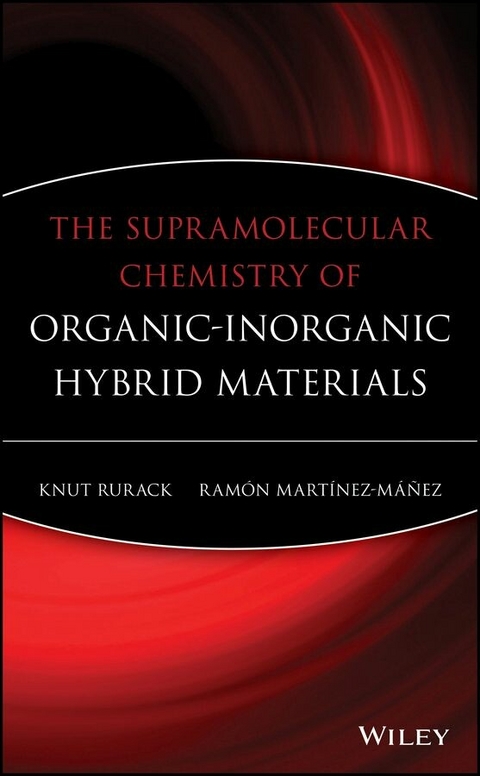
The Supramolecular Chemistry of Organic-Inorganic Hybrid Materials (eBook)
John Wiley & Sons (Verlag)
978-0-470-55269-8 (ISBN)
The book details how these designed materials can improve existing materials or generate novel functional features such as chemical amplification, cooperative binding and signal enhancement that are difficult or not at all achievable by classical organic supramolecular chemistry. It also discusses issues related to nanofabrication or nanotechnology such as the directed and controlled assembly or disassembly, biomimetic functions and strategies, and the gating and switching of surface functions or morphology.
Knut Rurack received his PhD from Humboldt University of Berlin and then joined the BAM Federal Institute for Materials Research and Testing where he currently leads a group in the Bioanalytics Division. The coauthor of over 70 research publications and one patent, he is a member of the German and American Chemical Societies.
Ramón Martínez-Máñez received his PhD in chemistry from the University of Valencia and was a postdoctoral fellow at Cambridge University, UK. He is currently a full professor in the Department of Chemistry at the Polytechnic University of Valencia and the coauthor of more than 170 research publications and eight patents. He is a member of the American Chemical Society.
The combination of supramolecular chemistry, inorganic solids, and nanotechnology has already led to significant advances in many areas such as sensing, controlled motion, and delivery. By making possible an unprecedented tunability of the properties of nanomaterials, these techniques open up whole new areas of application for future supramolecular concepts. The Supramolecular Chemistry of Organic Inorganic Hybrid Materials gathers current knowledge on the subject and provides an overview of the present state and upcoming challenges in this rapidly growing, highly cross- or interdisciplinary research field. The book details how these designed materials can improve existing materials or generate novel functional features such as chemical amplification, cooperative binding and signal enhancement that are difficult or not at all achievable by classical organic supramolecular chemistry. It also discusses issues related to nanofabrication or nanotechnology such as the directed and controlled assembly or disassembly, biomimetic functions and strategies, and the gating and switching of surface functions or morphology.
KNUT RURACK received his PhD from Humboldt University of Berlin and then joined the BAM Federal Institute for Materials Research and Testing where he currently leads a group in the Bioanalytics Division. The coauthor of over 70 research publications and one patent, he is a member of the German and American Chemical Societies. RAMÓN MARTÍNEZ-MÁÑEZ received his PhD in chemistry from the University of Valencia and was a postdoctoral fellow at Cambridge University, UK. He is currently a full professor in the Department of Chemistry at the Polytechnic University of Valencia and the coauthor of more than 170 research publications and eight patents. He is a member of the American Chemical Society.
Preface.
Editors and Contributors.
1. Hybrid (Nano)Materials Meet Supramolecular Chemistry: A BriefIntroduction To Basic Terms And Concepts (Knut Rurack andRamón Martínez-Máñez).
2. Supramolecular Chemistry at the Mesoscale (KatsuhikoAriga, Gary J. Richards, Jonathan P. Hill, Ajayan Vinu, andToshiyuki Mori).
Part One Organic-Inorganic Hybrid Nanomaterials.
3. Silica-Based Mesoporous Organic-Inorganic Hybrid Materials(Frank Hoffmann and Michael Fröba).
4. Modified Gold Nanoparticles and Surfaces (Paolo Pengo andLucia Pasquato).
5. Organically Functionalized Semiconductor Nanocrystals:Synthesis, Properties and System Design for OptoelectronicApplications (Peter Reiss, Julia De Girolamo and AdamPron).
6. Functionalized Carbon Nanotubes for Bioapplications(Lingrong Gu, Fushen Lu, Pengju G. Luo, Haifang Wang, MohammedJ. Meziani, and Ya-Ping Sun).
7. Metal-Organic Frameworks (MOFs) and Coordination Polymers(Shin-Ichiro Noro and Susumu Kitagawa).
Part Two Improvement of Signaling and Sensing by Organizationon Surfaces.
8. Nanoparticle and Biomolecular-Nanoparticle HybridSupramolecular Complexes for Electrochemical Signaling (RonenPolsky, Jason C. Harper and Susan M. Brozik).
9. Modified Nanoparticles as Nanoelectrocatalysts and AmplifyingSensors (Shaojun Guo, Erkang Wang and Xiurong Yang).
10. Signal Generation with Gold Nanoparticles: PhotophysicalProperties for Sensor and Imaging Applications (Qingshan Wei andAlexander Wei).
11. Optical Signaling with Silica Nanoparticles (FabrizioMancin, Paolo Tecilla, and Umberto Tonellato).
12. Organically Modified Quantum Dots in Chemical andBiochemical Analysis (María Teresa FernándezArgüelles, José M. Costa-Fernández, Rosario Pereiroand Alfredo Sanz-Medel).
Part Three Control of Supramolecular Nanofabrication, Motion,and Morphology.
13. Chemically Directed Self-Assembly of Nanoparticle Structureson Surfaces (Xing Yi Ling, David N. Reinhoudt and JurriaanHuskens).
14. Immobilization and Patterning of Biomolecules on Surfaces(Dorota I. Rozkiewicz, Bart Jan Ravoo, and David N.Reinhoudt).
15. Switchable Host-Guest Chemistry on Surfaces (Jilie Kong,Chunming Jiang and Li Mu).
16. Nanogated Mesoporous Silica Materials (Igor I. Slowing,Brian G. Trewyn, and Victor S.-Y. Lin).
17. Building Molecular Machines on Surfaces (Alberto Credi,Serena Silvi, and Margherita Venturi).
18. Control of Morphology in Mesoporous and MesostructuredHybrid Materials (Darren Dunphy, Bernd Smarsly, and C. JeffreyBrinker).
Part Four Biomimetic Chemistry.
19. Biomimetically Inspired Signaling (Knut Rurack,Ramón Martínez-Máñez, Félix Sancenónand Ana B. Descalzo).
20. Imprinted Functionalized Silica (Maryanne M.Collinson).
21. Bioinspired Block Copolymer-Based Hybrid Materials(Marleen Kamperman and Ulrich Wiesner).
Part Five Interfacial Chemistry, Multifunctionality, andInterdisciplinarity.
22. Emerging Concepts in Interfacial Chemistry of HybridMaterials: Nanocontainer-Based Self-Healing Coatings (Dmitry G.Shchukin, Daria V. Andreeva, Katja Skorb, and HelmuthMöhwald).
23. Molecular Schizophrenics: Switchable Materials with MultipleFunctions (Robert Byrne and Dermot Diamond).
24. Hybrid Nanomaterials Research: Is It ReallyInterdisciplinary? (Ismael Rafols, Martin Meyer, and Jae-HwanPark).
25. Supramolecular Chemistry Meets Hybrid (Nano)Materials: A Brief Look Ahead (Knut Rurack and RamónMartínez-Máñez).
Appendix 1.
Index.
"This book will find use for those generally interested in such
hybrid systems. With some prior knowledge, one can browse through
the topics and then proceed to the literature for more complete and
in-depth coverage." (JACS, 2010)
| Erscheint lt. Verlag | 7.4.2010 |
|---|---|
| Sprache | englisch |
| Themenwelt | Naturwissenschaften ► Chemie ► Organische Chemie |
| Technik ► Maschinenbau | |
| Schlagworte | Advances • already • Analytical Chemistry • Analytische Chemie • application • Applications • Areas • Chemie • Chemistry • combination • Concepts • Introduction • many • Nanomaterialien • nanomaterials • Nanotechnologie • nanotechnology • possible • Properties • sensing • significant • Supramolecular • supramolecular chemistry • supramolecular hybrid • Supramolekulare Chemie • unprecedented tunability |
| ISBN-10 | 0-470-55269-7 / 0470552697 |
| ISBN-13 | 978-0-470-55269-8 / 9780470552698 |
| Informationen gemäß Produktsicherheitsverordnung (GPSR) | |
| Haben Sie eine Frage zum Produkt? |
 PDF (Adobe DRM)
Kopierschutz: Adobe-DRM
Adobe-DRM ist ein Kopierschutz, der das eBook vor Mißbrauch schützen soll. Dabei wird das eBook bereits beim Download auf Ihre persönliche Adobe-ID autorisiert. Lesen können Sie das eBook dann nur auf den Geräten, welche ebenfalls auf Ihre Adobe-ID registriert sind.
Details zum Adobe-DRM
Dateiformat: PDF (Portable Document Format)
Mit einem festen Seitenlayout eignet sich die PDF besonders für Fachbücher mit Spalten, Tabellen und Abbildungen. Eine PDF kann auf fast allen Geräten angezeigt werden, ist aber für kleine Displays (Smartphone, eReader) nur eingeschränkt geeignet.
Systemvoraussetzungen:
PC/Mac: Mit einem PC oder Mac können Sie dieses eBook lesen. Sie benötigen eine
eReader: Dieses eBook kann mit (fast) allen eBook-Readern gelesen werden. Mit dem amazon-Kindle ist es aber nicht kompatibel.
Smartphone/Tablet: Egal ob Apple oder Android, dieses eBook können Sie lesen. Sie benötigen eine
Geräteliste und zusätzliche Hinweise
Buying eBooks from abroad
For tax law reasons we can sell eBooks just within Germany and Switzerland. Regrettably we cannot fulfill eBook-orders from other countries.
aus dem Bereich