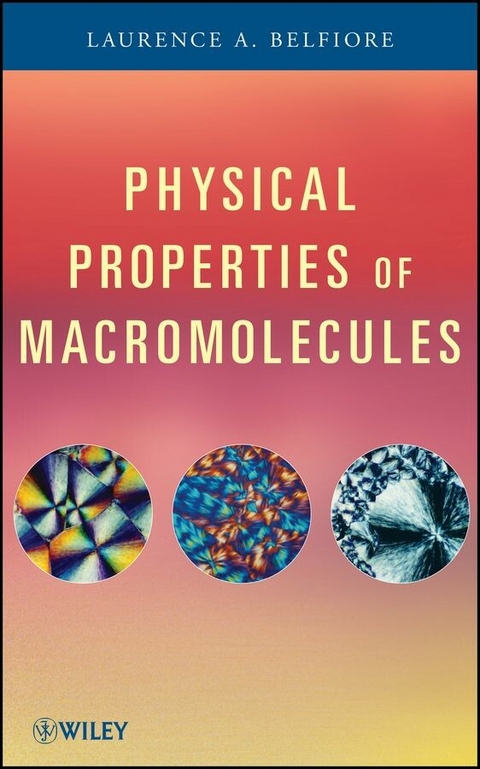
Physical Properties of Macromolecules (eBook)
John Wiley & Sons (Verlag)
978-0-470-55158-5 (ISBN)
Taking a fresh approach to polymer physical chemistry, Physical Properties of Macromolecules integrates the two foundations of physical polymer science, theory and practice. It provides the tools to understand polymer science concepts and research methods, while also instructing how to analyze experimental data.
Drawing on the author's own extensive research in physical properties of polymers as well as more traditional topics, this text offers detailed analysis of numerous problems in polymer science, including laboratory data and research results. Topics include:
- Solid-state dynamics of polymeric materials
Glass transitions in amorphous polymers
Semicrystalline polymers and melting transitions
Viscoelastic behavior
Relaxation processes
Macromolecule-metal complexes
Mechanical properties of linear and crosslinked polymers
Filled with detailed graphs to help explain important quantitative trends, Physical Properties of Macromolecules teaches by example, ensuring comprehension of the subject as well as the methodology to implement theory, problem-solving techniques, and research results in practical situations. This resource serves as the ideal companion for government laboratories, industrial research scientists, engineers, and professionals in polymer science fields who are interested in fully grasping all aspects of physical polymer science.
Explains and analyzes polymer physical chemistry research methods and experimental data Taking a fresh approach to polymer physical chemistry, Physical Properties of Macromolecules integrates the two foundations of physical polymer science, theory and practice. It provides the tools to understand polymer science concepts and research methods, while also instructing how to analyze experimental data. Drawing on the author's own extensive research in physical properties of polymers as well as more traditional topics, this text offers detailed analysis of numerous problems in polymer science, including laboratory data and research results. Topics include: Solid-state dynamics of polymeric materials Glass transitions in amorphous polymers Semicrystalline polymers and melting transitions Viscoelastic behavior Relaxation processes Macromolecule-metal complexes Mechanical properties of linear and crosslinked polymers Filled with detailed graphs to help explain important quantitative trends, Physical Properties of Macromolecules teaches by example, ensuring comprehension of the subject as well as the methodology to implement theory, problem-solving techniques, and research results in practical situations. This resource serves as the ideal companion for government laboratories, industrial research scientists, engineers, and professionals in polymer science fields who are interested in fully grasping all aspects of physical polymer science.
LARRY BELFIORE, PhD, is a professor of chemical engineering in the department of chemical and biological engineering at Colorado State University. He has written seventy refereed journal publications, seven book chapters, thirty-four proceedings, and has presented more than one hundred lectures at national and international symposia. He is the author of Transport Phenomena for Chemical Reactor Design, published by Wiley.
Preface.
Part One Glass Transitions in Amorphous Polymers.
1. Glass Transitions in Amorphous Polymers: Basic Concepts.
2. Diffusion in Amorphous Polymers Near the Glass Transition
Temperature.
3. Lattice Theories for Polymer-Small-Molecule Mixtures
and the Conformational Entropy Description of the Glass Transition
Temperature.
4. dc Electric Field Effects on First- and Second-Order Phase
Transitions in Pure Materials and Binary Mixtures.
5. Order Parameters for Glasses: Pressure and Compositional
Dependence of the Glass Transition Temperature.
6. Macromolecule-Metal Complexes: Ligand Field
Stabilization and Glass Transition Temperature Enhancement.
Part Two Semicrystalline Polymers and Melting
Transitions.
7. Basic Concepts and Molecular Optical Anisotropy in
Semicrystalline Polymers.
8. Crystallization Kinetics via Spherulitic Growth.
9. Experimental Analysis of Semicrystalline Polymers.
Part Three Mechanical Properties of Linear and Crosslinked
Polymers.
10. Mechanical Properties of Viscoelastic Materials: Basic
Concepts in Linear Viscoelasticity.
11. Nonlinear Stress Relaxation in Macromolecule-Metal
Complexes.
12. Kinetic Analysis of Molecular Weight Distribution Functions
in Linear Polymers.
13. Gaussian Statistics of Linear Chain Molecules and
Crosslinked Elastomers.
14. Classical and Statistical Thermodynamics of Rubber-Like
Materials.
Part Four Solid State Dynamics of Polymeric
Materials.
15. Molecular Dynamics via Magnetic Resonance, Viscoelastic, and
Dielectric Relaxation Phenomena.
16. Magnetic Spin Diffusion at the Nanoscale in Multiphase
Polymers and Molecular Complexes.
Index.
Postface.
"This resource serves as the ideal companion for government
laboratories, industrial research scientists, engineers and
professionals in polymer science fields who are interested in fully
grasping all aspects of physical polymer science". (ET Polymers, 8
January 2011)
| Erscheint lt. Verlag | 19.10.2010 |
|---|---|
| Sprache | englisch |
| Themenwelt | Naturwissenschaften ► Chemie ► Organische Chemie |
| Technik ► Maschinenbau | |
| Schlagworte | Analytical Chemistry • Analytische Chemie • Approach • Chemie • Chemistry • Concepts • Data • Experimental • extensive • Foundations • Fresh • integrates • Macromolecules • Materials Science • Materialwissenschaften • Methods • Optical and Non-Linear Optical Materials • Optische Materialien • Optische u. Nichtlineare Optische Materialien • Physical • Polymer • Polymere • Polymer Science & Technology • Polymerwissenschaft u. -technologie • Properties • Research • Science • Tools • Traditional |
| ISBN-10 | 0-470-55158-5 / 0470551585 |
| ISBN-13 | 978-0-470-55158-5 / 9780470551585 |
| Informationen gemäß Produktsicherheitsverordnung (GPSR) | |
| Haben Sie eine Frage zum Produkt? |
 PDF (Adobe DRM)
Kopierschutz: Adobe-DRM
Adobe-DRM ist ein Kopierschutz, der das eBook vor Mißbrauch schützen soll. Dabei wird das eBook bereits beim Download auf Ihre persönliche Adobe-ID autorisiert. Lesen können Sie das eBook dann nur auf den Geräten, welche ebenfalls auf Ihre Adobe-ID registriert sind.
Details zum Adobe-DRM
Dateiformat: PDF (Portable Document Format)
Mit einem festen Seitenlayout eignet sich die PDF besonders für Fachbücher mit Spalten, Tabellen und Abbildungen. Eine PDF kann auf fast allen Geräten angezeigt werden, ist aber für kleine Displays (Smartphone, eReader) nur eingeschränkt geeignet.
Systemvoraussetzungen:
PC/Mac: Mit einem PC oder Mac können Sie dieses eBook lesen. Sie benötigen eine
eReader: Dieses eBook kann mit (fast) allen eBook-Readern gelesen werden. Mit dem amazon-Kindle ist es aber nicht kompatibel.
Smartphone/Tablet: Egal ob Apple oder Android, dieses eBook können Sie lesen. Sie benötigen eine
Geräteliste und zusätzliche Hinweise
Buying eBooks from abroad
For tax law reasons we can sell eBooks just within Germany and Switzerland. Regrettably we cannot fulfill eBook-orders from other countries.
aus dem Bereich