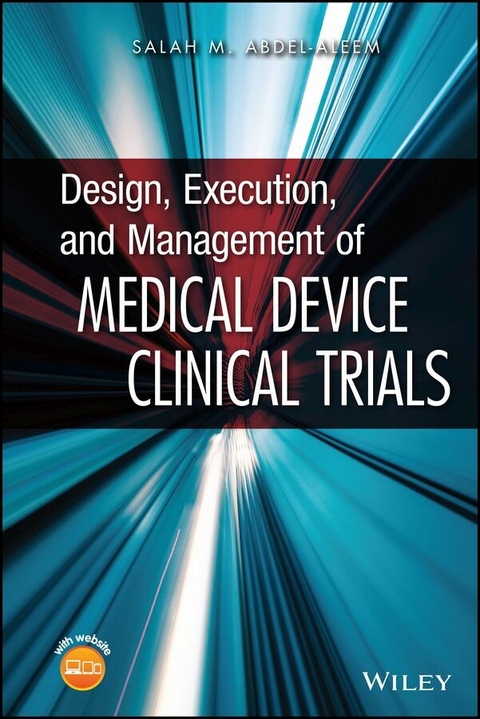
Design, Execution, and Management of Medical Device Clinical Trials (eBook)
John Wiley & Sons (Verlag)
978-0-470-47590-4 (ISBN)
Clinical research continues to be one of the most vital components of pharmaceutical, biostatistical, and medical studies. Design, Execution, and Management of Medical Device Clinical Trials provides a uniform methodology for conducting and managing clinical trials. Written in a style that is accessible to readers from diverse educational and professional backgrounds, this book provides an in-depth and broad overview for successfully performing clinical tasks and activities.
Throughout the book, practical examples compiled from both the author's and other researchers' previous clinical trial experiences are discussed in a sequential manner as they occur in the study, starting from the development of the clinical protocol and the selection of clinical sites and ending with the completion of the final clinical study report. Next, readers are guided through the development of important clinical documents, including informed consent forms, case report forms, and study logs. A careful review of the Food and Drug Administration (FDA) and International Conference on Harmonisation (ICH) regulations applicable to medical devices is also featured. Additional coverage includes:
-
Qualification and selection of investigators
-
Study monitoring visits
-
Definitions and reporting procedures for adverse events
-
The use of biostatistical methodology in clinical research, including the use of biostatistics for sample size determination and study endpoints
-
The roles and responsibilities of all members of a clinical research team
The book concludes with an insightful discussion of special ethical conduct for human research and challenging issues to consider during the design of clinical studies. A glossary lists important clinical and statistical terms used in clinical research, and an extensive reference section provides additional resources for the most up-to-date literature on the topic.
Design, Execution, and Management of Medical Device Clinical Trials is an excellent book for clinical research or epidemiology courses at the upper-undergraduate and graduate levels. It is also an indispensable reference for clinical research associates, clinical managers, clinical scientists, biostatisticians, pharmacologists, and any professional working in the field of clinical research who would like to better understand clinical research practices.
SALAH M. ABDEL-ALEEM, PHD, is Senior Manager of Clinical Operations at Proteus Biomedical, Inc., a medical device and pharmaceutical company that develops therapies for cardiovascular and diabetic diseases. Dr. Abdel-aleem has over twenty years of clinical research experience in various academic and corporate settings.
An essential introduction to conducting the various stages of medical device clinical trials Clinical research continues to be one of the most vital components of pharmaceutical, biostatistical, and medical studies. Design, Execution, and Management of Medical Device Clinical Trials provides a uniform methodology for conducting and managing clinical trials. Written in a style that is accessible to readers from diverse educational and professional backgrounds, this book provides an in-depth and broad overview for successfully performing clinical tasks and activities. Throughout the book, practical examples compiled from both the author's and other researchers' previous clinical trial experiences are discussed in a sequential manner as they occur in the study, starting from the development of the clinical protocol and the selection of clinical sites and ending with the completion of the final clinical study report. Next, readers are guided through the development of important clinical documents, including informed consent forms, case report forms, and study logs. A careful review of the Food and Drug Administration (FDA) and International Conference on Harmonisation (ICH) regulations applicable to medical devices is also featured. Additional coverage includes: Qualification and selection of investigators Study monitoring visits Definitions and reporting procedures for adverse events The use of biostatistical methodology in clinical research, including the use of biostatistics for sample size determination and study endpoints The roles and responsibilities of all members of a clinical research team The book concludes with an insightful discussion of special ethical conduct for human research and challenging issues to consider during the design of clinical studies. A glossary lists important clinical and statistical terms used in clinical research, and an extensive reference section provides additional resources for the most up-to-date literature on the topic. Design, Execution, and Management of Medical Device Clinical Trials is an excellent book for clinical research or epidemiology courses at the upper-undergraduate and graduate levels. It is also an indispensable reference for clinical research associates, clinical managers, clinical scientists, biostatisticians, pharmacologists, and any professional working in the field of clinical research who would like to better understand clinical research practices.
SALAH M. ABDEL-ALEEM, PHD, is Senior Manager of Clinical Operations at Proteus Biomedical, Inc., a medical device and pharmaceutical company that develops therapies for cardiovascular and diabetic diseases. Dr. Abdel-aleem has over twenty years of clinical research experience in various academic and corporate settings.
DESIGN, EXECUTION, AND MANAGEMENT OF MEDICAL DEVICE CLINICAL TRIALS 3
CONTENTS 9
List of Abbreviations 13
Preface 17
Acknowledgments 23
1 An Overview of Clinical Study Tasks and Activities 25
Key Clinical Study Tasks and Activities 26
Discussion of Key Tasks and Activities 27
Management of Key Clinical Tasks and Activities 33
Example of the Spread Sheet for Managing Clinical Study Activities 34
The Clinical Research Team 34
2 Development of Clinical Protocols, Case Report Forms, Clinical Standard Operating Procedures, Informed Consent Form, Study Regulatory Binder, Study Research Agreement, and Other Clinical Materials 39
Clinical Protocol 41
Case Report Forms (CRFs) 52
Example of the Case Report Form Template 56
Informed Consent Form (ICF) 59
Instructions for Use of Device 62
Study Regulatory Binder 63
Study Research Agreement 64
Research Agreement Template 67
Research Contract Challenges 74
Clinical Forms and Certificates 75
Clinical Standard Operating Procedures (SOPs) 78
3 Qualification/Selection of Study Investigators and Study Monitoring Visits 87
Qualification and Selection of Investigators 88
Monitoring Visits 91
Monitoring Reports 97
Interim Monitoring Visit Report Template 99
4 Adverse Events Definitions and Reporting Procedures 105
Adverse Event Definitions 107
Policies, Regulations, and Guidelines Regarding Adverse Event Reporting 108
Adverse Event Reporting Pathway 108
Terms for Causality Assessment 109
GAPS/Challenges in Adverse Event Reporting 110
Adverse Event Reporting Time Periods (21 CFR 803) 112
Differences between the United States and Europe in Reporting Adverse Events 112
Serious Adverse Event Narratives 113
Classification of Adverse Events 114
Special Requirement for Reporting Certain Adverse Events 116
Case Example 116
Mandatory Device Reporting for FDA-Approved Devices 116
5 Statistical Analysis Plan (SAP) and Biostatistics in Clinical Research 117
Statistical Analysis Plan (SAP) 118
Selection of Study Endpoints 121
Biostatistics in Clinical Research 125
6 Final Clinical Study Report 137
Final Clinical Report’s Outline 138
Discussion of Sections in the Final Clinical Report 140
7 Medical Device Regulations, Combination Product, Study Committees, and FDA-Sponsor Meetings 151
Medical Device Regulations 153
Combination Products 188
Study Committees 192
FDA-Sponsor Meetings 194
Registration of Clinical Trials 198
Implementation of the HIPAA Privacy Rule in Clinical Research 199
Institutional Review Boards (IRB) 204
FDA’s Oversight of Clinical Trials (Bioresearch Monitoring) 215
Code of Federal Regulations of Medical Devices 218
8 Design Issues in Medical Devices Studies 219
Design of the Clinical Trial 220
Assumptions and Parameters of Clinical Trial Design 220
Clinical Trials’ Design Issues and Data Analysis Issues 226
Use of Historic Controls as the Control Group in IDE Studies 230
Summary of Recommendations When Using Historic Controls 242
9 Investigator-Initiated Clinical Research 245
Definition and Examples of Investigator-Initiated Clinical Research 246
Development, Conduct, and Management of Investigator-Initiated Clinical Research 248
Regulation of Investigator-Initiated Clinical Research 249
Required Infrastructure for Investigator-Initiated Clinical Research 250
Clinical Research Sponsored by NIH 251
10 Ethical Conduct for Human Research 253
The Nuremberg Code (1947) 254
World Medical Association—Declaration of Helsinki (1964–Present) 255
National Commission for the Protection of Human Subjects of Biomedical and Behavioral Research (1974) 255
The Belmont Report (1978) 256
Special Ethical Concerns in Clinical Research on Use of Placebo 256
Glossary of Clinical Trial and Statistical Terms 259
References 273
Index 279
| Erscheint lt. Verlag | 19.8.2009 |
|---|---|
| Zusatzinfo | Charts: 4 B&W, 0 Color; Screen captures: 0 B&W, 0 Color; Graphs: 1 B&W, 0 Color |
| Sprache | englisch |
| Themenwelt | Mathematik / Informatik ► Mathematik ► Statistik |
| Mathematik / Informatik ► Mathematik ► Wahrscheinlichkeit / Kombinatorik | |
| Medizin / Pharmazie | |
| Technik ► Medizintechnik | |
| Schlagworte | accessible • Activities • Biostatistics • Biostatistik • Book • broad • Clinical • Clinical Trials • Continues • device clinical • essential introduction • Klinische Studien • Managing • Medical • Medical Science • Medizin • Methodology • Overview • performing • Pharmacology & Pharmaceutical Medicine • Pharmakologie u. Pharmazeutische Medizin • Pharmazeutische Medizin • Professional • Readers • Research • Stages • Statistics • Statistik • Studies • Style • Uniform • various |
| ISBN-10 | 0-470-47590-0 / 0470475900 |
| ISBN-13 | 978-0-470-47590-4 / 9780470475904 |
| Informationen gemäß Produktsicherheitsverordnung (GPSR) | |
| Haben Sie eine Frage zum Produkt? |
 PDF (Adobe DRM)
Kopierschutz: Adobe-DRM
Adobe-DRM ist ein Kopierschutz, der das eBook vor Mißbrauch schützen soll. Dabei wird das eBook bereits beim Download auf Ihre persönliche Adobe-ID autorisiert. Lesen können Sie das eBook dann nur auf den Geräten, welche ebenfalls auf Ihre Adobe-ID registriert sind.
Details zum Adobe-DRM
Dateiformat: PDF (Portable Document Format)
Mit einem festen Seitenlayout eignet sich die PDF besonders für Fachbücher mit Spalten, Tabellen und Abbildungen. Eine PDF kann auf fast allen Geräten angezeigt werden, ist aber für kleine Displays (Smartphone, eReader) nur eingeschränkt geeignet.
Systemvoraussetzungen:
PC/Mac: Mit einem PC oder Mac können Sie dieses eBook lesen. Sie benötigen eine
eReader: Dieses eBook kann mit (fast) allen eBook-Readern gelesen werden. Mit dem amazon-Kindle ist es aber nicht kompatibel.
Smartphone/Tablet: Egal ob Apple oder Android, dieses eBook können Sie lesen. Sie benötigen eine
Geräteliste und zusätzliche Hinweise
Buying eBooks from abroad
For tax law reasons we can sell eBooks just within Germany and Switzerland. Regrettably we cannot fulfill eBook-orders from other countries.
aus dem Bereich