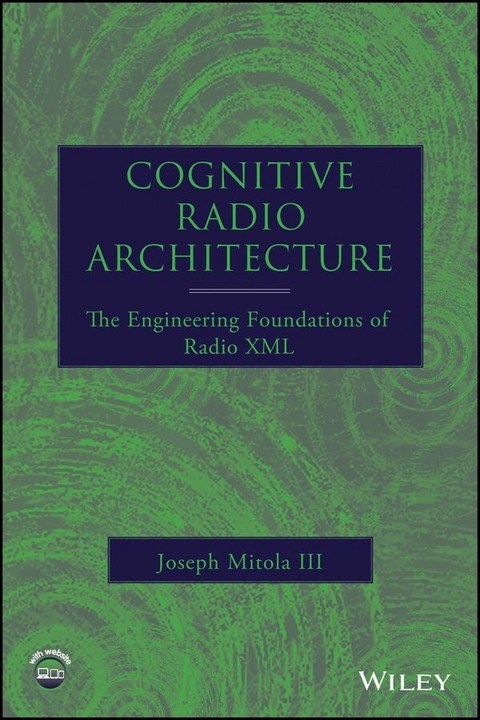
Cognitive Radio Architecture (eBook)
John Wiley & Sons (Verlag)
978-0-471-77372-6 (ISBN)
This is the first book dedicated to cognitive radio, a promising new technology that is poised to revolutionize the telecommunications industry with increased wireless flexibility. Cognitive radio technology integrates computational intelligence into software-defined radio for embedded intelligent agents that adapt to RF environments and user needs. Using this technology, users can more fully exploit the radio spectrum and services available from wireless connectivity. For example, an attempt to send a 10MB e-mail in a zone where carrier charges are high might cause a cognitive radio to alert its user and suggest waiting until getting to the office to use the LAN instead. Cognitive Radio Architecture examines an 'ideal cognitive radio' that features autonomous machine learning, computer vision, and spoken or written language perception.
The author of this exciting new book is the inventor of the technology and a leader in the field. Following his step-by-step introduction, readers can start building aware/adaptive radios and then make steps towards cognitive radio. After an introduction to adaptive, aware, and cognitive radio, the author develops three major themes in three sections:
- Foundations
- Radio Competence
- User Domain Competence
The book makes the design principles of cognitive radio more accessible to students of teleinformatics, as well as to wireless communications systems developers. It therefore embraces the practice of cognitive radio as well as the theory. In particular, the publication develops a cognitive architecture that integrates disparate disciplines, including autonomous machine learning, computer vision, and language perception technologies. An accompanying CD-ROM contains the Java source code and compiled class files for applications developed in the book. In addition, for the convenience of the reader, Web resources introducing key concepts such as speech applications programmer interfaces (APIs) are included.
Although still five to ten years away from full deployment, telecommunications giants and research labs around the world are already dedicating R&D to this new technology. Telecommunications engineers as well as advanced undergraduate and graduate students can learn the promising possibilities of this innovative technology from the one who invented it.
Note: CD-ROM/DVD and other supplementary materials are not included as part of eBook file.
Dr. JOSEPH MITOLA III is a Consulting Scientist with The MITRE Corporation. A pioneer in telecommunications, Dr. Mitola published the first paper on software radios in 1992 and continues to write and teach extensively on this technology. His current research interests center on enhancing the computational intelligence of software radios to develop cognitive radios.
An exciting new technology, described by the one who invented it This is the first book dedicated to cognitive radio, a promising new technology that is poised to revolutionize the telecommunications industry with increased wireless flexibility. Cognitive radio technology integrates computational intelligence into software-defined radio for embedded intelligent agents that adapt to RF environments and user needs. Using this technology, users can more fully exploit the radio spectrum and services available from wireless connectivity. For example, an attempt to send a 10MB e-mail in a zone where carrier charges are high might cause a cognitive radio to alert its user and suggest waiting until getting to the office to use the LAN instead. Cognitive Radio Architecture examines an "e;ideal cognitive radio"e; that features autonomous machine learning, computer vision, and spoken or written language perception. The author of this exciting new book is the inventor of the technology and a leader in the field. Following his step-by-step introduction, readers can start building aware/adaptive radios and then make steps towards cognitive radio. After an introduction to adaptive, aware, and cognitive radio, the author develops three major themes in three sections: Foundations Radio Competence User Domain Competence The book makes the design principles of cognitive radio more accessible to students of teleinformatics, as well as to wireless communications systems developers. It therefore embraces the practice of cognitive radio as well as the theory. In particular, the publication develops a cognitive architecture that integrates disparate disciplines, including autonomous machine learning, computer vision, and language perception technologies. In addition, for the convenience of the reader, Web resources introducing key concepts such as speech applications programmer interfaces (APIs) are included. Although still five to ten years away from full deployment, telecommunications giants and research labs around the world are already dedicating R&D to this new technology. Telecommunications engineers as well as advanced undergraduate and graduate students can learn the promising possibilities of this innovative technology from the one who invented it.
Dr. JOSEPH MITOLA III is a Consulting Scientist with The MITRE Corporation. A pioneer in telecommunications, Dr. Mitola published the first paper on software radios in 1992 and continues to write and teach extensively on this technology. His current research interests center on enhancing the computational intelligence of software radios to develop cognitive radios.
Preface.
1. Introduction.
SECTION I: FOUNDATIONS.
2. Technical Overview.
3. Evolving from Aware and Adaptive to Cognitive Radio.
4. Autonomous Machine Learning for AACR.
5. Cognitive Radio Architecture.
6. Introduction to CRI.
SECTION II: RADIO COMPETENCE.
7. Radio Domain Use Cases.
8. Radio Knowledge.
9. Implementing Radio Domain Skills.
SECTION III: USER DOMAIN COMPETENCE.
10. User Domain Use Cases.
11. User-Domain Knowledge.
12. Implementing User Domain Skills.
13. Semantic Radio.
14. Conclusions.
Glossary.
15. References.
| Erscheint lt. Verlag | 30.9.2006 |
|---|---|
| Sprache | englisch |
| Themenwelt | Technik ► Elektrotechnik / Energietechnik |
| Technik ► Nachrichtentechnik | |
| Schlagworte | Adapt • Agents • book dedicated • Computational • Computer Science • Drahtlose Kommunikation • Electrical & Electronics Engineering • Elektrotechnik u. Elektronik • First • flexibility • Industry • Informatik • integrates • Intelligence • Intelligent • Mobile & Wireless Communications • Networking • Netzwerke • New • One • Programmierung u. Software-Entwicklung • Programming & Software Development • Radio • softwaredefined • Technology • telecommunications • Users • Wireless |
| ISBN-10 | 0-471-77372-7 / 0471773727 |
| ISBN-13 | 978-0-471-77372-6 / 9780471773726 |
| Informationen gemäß Produktsicherheitsverordnung (GPSR) | |
| Haben Sie eine Frage zum Produkt? |
 PDF (Adobe DRM)
Kopierschutz: Adobe-DRM
Adobe-DRM ist ein Kopierschutz, der das eBook vor Mißbrauch schützen soll. Dabei wird das eBook bereits beim Download auf Ihre persönliche Adobe-ID autorisiert. Lesen können Sie das eBook dann nur auf den Geräten, welche ebenfalls auf Ihre Adobe-ID registriert sind.
Details zum Adobe-DRM
Dateiformat: PDF (Portable Document Format)
Mit einem festen Seitenlayout eignet sich die PDF besonders für Fachbücher mit Spalten, Tabellen und Abbildungen. Eine PDF kann auf fast allen Geräten angezeigt werden, ist aber für kleine Displays (Smartphone, eReader) nur eingeschränkt geeignet.
Systemvoraussetzungen:
PC/Mac: Mit einem PC oder Mac können Sie dieses eBook lesen. Sie benötigen eine
eReader: Dieses eBook kann mit (fast) allen eBook-Readern gelesen werden. Mit dem amazon-Kindle ist es aber nicht kompatibel.
Smartphone/Tablet: Egal ob Apple oder Android, dieses eBook können Sie lesen. Sie benötigen eine
Geräteliste und zusätzliche Hinweise
Buying eBooks from abroad
For tax law reasons we can sell eBooks just within Germany and Switzerland. Regrettably we cannot fulfill eBook-orders from other countries.
aus dem Bereich