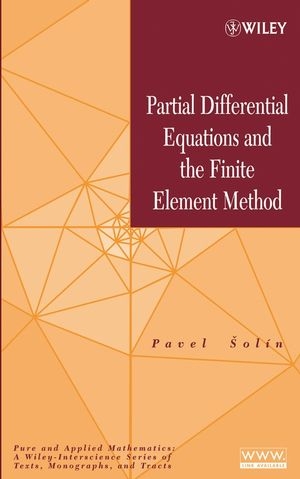
Partial Differential Equations and the Finite Element Method (eBook)
512 Seiten
John Wiley & Sons (Verlag)
978-0-471-76409-0 (ISBN)
equations and modern finite element methods for their efficient
numerical solution
Partial Differential Equations and the Finite Element Method
provides a much-needed, clear, and systematic introduction to
modern theory of partial differential equations (PDEs) and finite
element methods (FEM). Both nodal and hierachic concepts of the FEM
are examined. Reflecting the growing complexity and multiscale
nature of current engineering and scientific problems, the author
emphasizes higher-order finite element methods such as the spectral
or hp-FEM.
A solid introduction to the theory of PDEs and FEM contained in
Chapters 1-4 serves as the core and foundation of the publication.
Chapter 5 is devoted to modern higher-order methods for the
numerical solution of ordinary differential equations (ODEs) that
arise in the semidiscretization of time-dependent PDEs by the
Method of Lines (MOL). Chapter 6 discusses fourth-order PDEs rooted
in the bending of elastic beams and plates and approximates their
solution by means of higher-order Hermite and Argyris elements.
Finally, Chapter 7 introduces the reader to various PDEs governing
computational electromagnetics and describes their finite element
approximation, including modern higher-order edge elements for
Maxwell's equations.
The understanding of many theoretical and practical aspects of both
PDEs and FEM requires a solid knowledge of linear algebra and
elementary functional analysis, such as functions and linear
operators in the Lebesgue, Hilbert, and Sobolev spaces. These
topics are discussed with the help of many illustrative examples in
Appendix A, which is provided as a service for those readers who
need to gain the necessary background or require a refresher
tutorial. Appendix B presents several finite element computations
rooted in practical engineering problems and demonstrates the
benefits of using higher-order FEM.
Numerous finite element algorithms are written out in detail
alongside implementation discussions. Exercises, including many
that involve programming the FEM, are designed to assist the reader
in solving typical problems in engineering and science.
Specifically designed as a coursebook, this student-tested
publication is geared to upper-level undergraduates and graduate
students in all disciplines of computational engineeringand
science. It is also a practical problem-solving reference for
researchers, engineers, and physicists.
PAVEL SOLÍN, PhD, is Associate Professor in the Department of Mathematical Sciences at The University of Texas at El Paso. Prior to this appointment, Dr. Solin was a postdoctoral research associate at the Johannes Kepler University (Linz, Austria), The University of Texas at Austin, and Rice University (Houston, Texas). He received his PhD from the Charles University in Prague, Czech Republic, in 1999. Dr. Sol?n is a coauthor of the monograph Higher-Order Finite Element Methods.
List of Figures.
List of Tables.
Preface.
Acknowldegments.
1. Partial Differential Equations.
2. Continuous Elements for 1D Problems.
3. General Concept of Nodal Elements.
4. Continuous Finite Elements for 2D Problems.
5. Transient Problems and ODE Solvers.
6. Beam and Plate Bending Problems.
7. Equations of Electrimagnetics.
Appendix A: Basics of Functional Analysis.
Appendix B: Software and Examples.
References.
Index.
"This well-written book discusses the modern methods of partial differential equations and the finite element methods...recommended." (CHOICE, July 2006)
| Erscheint lt. Verlag | 16.12.2005 |
|---|---|
| Reihe/Serie | Wiley Series in Pure and Applied Mathematics | Wiley Series in Pure and Applied Mathematics |
| Sprache | englisch |
| Themenwelt | Mathematik / Informatik ► Mathematik ► Analysis |
| Technik | |
| Schlagworte | Applied Mathematics in Science • Differential Equations • Differentialgleichungen • Mathematics • Mathematik • Mathematik in den Naturwissenschaften |
| ISBN-10 | 0-471-76409-4 / 0471764094 |
| ISBN-13 | 978-0-471-76409-0 / 9780471764090 |
| Informationen gemäß Produktsicherheitsverordnung (GPSR) | |
| Haben Sie eine Frage zum Produkt? |
 PDF (Adobe DRM)
Kopierschutz: Adobe-DRM
Adobe-DRM ist ein Kopierschutz, der das eBook vor Mißbrauch schützen soll. Dabei wird das eBook bereits beim Download auf Ihre persönliche Adobe-ID autorisiert. Lesen können Sie das eBook dann nur auf den Geräten, welche ebenfalls auf Ihre Adobe-ID registriert sind.
Details zum Adobe-DRM
Dateiformat: PDF (Portable Document Format)
Mit einem festen Seitenlayout eignet sich die PDF besonders für Fachbücher mit Spalten, Tabellen und Abbildungen. Eine PDF kann auf fast allen Geräten angezeigt werden, ist aber für kleine Displays (Smartphone, eReader) nur eingeschränkt geeignet.
Systemvoraussetzungen:
PC/Mac: Mit einem PC oder Mac können Sie dieses eBook lesen. Sie benötigen eine
eReader: Dieses eBook kann mit (fast) allen eBook-Readern gelesen werden. Mit dem amazon-Kindle ist es aber nicht kompatibel.
Smartphone/Tablet: Egal ob Apple oder Android, dieses eBook können Sie lesen. Sie benötigen eine
Geräteliste und zusätzliche Hinweise
Buying eBooks from abroad
For tax law reasons we can sell eBooks just within Germany and Switzerland. Regrettably we cannot fulfill eBook-orders from other countries.
aus dem Bereich