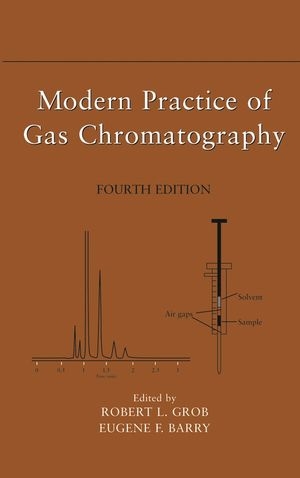
Modern Practice of Gas Chromatography (eBook)
1064 Seiten
John Wiley & Sons (Verlag)
978-0-471-65115-4 (ISBN)
professional and the novice need to know about running,
maintaining, and interpreting the results from GC
Analytical chemists, technicians, and scientists in allied
disciplines have come to regard Modern Practice of Gas
Chomatography as the standard reference in gas chromatography. In
addition to serving as an invaluable reference for the experienced
practitioner, this bestselling work provides the beginner with a
solid understanding of gas chromatographic theory and basic
techniques.
This new Fourth Edition incorporates the most recent developments
in the field, including entirely new chapters on gas
chromatography/mass spectrometry (GC/MS); optimization of
separations and computer assistance; high speed or fast gas
chromatography; mobile phase requirements: gas system requirements
and sample preparation techniques; qualitative and quantitative
analysis by GC; updated information on detectors; validation and
QA/QC of chromatographic methods; and useful hints for good gas
chromatography.
As in previous editions, contributing authors have been chosen for
their expertise and active participation in their respective areas.
Modern Practice of Gas Chromatography, Fourth Edition presents a
well-rounded and comprehensive overview of the current state of
this important technology, providing a practical reference that
will greatly appeal to both experienced chomatographers and
novices.
ROBERT L. GROB, PhD, is Professor Emeritus of Analytical Chemistry at Villanova University and a consultant in analytical and environmental chemistry. His previous books include Environmental Problem-Solving Using Gas and Liquid Chromatography (with Dr. Mary A. Kaiser of the DuPont Company), Chromatographic Analysis of the Environment, and three editions of this text. Dr. Grob is the recipient of the Stephen Dal Nogare Award in Chromatography, the EAS Award in Separation Science, and the Father Daniel Egan Award (from his undergraduate alma mater) for Excellence in Science and Teaching. Dr. Grob received his BS in Chemistry from the Franciscan University of Steubenville and his MS and PhD in Analytical Chemistry from the University of Virginia. EUGENE F. BARRY, PhD, is Professor of Chemistry and Chair of the Chemistry Department at the University of Massachusetts, Lowell. Dr. Barry has lectured in numerous short courses on GC, HPLC, and Capillary Electrophoresis. Along with Dr. Grob, he is coinstructor of the popular short course "Practical Gas Chromatography: Packed and Capillary Columns," annually presented at the Eastern Analytical Symposium and the Pittsburgh Conference. He is author or coauthor of over 100 publications and has several patents. He received his BS in Chemistry from Villanova University and his PhD in Analytical Chemistry from the University of Rhode Island.
Preface.
1. Introduction (Robert L. Grob).
PART I: THEORY AND BASICS.
2. Theory of Gas Chromatography (Robert L. Grob).
3. Columns: Packed and Capillary; Column Selection in Gas
Chromatography (Eugene F. Barry).
4. Optimization of Separations and Computer Assistance (John
V. Hinshaw).
5. High-Speed Gas Chromatography (Richard D. Sacks).
PART II: TECHNIQUES AND INSTRUMENTATION.
6. Detectors in Modern Gas Chromatography (Luis A. Colón
and Lisa J. Baird).
7. Techniques for Gas Chromatography/Mass Spectrometry (John
A. Masucci and Gary W. Caldwell).
8. Qualitative and Quantitative Analysis by Gas Chromatography
(Robert L. Grob and Mary A. Kaiser).
9. Inlet Systems for Gas Chromatography (Nicholas H.
Snow).
10. Gas Management Systems for Gas Chromatography (Reginald
J. Bartram).
PART III: APPLICATIONS.
11. Sample Preparation Techniques for Gas Chromatography
(Nicholas H. Snow and Gregory C. Slack).
12. Physicochemical Measurements by Gas Chromatography (Mary
A. Kaiser and Cecil R. Dybowski).
13. Petroleum and Petrochemical Analysis by Gas Chromatography
(Edward F. Smith, Mark E. Craig, and Clifford C.
Walters).
14. Clinical and Pharmaceutical Applications of Gas
Chromatography (Juan G. Alvarez).
15. Environmental Applications of Gas Chromatography (John L.
Snyder).
16. Forensic Science Applications of Gas Chromatography
(Thomas A. Brettell).
17. Validation and QA/QC of Gas Chromatographic Methods
(Thomas A. Brettell and Richard E. Lester).
APPENDIXES.
Appendix A. Effect of Detector Attenuation Change and Chart
Speed on Peak Height, Peak Width, and Peak Area (Robert L. Grob
and Eugene F. Barry).
Appendix B. Gas Chromatographic Acronyms and Symbols and Their
Definitions (Robert L. Grob and Eugene F. Barry).
Appendix C. Useful Hints for Gas Chromatography (Robert L.
Grob and Eugene F. Barry).
INDEX.
"This new and largely illustrated edition represents an
all-inclusive text that may be used for university courses as well
as short courses." (International Journal of
Environmental Analytical Chemistry, August 2005)
"In addition to being a very thorough instrumental work, this
book also covers modern applications of GC in numerous
disciplines." (CHOICE, January 2005)
"For students and professors of GC, this edition is a must-have.
It is comprehensive and contains many special topics, including all
the current references needed to continue your study."
(Analytical Chemistry, February 1, 2005)
"This book will not only be helpful for novices in the
field...but will also serve as an invaluable reference tool for
more experienced users ..." (E-STREAMS, December
2004)
"It is a pleasure to review the fourth edition of what many
regard as the 'Bible' of gas chromatography...a must-have book on
the shelves of all laboratories doing gas chromatographic
analyses." (Journal of Medicinal Chemistry, October 7,
2004)
"...valuable reference on gas chromatography." (Journal
of the American Chemical Society, Sept 15, 2004)
| Erscheint lt. Verlag | 4.8.2004 |
|---|---|
| Sprache | englisch |
| Themenwelt | Naturwissenschaften ► Chemie ► Analytische Chemie |
| Technik | |
| Schlagworte | Analytical Chemistry • Analytische Chemie • Chemie • Chemistry • Chromatographie • Chromatographie / Trennverfahren • Chromatography / Separation Techniques |
| ISBN-10 | 0-471-65115-X / 047165115X |
| ISBN-13 | 978-0-471-65115-4 / 9780471651154 |
| Informationen gemäß Produktsicherheitsverordnung (GPSR) | |
| Haben Sie eine Frage zum Produkt? |
 PDF (Adobe DRM)
Kopierschutz: Adobe-DRM
Adobe-DRM ist ein Kopierschutz, der das eBook vor Mißbrauch schützen soll. Dabei wird das eBook bereits beim Download auf Ihre persönliche Adobe-ID autorisiert. Lesen können Sie das eBook dann nur auf den Geräten, welche ebenfalls auf Ihre Adobe-ID registriert sind.
Details zum Adobe-DRM
Dateiformat: PDF (Portable Document Format)
Mit einem festen Seitenlayout eignet sich die PDF besonders für Fachbücher mit Spalten, Tabellen und Abbildungen. Eine PDF kann auf fast allen Geräten angezeigt werden, ist aber für kleine Displays (Smartphone, eReader) nur eingeschränkt geeignet.
Systemvoraussetzungen:
PC/Mac: Mit einem PC oder Mac können Sie dieses eBook lesen. Sie benötigen eine
eReader: Dieses eBook kann mit (fast) allen eBook-Readern gelesen werden. Mit dem amazon-Kindle ist es aber nicht kompatibel.
Smartphone/Tablet: Egal ob Apple oder Android, dieses eBook können Sie lesen. Sie benötigen eine
Geräteliste und zusätzliche Hinweise
Buying eBooks from abroad
For tax law reasons we can sell eBooks just within Germany and Switzerland. Regrettably we cannot fulfill eBook-orders from other countries.
aus dem Bereich