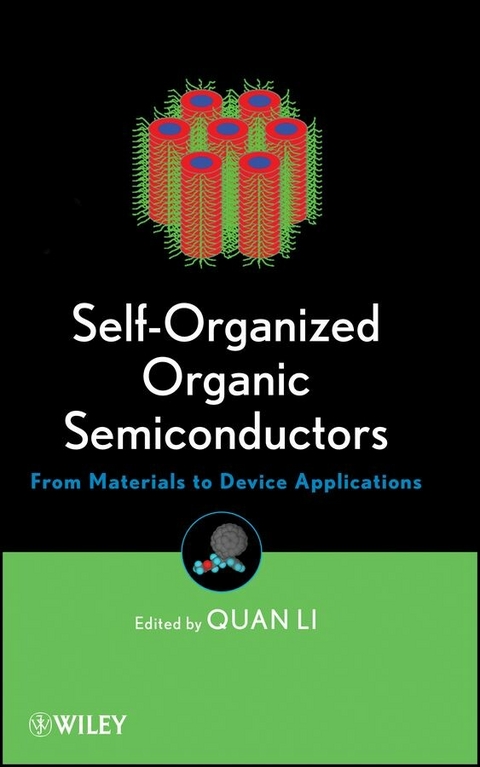
Self-Organized Organic Semiconductors (eBook)
John Wiley & Sons (Verlag)
978-0-470-94911-5 (ISBN)
Quan Li, PhD, is Director of Organic Synthesis and Advanced Materials Laboratory at the Liquid Crystal Institute and Adjunct Professor in the Chemical Physics Interdisciplinary Program of Kent State University, where he has directed research projects supported by the National Science Foundation and other U.S. government agencies and several companies. He received his PhD in organic chemistry from the Chinese Academy of Sciences in Shanghai, where he was promoted to a Full Professor of Organic Chemistry and MedicinalChemistry in 1998.
This book focuses on the exciting topic on self-organized organic semiconductors from materials to device applications. It offers up-to-date and accessible coverage of self-organized semiconductors for organic chemistry, polymer science, liquid crystals, materials science, material engineering, electrical engineering, chemical engineering, optics, optic-electronics, nanotechnology and semiconductors. Chapters cover chemistry, physics, processing, and characterization. The applications include photovoltaics, light-emitting diodes (LEDs), and transistors.
Quan Li, PhD, is Director of Organic Synthesis and Advanced Materials Laboratory at the Liquid Crystal Institute and Adjunct Professor in the Chemical Physics Interdisciplinary Program of Kent State University, where he has directed research projects supported by the National Science Foundation and other U.S. government agencies and several companies. He received his PhD in organic chemistry from the Chinese Academy of Sciences in Shanghai, where he was promoted to a Full Professor of Organic Chemistry and MedicinalChemistry in 1998.
Preface.
Contributors.
1 Crystal Engineering Organic Semiconductors (Joseph C.
Sumrak, Anatoliy N. Sokolov, and Leonard R. MacGillivray).
2 Conjugated Block Copolymers and Cooligomers (Yongye
Liang and Luping Yu).
3 Charge Transports and Its Modeling in Liquid Crystals
(Jun-ichi Hanna and Akira Ohno).
4 Self-Organized Discotic Liquid Crystals as Novel Organic
Semiconductors (Manoj Mathew and Quan Li).
5 Self-Organized Semiconducting Smectic Liquid Crystals
(Ji Ma and Quan Li).
6 Self-Assembling of Carbon Nanotubes (Liming
Dai).
7 Self-Organized Fullerene Based Organic Semiconductors
(Li-Mei Jin and Quan Li).
8 High-Efficiency Organic Solar Cells Using Self-Organized
Materials (Paul A. Lane).
9 Selective Molecular Assembly for Bottom-Up Fabrication of
Organic Thin-Film Transistors (Takeo Minari, Masataka Kano, and
Kazuhito Tsukagoshi).
Index.
| Erscheint lt. Verlag | 3.3.2011 |
|---|---|
| Sprache | englisch |
| Themenwelt | Technik ► Elektrotechnik / Energietechnik |
| Schlagworte | accessible • across • Book • Chemie • Chemistry • combines information • complete • cuttingedge introduction • Electrical & Electronics Engineering • Elektrotechnik u. Elektronik • exciting • First • Halbleiter • Halbleiterphysik • Introduction • Literature • Market • One • Organic Chemistry • Organische Chemie • Physics • Physik • selforganized organic • Semiconductor physics • semiconductors • Subject • topic • Volume |
| ISBN-10 | 0-470-94911-2 / 0470949112 |
| ISBN-13 | 978-0-470-94911-5 / 9780470949115 |
| Informationen gemäß Produktsicherheitsverordnung (GPSR) | |
| Haben Sie eine Frage zum Produkt? |
 EPUB (Adobe DRM)
Größe: 23,5 MB
Kopierschutz: Adobe-DRM
Adobe-DRM ist ein Kopierschutz, der das eBook vor Mißbrauch schützen soll. Dabei wird das eBook bereits beim Download auf Ihre persönliche Adobe-ID autorisiert. Lesen können Sie das eBook dann nur auf den Geräten, welche ebenfalls auf Ihre Adobe-ID registriert sind.
Details zum Adobe-DRM
Dateiformat: EPUB (Electronic Publication)
EPUB ist ein offener Standard für eBooks und eignet sich besonders zur Darstellung von Belletristik und Sachbüchern. Der Fließtext wird dynamisch an die Display- und Schriftgröße angepasst. Auch für mobile Lesegeräte ist EPUB daher gut geeignet.
Systemvoraussetzungen:
PC/Mac: Mit einem PC oder Mac können Sie dieses eBook lesen. Sie benötigen eine
eReader: Dieses eBook kann mit (fast) allen eBook-Readern gelesen werden. Mit dem amazon-Kindle ist es aber nicht kompatibel.
Smartphone/Tablet: Egal ob Apple oder Android, dieses eBook können Sie lesen. Sie benötigen eine
Geräteliste und zusätzliche Hinweise
Buying eBooks from abroad
For tax law reasons we can sell eBooks just within Germany and Switzerland. Regrettably we cannot fulfill eBook-orders from other countries.
 PDF (Adobe DRM)
Kopierschutz: Adobe-DRM
Adobe-DRM ist ein Kopierschutz, der das eBook vor Mißbrauch schützen soll. Dabei wird das eBook bereits beim Download auf Ihre persönliche Adobe-ID autorisiert. Lesen können Sie das eBook dann nur auf den Geräten, welche ebenfalls auf Ihre Adobe-ID registriert sind.
Details zum Adobe-DRM
Dateiformat: PDF (Portable Document Format)
Mit einem festen Seitenlayout eignet sich die PDF besonders für Fachbücher mit Spalten, Tabellen und Abbildungen. Eine PDF kann auf fast allen Geräten angezeigt werden, ist aber für kleine Displays (Smartphone, eReader) nur eingeschränkt geeignet.
Systemvoraussetzungen:
PC/Mac: Mit einem PC oder Mac können Sie dieses eBook lesen. Sie benötigen eine
eReader: Dieses eBook kann mit (fast) allen eBook-Readern gelesen werden. Mit dem amazon-Kindle ist es aber nicht kompatibel.
Smartphone/Tablet: Egal ob Apple oder Android, dieses eBook können Sie lesen. Sie benötigen eine
Geräteliste und zusätzliche Hinweise
Buying eBooks from abroad
For tax law reasons we can sell eBooks just within Germany and Switzerland. Regrettably we cannot fulfill eBook-orders from other countries.
aus dem Bereich