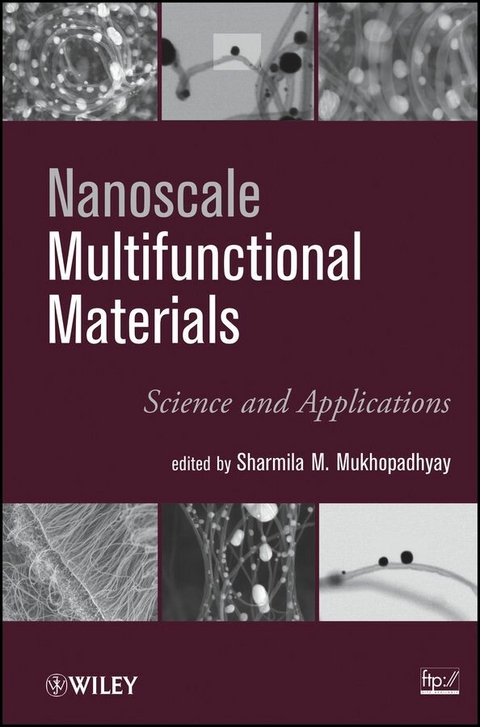
Nanoscale Multifunctional Materials (eBook)
John Wiley & Sons (Verlag)
978-1-118-11403-2 (ISBN)
A multidisciplinary approach that explores the diverse properties, functions, and applications of nanomaterials
Drawing together the many scientific and engineering disciplines underlying the development of nanomaterials, Nanoscale Multifunctional Materials provides a multidisciplinary review of the diverse properties, functions, and applications of nanomaterials. The book examines both nanoparticles, which have larger-scale equivalents, and uniquely assembled nanomaterials, which do not have larger-scale equivalents. Readers will gain a tremendous appreciation of the versatility of nanomaterials as well as an understanding of how the same nanomaterial can have several distinct applications across a broad range of fields and industries.
Nanoscale Multifunctional Materials is divided into three sections:
?Section I, Overview, describes the scientific phenomena underlying the special properties of nanomaterials, making them desirable as novel materials and different from conventional solids. Next, readers will learn about the effect of nanomaterials on contemporary society as well as future trends in nanomaterials production and use.
?Section II, Processing and Analysis, explores several experimental approaches in nanomaterial fabrication and characterization as well as in theoretical approaches in modeling and simulation.
?Section III, Applications, offers detailed examples of nanomaterial applications in alternative energy, thermal management, environmental cleanup, water treatment, and biomedicine.
Each chapter has been written by one or more leading experts in the science, engineering, and application of nanomaterials. Within each chapter, readers will find a thorough review of the current literature, with references to facilitate further investigation of individual topics.
Underscoring the multidisciplinary and multifunctional characteristics of nanomaterials, this book is recommended for students and professionals in science and engineering who need a broad perspective on both the nature and application of nanomaterials. The text also sets the stage for the development of new nanomaterials and new applications.
SHARMILA M. MUKHOPADHYAY, PhD, is Professor of Mechanical and Materials Engineering at Wright State University. Her research, supported by grants from the USEPA, AFOSR, AFRL, NSF, DOE, OBOR, NASA, and industry, focuses on nanomaterials, surface and interface phenomena, and multidisciplinary materials education. Dr. Mukhopadhyay has published more than one hundred articles and reports.
This book consolidates various aspects of nanomaterials, highlighting their versatility as well as how the same materials can be used in seemingly diverse applications spanning across disciplines. It captures the multi-disciplinary and multi-functional aspects of nanomaterials in a holistic way. Chapters address the key attributes of nanoscale materials that make them special and desirable as novel materials; functionality that emerges based on these unique attributes; multiple uses of nanomaterials incuding combining properties and materials selection, and then separate chapters devoted to energy, biomedical materials, environmental applications, and chemical engineering applications.
SHARMILA M. MUKHOPADHYAY, PhD, is Professor of Mechanical and Materials Engineering at Wright State University. Her research, supported by grants from the USEPA, AFOSR, AFRL, NSF, DOE, OBOR, NASA, and industry, focuses on nanomaterials, surface and interface phenomena, and multidisciplinary materials education. Dr. Mukhopadhyay has published more than one hundred articles and reports.
Preface.
Section I. Overview.
1. Key attributes of nano-scale materials and functionalities
emerging from them (S. M. Mukhopadhyay).
2. Societal Impact and Future Trends in Nanomaterials (S. M.
Mukhopadhyay).
Section II. Processing and Analysis.
3. Fabrication Techniques for Growing Carbon Nanotubes (I. T.
Barney).
4. Nanoparticles and Polymer Nanocomposites (G. A. Jimenez,
B. J. Lee, and S. C. Jana).
5. Laser-Assisted Fabrication Techniques (T. Murray).
6. Experimental Characterization of Nanomaterials (A.
Jackson).
7. Modeling and Simulation of Nanoscale Materials (S. Patnaik
and M. Tsige).
Section III. Applications.
8. Nanomaterials for Alternate Energy (H. Huang and B. Z.
Jang).
9. Enhancement of Through-Thickness Thermal conductivity in
Adhesively Bonded Joints Using Aligned Carbon Nanotubes (S.
Sihn, S. Ganguli, A. K. Roy, L. Qu, and L. Dai).
10. Applications of Metal Nanoparticles in Environmental Cleanup
(S. R. Kanel, C. Su, U. Patel, and A. Agrawal).
11. Application of Carbon Nanomaterials in Water Treatment:
Removal of Common Chemical and Biological Contaminants by
Adsorption (V. K. K. Updahyayula, J. R. Ruparelia, and A.
Agrawal).
12. Peptide Nanotubes for Biomedical and Environmental
Applications (B. W. Park and D. S. Kim).
Index.
"Leading nanomaterial specialists have contributed to the content of this book. Each chapter provides a comprehensive review of the latest literature. References provided in each chapter will be helpful for readers to study individual topics in detail." (Azonano.com, 3 February 2012)
| Erscheint lt. Verlag | 26.8.2011 |
|---|---|
| Sprache | englisch |
| Themenwelt | Naturwissenschaften ► Chemie |
| Technik ► Maschinenbau | |
| Technik ► Umwelttechnik / Biotechnologie | |
| Schlagworte | Biomaterialien • biomaterials • biomedical engineering • Biomedizintechnik • Elektrochemie • Materialeigenschaften • Materials Science • Materialwissenschaften • Nanomaterial • Nanomaterialien • nanomaterials • nanomaterials, nanoscale materials, nanotech, nanotechnology, biomedical structures, nanoscale, nanotechnolgy applications • Nanostrukturiertes Material • Nanotechnologie • nanotechnology • properties of materials |
| ISBN-10 | 1-118-11403-5 / 1118114035 |
| ISBN-13 | 978-1-118-11403-2 / 9781118114032 |
| Informationen gemäß Produktsicherheitsverordnung (GPSR) | |
| Haben Sie eine Frage zum Produkt? |
 EPUB (Adobe DRM)
Größe: 4,9 MB
Kopierschutz: Adobe-DRM
Adobe-DRM ist ein Kopierschutz, der das eBook vor Mißbrauch schützen soll. Dabei wird das eBook bereits beim Download auf Ihre persönliche Adobe-ID autorisiert. Lesen können Sie das eBook dann nur auf den Geräten, welche ebenfalls auf Ihre Adobe-ID registriert sind.
Details zum Adobe-DRM
Dateiformat: EPUB (Electronic Publication)
EPUB ist ein offener Standard für eBooks und eignet sich besonders zur Darstellung von Belletristik und Sachbüchern. Der Fließtext wird dynamisch an die Display- und Schriftgröße angepasst. Auch für mobile Lesegeräte ist EPUB daher gut geeignet.
Systemvoraussetzungen:
PC/Mac: Mit einem PC oder Mac können Sie dieses eBook lesen. Sie benötigen eine
eReader: Dieses eBook kann mit (fast) allen eBook-Readern gelesen werden. Mit dem amazon-Kindle ist es aber nicht kompatibel.
Smartphone/Tablet: Egal ob Apple oder Android, dieses eBook können Sie lesen. Sie benötigen eine
Geräteliste und zusätzliche Hinweise
Buying eBooks from abroad
For tax law reasons we can sell eBooks just within Germany and Switzerland. Regrettably we cannot fulfill eBook-orders from other countries.
 PDF (Adobe DRM)
Kopierschutz: Adobe-DRM
Adobe-DRM ist ein Kopierschutz, der das eBook vor Mißbrauch schützen soll. Dabei wird das eBook bereits beim Download auf Ihre persönliche Adobe-ID autorisiert. Lesen können Sie das eBook dann nur auf den Geräten, welche ebenfalls auf Ihre Adobe-ID registriert sind.
Details zum Adobe-DRM
Dateiformat: PDF (Portable Document Format)
Mit einem festen Seitenlayout eignet sich die PDF besonders für Fachbücher mit Spalten, Tabellen und Abbildungen. Eine PDF kann auf fast allen Geräten angezeigt werden, ist aber für kleine Displays (Smartphone, eReader) nur eingeschränkt geeignet.
Systemvoraussetzungen:
PC/Mac: Mit einem PC oder Mac können Sie dieses eBook lesen. Sie benötigen eine
eReader: Dieses eBook kann mit (fast) allen eBook-Readern gelesen werden. Mit dem amazon-Kindle ist es aber nicht kompatibel.
Smartphone/Tablet: Egal ob Apple oder Android, dieses eBook können Sie lesen. Sie benötigen eine
Geräteliste und zusätzliche Hinweise
Buying eBooks from abroad
For tax law reasons we can sell eBooks just within Germany and Switzerland. Regrettably we cannot fulfill eBook-orders from other countries.
aus dem Bereich