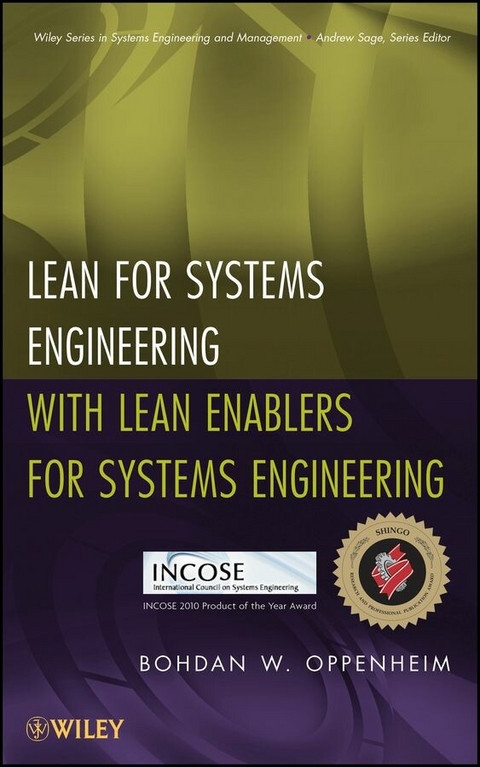
Lean for Systems Engineering with Lean Enablers for Systems Engineering (eBook)
336 Seiten
John Wiley & Sons (Verlag)
978-1-118-06398-9 (ISBN)
insights of experts across industry, government, and academia into
a comprehensive sourcebook for lean systems engineering principles
and practices. This book can educate those new to lean engineering,
as well as provide new insights and enablers that best-in-class
organizations will want to adopt." --Dr. Donna H. Rhodes,
Principal Research Scientist, SEAri and LAI, Massachusetts
Institute of Technology
"Lean for Systems Engineering is targeted at the practitioner
who is trying to make systems engineering more effective in her or
his organization or program, yet its scholarly underpinnings make
the text very suitable for teachers. Educators and trainers who
wish to weave lean thinking into their systems engineering
curriculum will find this an invaluable text." --Earll M.
Murman, Ford Professor of Engineering Emeritus, Massachusetts
Institute of Technology
"At last, a book that distills years of research and scholarly
inquiry into a concise and coherent form for both the student and
practitioner. This book will become the favored guide and 'must
read' for any engineer and manager trying to establish and maintain
lean practices and principles in their systems engineering/product
development processes. --J. Robert Wirthlin, PhD, Lt. Col.,
USAF, Program Director of the Graduate Research and Development
Management Program, Air Force Institute of Technology Visiting
Faculty, U.S. Air Force Center for Systems Engineering
"A vital contribution to linking lean practices to systems
engineering. I will definitely use it as a reference for my course
and writings on a value approach to product and system
development." --Dr. Stanley I. Weiss, Consulting Professor,
Dept. of Aeronautics and Astronautics, Stanford University
"Taking the opportunity to develop and refine the Lean Enablers
for Systems Engineering provided clear direction for Lean
Engineering Accelerated Planning at Rockwell Collins. The Lean
Enablers form a solid basis for Lean Product Development. Following
this checklist and methodology promotes Lean value and waste
elimination--and commonsense best practices." --Deborah A.
Secor, Principal Project Manager and Lean Master, Rockwell
Collins
"Bo Oppenheim has been at the forefront of lean systems
engineering for the better part of the last decade...An ardent
advocate of lean systems engineering, the author has offered an
honest appraisal of where lean systems engineering stands today.
Practitioners interested in lean systems engineering will find the
Lean Enablers especially useful."-- Azad M. Madni, PhD,
Professor and Director, SAE Program, Viterbi School of Engineering;
Professor, Keck School of Medicine, University of Southern
California
Bohdan W. Oppenheim is the founder and Co-Chair of the Lean Systems Engineering Working Group of INCOSE and leader of the development effort of Lean Enablers for Systems Engineering. Dr. Oppenheim is Professor of Systems Engineering at Loyola Marymount University. He serves as a coordinator of the Educational Network of the Lean Advancement Initiative Consortium at MIT. Previously, Dr. Oppenheim served seven years as a director of the U.S. Department of Energy Industrial Assessment Center, assessing some 125 industrial plants for lean productivity. He has consulted with Boeing, Northrop Grumman, Raytheon, and many other U.S. and foreign firms on lean systems engineering.
Foreword xi
Preface xv
Acknowledgments xix
List of Enablers and Subenablers in Chapter 7 xxiii
List of Figures and Numbered Text Boxes xxxiii
1 Introduction 1
1.1 Introducing Lean Systems Engineering and Lean Enablers for Systems Engineering 1
1.2 Organization of the Book 6
2 A Brief History of Recent Management Paradigms 9
2.1 From TQM to Six Sigma and Lean 9
2.2 Lean Six Sigma 13
3 Lean Fundamentals 14
3.1 Value 14
3.2 Waste 15
3.3 Lean Principles 17
3.3.1 Principle 1: Value 17
3.3.2 Principle 2: Map the Value Stream 17
3.3.3 Principle 3: Flow 20
3.3.4 Principle 4: Pull 21
3.3.5 Principle 5: Perfection 21
3.3.6 Principle 6: Respect for People 22
3.4 The Lean Symphony of the Principles 22
4 Lean in Product Development 25
4.1 Review of Progress 25
4.2 The Method of Lean Product Development Flow (LPDF) 28
4.2.1 Introduction to LPDF 28
4.2.2 Lean Manufacturing: A Refresher 29
4.2.3 Overview of LPDF 30
4.2.4 Integrative Events 33
4.2.5 Selecting the Project Schedule 34
4.2.6 Mapping the Value Stream 35
4.2.7 Project Leadership and Management 38
4.2.8 Project Room 40
4.2.9 Closing Remarks about LPDF 40
5 From Traditional to Lean Systems Engineering 42
5.1 Successes and Failures of Traditional Systems Engineering 42
5.2 Waste in Traditional Systems Engineering 44
5.3 Beginnings of Lean Systems Engineering 49
5.4 Lean Systems Engineering Working Group of INCOSE 50
5.5 Value in Lean Systems Engineering 51
6 Development of Lean Enablers for Systems Engineering (LEfSE) 54
6.1 Strategy 54
6.2 Development of LEfSE 55
6.3 Survey 58
6.4 Benchmarking with NASA and GAO Recommendations 59
6.5 Version 1.0 and Awards 59
7 Lean Enablers for Systems Engineering 64
7.1 Organization 64
7.2 Tables with Lean Enablers for Systems Engineering (LEfSE) 67
7.2.1 Lean Principle 1: Value 67
7.2.2 Lean Principle 2: Map the Value Stream (Plan the Program) 85
7.2.3 Lean Principle 3: Flow 116
7.2.4 Lean Principle 4: Pull 164
7.2.5 Lean Principle 5: Perfection 169
7.2.6 Lean Principle 6: Respect for People 204
8 General Guidance for Implementation 247
8.1 General Guidance for Implementing LEfSE 247
8.2 Early Case Studies 249
8.2.1 Rockwell Collins, Incorporated (RC) 250
8.2.2 Thales Aerospace, France 251
8.2.3 Rafael, Israel 251
8.2.4 EADS and AFIS 252
8.2.5 Early Results from a Study by E. Honour 252
8.2.6 Toyota 253
Glossary of Abbreviations 254
Glossary of Idioms, Colloquialisms and Foreign Expressions 256
References 259
Appendix 1. INCOSE Web Page with LEfSE 265
Appendix 2. Mapping of LEfSE onto INCOSE SE Processes 267
Author's Biography 281
Index 283
| Erscheint lt. Verlag | 15.9.2011 |
|---|---|
| Reihe/Serie | Wiley Series in Systems Engineering and Management | Wiley Series in Systems Engineering and Management |
| Sprache | englisch |
| Themenwelt | Technik ► Elektrotechnik / Energietechnik |
| Technik ► Maschinenbau | |
| Schlagworte | Electrical & Electronics Engineering • Elektrotechnik u. Elektronik • Industrial Engineering • Industrial Engineering / Quality Control • Industrielle Verfahrenstechnik • Qualitätssicherung i. d. Industriellen Verfahrenstechnik • Qualitätssicherung i. d. Industriellen Verfahrenstechnik • Systems Engineering & Management • Systemtechnik • Systemtechnik u. -management |
| ISBN-10 | 1-118-06398-8 / 1118063988 |
| ISBN-13 | 978-1-118-06398-9 / 9781118063989 |
| Informationen gemäß Produktsicherheitsverordnung (GPSR) | |
| Haben Sie eine Frage zum Produkt? |
 EPUB (Adobe DRM)
Kopierschutz: Adobe-DRM
Adobe-DRM ist ein Kopierschutz, der das eBook vor Mißbrauch schützen soll. Dabei wird das eBook bereits beim Download auf Ihre persönliche Adobe-ID autorisiert. Lesen können Sie das eBook dann nur auf den Geräten, welche ebenfalls auf Ihre Adobe-ID registriert sind.
Details zum Adobe-DRM
Dateiformat: EPUB (Electronic Publication)
EPUB ist ein offener Standard für eBooks und eignet sich besonders zur Darstellung von Belletristik und Sachbüchern. Der Fließtext wird dynamisch an die Display- und Schriftgröße angepasst. Auch für mobile Lesegeräte ist EPUB daher gut geeignet.
Systemvoraussetzungen:
PC/Mac: Mit einem PC oder Mac können Sie dieses eBook lesen. Sie benötigen eine
eReader: Dieses eBook kann mit (fast) allen eBook-Readern gelesen werden. Mit dem amazon-Kindle ist es aber nicht kompatibel.
Smartphone/Tablet: Egal ob Apple oder Android, dieses eBook können Sie lesen. Sie benötigen eine
Geräteliste und zusätzliche Hinweise
Buying eBooks from abroad
For tax law reasons we can sell eBooks just within Germany and Switzerland. Regrettably we cannot fulfill eBook-orders from other countries.
aus dem Bereich