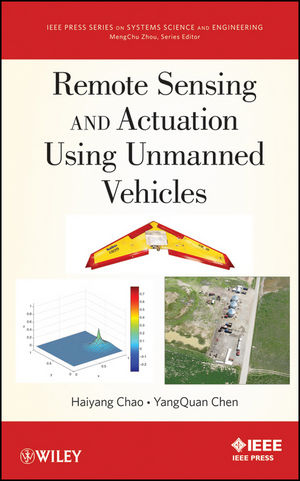
HAIYANG CHAO, PhD, is a postdoctoral fellow in the Department of Mechanical and Aerospace Engineering at West Virginia University in Morgantown. He authored or coauthored more than twenty peer-reviewed research papers and is one of the key developers of AggieAir, a low-cost, small UAV platform for remote sensing applications. YANGQUAN CHEN, PhD, is Associate Professor of Electrical and Computer Engineering at Utah State University in Logan. He holds fourteen U.S. patents and is the author of several research monographs and edited volumes, five textbooks, and over 500 peer-reviewed research papers.
List of Figures
List of Tables
Foreword
Preface
Acknowledgments
Acronyms
1 Introduction
1.1 Monograph Roadmap
1.2 Research Motivations
1.3 Monograph Contributions
1.4 Monograph Organization
References
2 AggieAir: a Low-Cost Unmanned Aircraft System for Remote Sensing
2.1 Introduction
2.2 Small UAS Overview
2.3 AggieAir UAS Platform
2.4 OSAM-Paparazzi Interface Design for IMU Integration
2.5 Aggie Air UAS Test Protocol and Tuning
2.6 Typical Platforms
2.7 Chapter Summary
References
3 Attitude Estimation Using Low-Cost IMUs for Small Unmanned Aerial Vehicles
3.1 State Estimation Problem Definition
3.2 Rigid Body Rotations Basics
3.3 Low-Cost Inertial Measurement Units: Hardware and Sensor Suites
3.4 Attitude Estimation Using Complementary Filters on SO (3)
3.5 Attitude Estimation Using Extended Kalman Filters
3.6 AggieEKF: GPS-Aided Extended Kalman Filter
3.7 chapter Summary
References
4 Lateral Channel Fractional Order Flight Controller Design for a Small UAV
4.1 Introduction
4.2 Preliminaries of UAV Flight Control
4.3 Roll-Channel System Identification and Control
4.4 Fractional Order Controller Design
4.5 Simulation Results
4.6 UAV Flight Testing Results
4.7 Chapter Summary
References
5 Remote Sensing Using Single Unmanned Aerial Vehicle
5.1 Motivations for Remote Sensing
5.2 Remote Sensing Using Small UAVs
5.3 Sample Applications for AggieAir UAS
5.4 Chapter Summary
References
6 Cooperative Remote Sensing Using Multiple Unmanned Vehicles
6.1 Consensus-Based Formation control
6.2 Surface Wind Profile Measurement Using Multiple UAVs
6.3 Chapter Summary
References
7 Diffusion Control Using Mobile Sensor and Actuator Networks
7.1 Motivation and Background
7.2 Mathematical Modelling and Problem Formulation
7.3 CVT-Based Dynamical Actuator Motion Scheduling Algorithm
7.4 Grouping Effect in CVT-based Diffusion Control
7.5 Information Consensus in CVT Algorithm
7.6 Simulation Results
7.7 Chapter Summary
References
8 Conclusions and Future Research Suggestions
8.1 Conclusions
8.2 Future Research Suggestions
References
9 Appendix
9.1 List of Documents for CSOIS Flight Test Protocol
9.2 IMU/GPS Serial Communication Protocols
9.3 Paparazzi Autopilot Software Architecture: A Modification Guide
9.4 DiffMAS2D Code Modification Guide
References
Topic Index
| Erscheint lt. Verlag | 3.8.2012 |
|---|---|
| Reihe/Serie | IEEE Press Series on Systems Science and Engineering |
| IEEE Series on Systems Science and Engineering | IEEE Series on Systems Science and Engineering |
| Sprache | englisch |
| Themenwelt | Technik ► Elektrotechnik / Energietechnik |
| Schlagworte | aggieair • aggieair applications • Control Systems Technology • cooperative remote sensing for unmanned vehicles • Electrical & Electronics Engineering • Elektrotechnik u. Elektronik • engineering unmanned aircraft • Fernerkundung • guidance of unmanned aerial vehicles • haiyang chao • IEEE • ieee book • ieee series • Regelungstechnik • Remote Sensing • Robotics • Robotik • small UAV • uav application • unmanned autonomous systems • yangquan chen • Yanushevsky |
| ISBN-10 | 1-118-37718-4 / 1118377184 |
| ISBN-13 | 978-1-118-37718-5 / 9781118377185 |
| Informationen gemäß Produktsicherheitsverordnung (GPSR) | |
| Haben Sie eine Frage zum Produkt? |
 PDF (Ohne DRM)
Digital Rights Management: ohne DRM
Dieses eBook enthält kein DRM oder Kopierschutz. Eine Weitergabe an Dritte ist jedoch rechtlich nicht zulässig, weil Sie beim Kauf nur die Rechte an der persönlichen Nutzung erwerben.
Dateiformat: PDF (Portable Document Format)
Mit einem festen Seitenlayout eignet sich die PDF besonders für Fachbücher mit Spalten, Tabellen und Abbildungen. Eine PDF kann auf fast allen Geräten angezeigt werden, ist aber für kleine Displays (Smartphone, eReader) nur eingeschränkt geeignet.
Systemvoraussetzungen:
PC/Mac: Mit einem PC oder Mac können Sie dieses eBook lesen. Sie benötigen dafür einen PDF-Viewer - z.B. den Adobe Reader oder Adobe Digital Editions.
eReader: Dieses eBook kann mit (fast) allen eBook-Readern gelesen werden. Mit dem amazon-Kindle ist es aber nicht kompatibel.
Smartphone/Tablet: Egal ob Apple oder Android, dieses eBook können Sie lesen. Sie benötigen dafür einen PDF-Viewer - z.B. die kostenlose Adobe Digital Editions-App.
Buying eBooks from abroad
For tax law reasons we can sell eBooks just within Germany and Switzerland. Regrettably we cannot fulfill eBook-orders from other countries.
aus dem Bereich